
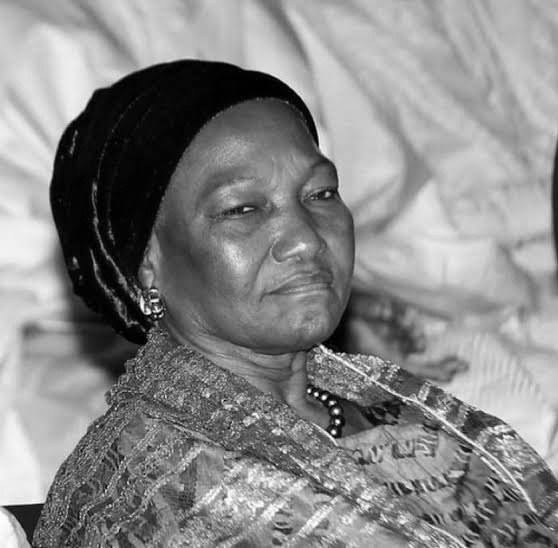
Ajoke Muhammed: Six Months as First Lady, Decades After Murtala
Her husband, General Murtala Muhammed, became Head of State in 1975 and was assassinated less than seven months later. Ajoke Muhammed’s story, however, continued long after her brief tenure as First Lady.
By Abdullahi Yusuf
Hafsatu Ajoke was the wife of General Murtala Ramat Muhammed, who became Nigeria’s Head of State on July 29, 1975, following the military coup that removed General Yakubu Gowon. The National Library of Nigeria identifies the woman in the archival portrait as Ajoke Muhammed, First Lady of the Federal Republic of Nigeria from 1975 to 1976.
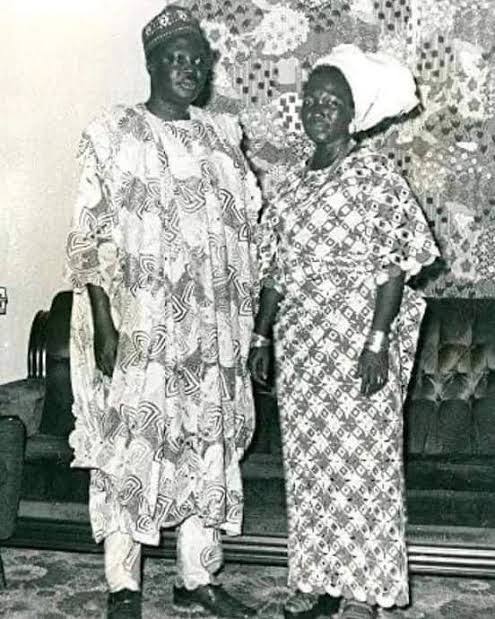
Her time as First Lady would last less than seven months. On February 13, 1976, Murtala was assassinated in Lagos during an abortive coup, abruptly ending his government and changing the course of Ajoke’s life.
The photograph captures a brief moment when she was the wife of Nigeria’s Head of State, before the events of the following year transformed her from First Lady into a widow.
Hafsatu Ajoke Muhammed was born on May 23, 1941. Before her husband’s rise to national prominence, she trained as a dental therapist. The National Library records that she married Murtala Muhammed in 1963.
The couple had six children and built their family while Murtala’s military career advanced through the ranks.
By the time he became Head of State in 1975, Murtala had already spent years at the centre of Nigeria’s military and political affairs. Ajoke, meanwhile, had remained outside the political office her husband eventually occupied.
Her entry into national public life came with his assumption of power.
On July 29, 1975, Murtala Muhammed became Nigeria’s Head of State after the military removed Gowon from office. His government immediately embarked on a programme of major administrative and political changes.
His administration created seven additional states, pursued preparations for a return to civilian rule by 1979 and advanced the process that eventually resulted in Abuja becoming Nigeria’s federal capital.
Ajoke occupied the First Lady’s position throughout those months.
Yet her place in the period was fundamentally different from that of her husband. Murtala was the public face of the government; Ajoke was present largely through the official and social obligations that accompanied her husband’s office.
That distinction is important when looking at photographs from the period. The image does not document a political career of her own. It records a woman whose public identity had suddenly become connected to the highest office in the country.
Behind the official portrait was also a young mother whose family had been brought into the public consciousness by her husband’s rise.
Murtala Muhammed’s time in office was brief but consequential.
His government moved rapidly on issues of administration, federal restructuring, the location of the federal capital and the timetable for a return to civilian government. His administration also pursued an assertive foreign policy during a period of intense regional and continental politics.
Ajoke’s First Ladyship unfolded against that backdrop.
She did not hold a government office or speak for the administration. Her significance to the historical record comes instead from her position beside the man directing one of the most consequential transitions in Nigeria’s military era.
For less than seven months, the photograph of her belonged to the same political moment as the speeches, decrees and reforms of the Murtala government. Then everything changed.
February 13, 1976
On February 13, 1976, Murtala Muhammed was assassinated in Lagos during an attempted coup. He was 37. His deputy, Olusegun Obasanjo, succeeded him as Head of State.
For Ajoke, the political transition was also a personal catastrophe. The First Lady of Nigeria suddenly became a widow.
She was still a young woman and had six children to care for. Later accounts of her life describe the years that followed as a period in which she raised her family while maintaining a largely private existence.
The public office that had brought her into national attention had lasted only months. Widowhood, however, would become a much longer chapter of her life.
In the years that followed, she developed a substantial interest in plants and conservation. The National Library of Nigeria records the Murtala Muhammed Memorial Botanical Garden, a 30-hectare garden along the Lekki-Epe Expressway in Lagos, as having been established in 1991.
Later accounts describe a much wider conservation career. The Guardian reported in 2021 that she had established and managed botanical gardens in Lagos and Abuja, travelled in search of endangered plants and worked to conserve and propagate indigenous species. It also reported her association with the Nigerian Conservation Foundation.
She was also associated with the Murtala Muhammed Foundation, which was established in memory of her husband and has worked on issues including education, human rights, women’s empowerment and humanitarian assistance.
That later chapter is important because it places Ajoke Muhammed beyond the familiar description of her simply as the widow of a former Head of State. Her life after 1976 acquired its own identity.
The history of Murtala Muhammed’s government is usually remembered through its political milestones: the 1975 coup, the reforms that followed, the creation of new states, the decision to establish a new federal capital, the return-to-civilian-rule programme and the assassination that brought his government to an abrupt end.
Ajoke Muhammed offers another way of looking at that history. The photograph places a person beside the political story.
It captures a woman who, for a brief period, occupied one of the most visible positions in the country without herself being a political actor. Within months, that position disappeared with her husband’s death.
Murtala Muhammed’s assassination ended Ajoke Muhammed’s six-month tenure as First Lady. She was 34, a widow and the mother of six children. She subsequently lived largely outside formal politics, with later public-interest work including conservation and initiatives associated with her husband’s legacy.
SPONSORED

SPONSORED

SONSORED
