
Arab Parties Deliver Crucial Backing as Netanyahu’s Rival Gets Government Mandate
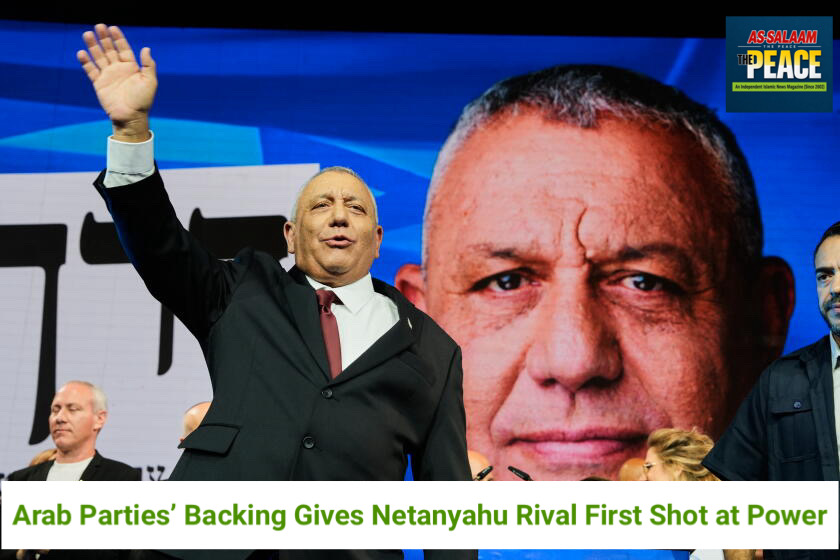
Gadi Eisenkot secures the mandate to form Israel’s next government after 67 lawmakers recommend him, with record parliamentary gains by Arab-led parties proving decisive despite divisions over their possible role in his administration.
By Abdullahi Yusuf
Israeli President Isaac Herzog has tasked opposition leader Gadi Eisenkot with forming the country’s next government, giving Prime Minister Benjamin Netanyahu’s main political rival an opportunity to end his longstanding rule following the October 27 parliamentary elections.
Herzog’s decision followed consultations with political parties represented in the Knesset, in which 67 lawmakers recommended Eisenkot for the premiership, compared with 46 who backed Netanyahu.
Seven lawmakers did not recommend either candidate. Eisenkot, a former Israeli military chief and leader of the Yashar party, will have 28 days to assemble a governing coalition, with a possible 14-day extension.
The election produced a fragmented parliament, with neither Netanyahu’s governing bloc nor the opposition securing the 61 seats required for a majority in the 120-member Knesset. Netanyahu’s right-wing and religious coalition won 53 seats, while the four-party opposition bloc led by Eisenkot secured 48.
Netanyahu’s Likud party emerged as the largest individual party with 27 seats, while Eisenkot’s Yashar secured 21. The remaining 19 seats went to two Arab-led political formations, giving them significant influence over negotiations to establish the next government.
The election marked an unprecedented parliamentary achievement for Arab-led parties, whose combined representation reached 19 seats. The Joint List, an alliance of Arab-led parties headed by Yousef Jabareen, won 11 seats, while the Islamist Ra’am party, led by Mansour Abbas, secured eight.
Their combined representation surpassed the previous record of 15 seats achieved by Arab-led parties in 2020, strengthening their position in Israel’s parliamentary politics.
The result also gave them the potential to determine whether an opposition-led government could secure parliamentary support.
Both formations subsequently recommended Eisenkot to Herzog for the mandate to form a government. Their endorsements, alongside those of opposition parties, brought the number of lawmakers recommending him to 67, exceeding the 61-seat majority threshold.
However, the recommendations do not automatically mean that the Arab-led parties will join Eisenkot’s government.
The Joint List has indicated that it could support an opposition government from outside the coalition, while Ra’am has expressed willingness to participate in government negotiations.
Eisenkot has faced resistance from within his own opposition bloc over cooperation with the Arab-led parties.
Avigdor Liberman, leader of the Yisrael Beiteinu party, has rejected the possibility of supporting a minority government dependent on their parliamentary backing.
Other opposition figures have also expressed reservations about formally including the parties in a governing coalition.
Netanyahu has meanwhile called for a national unity government and warned against an administration dependent on what he described as supporters of terrorism, remarks widely interpreted as targeting Arab-led lawmakers.
Eisenkot has also attached conditions to possible cooperation, including recognition of Hamas as a terrorist organization and its removal from power.
The disagreement has complicated efforts to translate the opposition’s combined parliamentary support into a functioning government. Although the Arab-led parties helped secure Eisenkot’s nomination, their participation in the next administration remains uncertain.
Eisenkot could seek support from ultra-Orthodox parties to reach the required majority, although negotiations over military service exemptions and other policy differences could complicate such an arrangement.
Another possibility would be a minority government relying on parliamentary support from outside the coalition, an option opposed by some of his potential allies.
If Eisenkot fails to form a government within the allotted period, the president could give another lawmaker an opportunity to assemble a coalition. Continued failure to establish a government could eventually lead to another parliamentary election.
The outcome leaves Israel facing another difficult coalition-building process, with the record parliamentary representation of Arab-led parties creating a significant political factor in determining the country’s next government.
SPONSORED
SPONSORED

SPONSORED

SPONSORED

May Allah (SWT) reward you abundantly with good, here and beyond- Amin.