

Science and Signs in the Qur’an
“Allah takes the souls at the time of their death, and those that do not die [He takes] during their sleep. Then He keeps those for which He has decreed death and releases the other for a specified term. Indeed, in that are signs for a people who give thought.” Qur’an (Az-Zumar 39:42)
The Grand Design of Sleep in the HolyQur’an: A Divine Miracle and Scientific Marvel
By A.S.M Razan
The grand design of sleep stands as one of the most profound physiological necessities and restorative sanctuaries for human existence. After days of relentless toil and worldly effort, the body and mind naturally reach a state of exhaustion, seeking solace and rejuvenation.
Long before modern medical equipment or advanced sleep laboratories ever existed, the Holy Qur’an highlighted sleep as a deliberate design and a miraculous sign of the Creator, masterfully interweaving physical science with spiritual awakening.
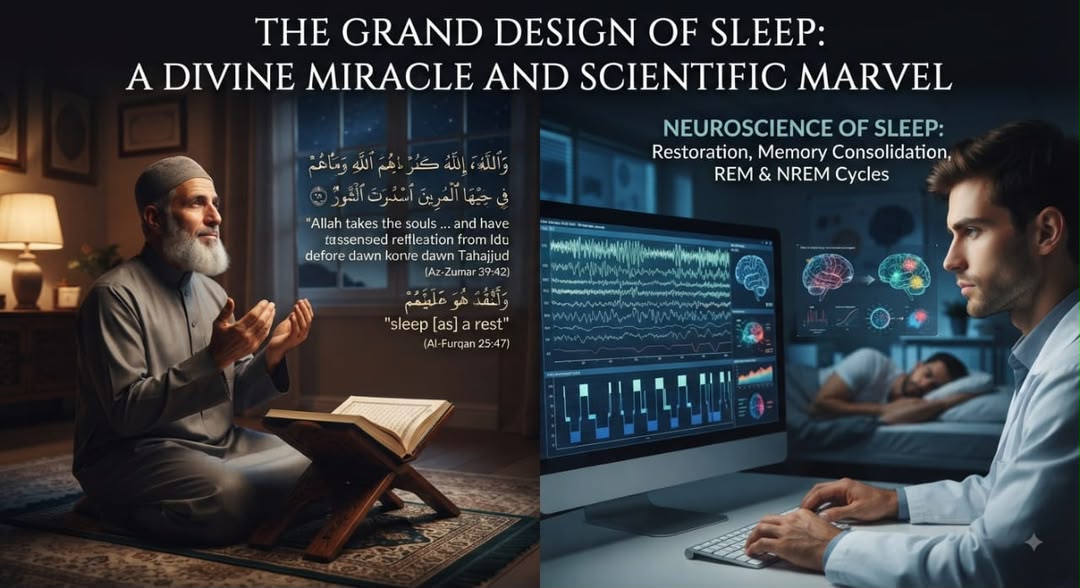
The Qur’an employs an exquisite metaphor to describe the restorative nature of rest, stating in Al-Furqan (25:47): “And He it is who hasmade the night for you as clothing and sleep [as] a rest, and has made the day a resurrection.”
Day and night represent a divine rhythm, shielding the human body from the overwhelming pressures and sensory burdens of daily life. In Arabic, the designation of thenight as ‘libas’ (clothing) signifies how darkness envelops and covers the body like a protective garment, bringing peace.
Furthermore, the Qur’an draws a striking parallel between sleep anddeath, framing it as a temporary suspension of consciousness. As stated in Az-Zumar (39:42): “Allah takes the souls at the time oftheir death, and those that do not die [He takes] during theirsleep. Then He keeps those for which He has decreed death and releases the other for a specified term. Indeed, in that are signs for a people who give thought.”
Modern neuroscience echoes thisconcept, revealing that during deep sleep, brain activity shifts and autonomic functions scale down into a state remarkably similar to a temporary, reversible suspension.

Amidst acute distress, anxiety, and overwhelming life trials, theDivine offers absolute tranquility through rest. Reflecting on thecomfort sent after trials, Ali ‘Imran (3:1 54) notes: “Then after distress, He sent down upon you security [in the form of]drowsiness, overcoming a faction of you…”
Modern medical research validates this exact phenomenon, showing that moments of rest and restorative sleep significantly lower stress hormones, enhancebrain function by up to thirty-five percent, and regulate emotionalwell-being. Sleep is far more than passive downtime; it is a vital biological mechanism through which the brain clears toxins and repairs neural networks.
The Qur’an also outlines the daily habits of those deeply connected to the Divine through late-night vigilance and reflection. Describing the righteous, Adh-Dhariyat (51 :1 7-1 8) records: “They used to sleepbut little of the night, and in the hours before dawn they wouldask forgiveness.”
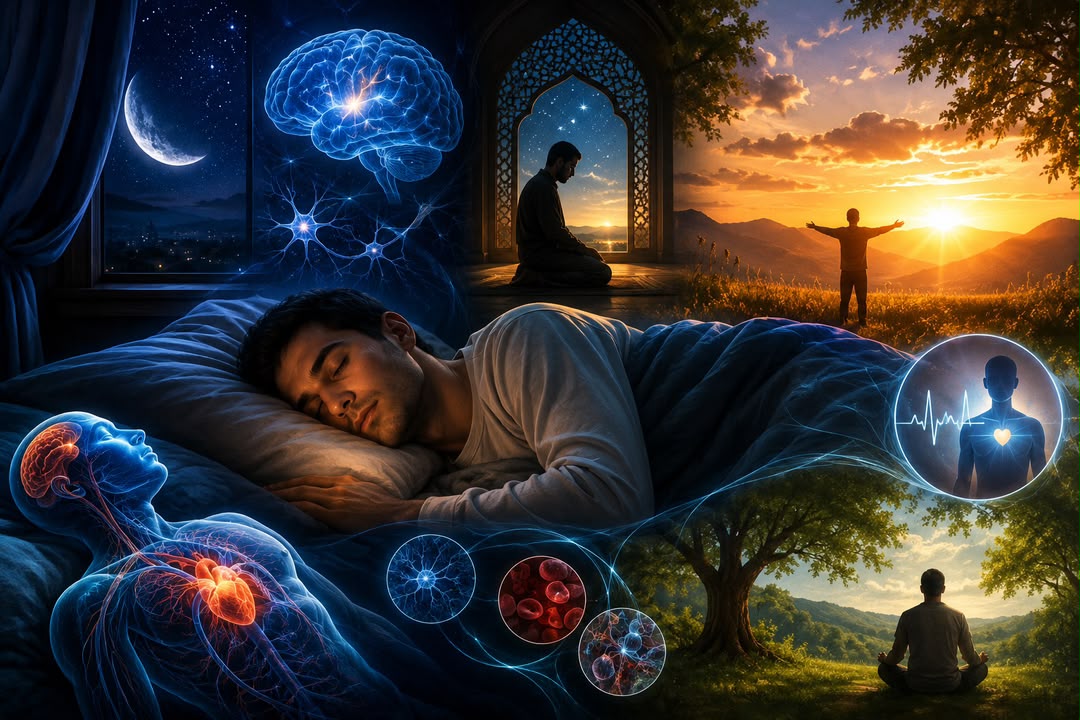
Chronobiologically, the hours preceding dawn mark a period when melatonin regulation and the endocrine system synchronize to refresh thehuman body. Ultimately, sleep is not merely a biological baseline tobe taken for granted, but a profound canvas displaying the Creator’s infinite wisdom, binding physical health and spiritual devotiontogether in harmonious grace.
References
- Classical Texts & Exegesis: ‘Tafsir Ibn Kathir’ offers linguisticcontext on Qur’anic verses about rest, while “Sahih al-Bukhari &Sahih Muslim” detail nightly vigilance and sleep etiquettes.
- Neuroscientific Research: Xie et al. (201 3) discovered theglymphatic system showing brain waste clearance during sleep, JamesB. Maas (Power Sleep) covers cognitive enhancement and stressreduction, and Matthew Walker (Why We Sleep) details neuralrepair and memory consolidation.
- Chronobiological Studies: Czeisler & Klerman explore circadianregulation, melatonin synchronization, and endocrine rhythmsleading up to dawn.
About the Author:
A.S.M. Razan (Abdul Salam Mohamed Razan) writes on Islam and science, with particular interest in the relationship between Qur’anic revelation and discoveries in biology, astronomy and cosmology. He is a physiotherapy student at the Faculty of Medicine, University of Colombo, Sri Lanka, and has a background in Biological Sciences. He is a guest writer for PEACE Magazine.
SPONSORED

SPONSORED

SONSORED
