
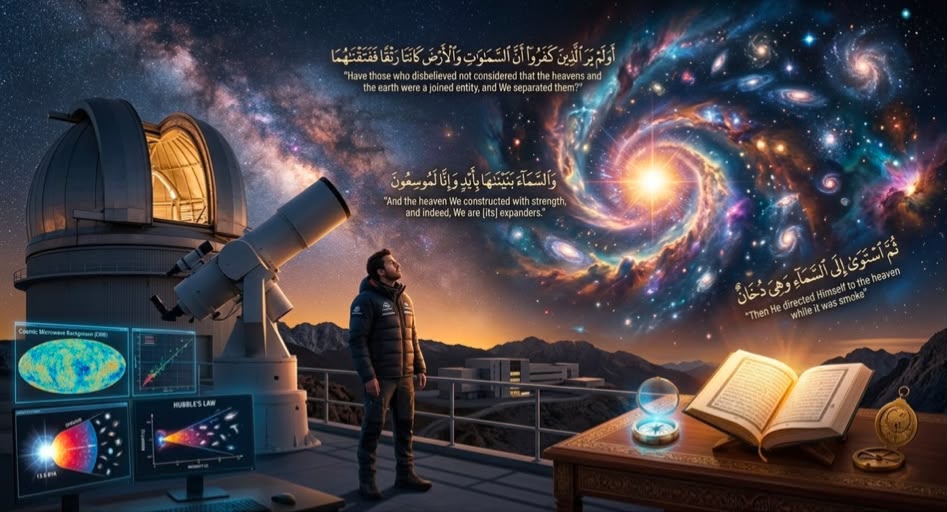
Science and Signs in the Qur’an
“Have those who disbelieved not considered that the heavens and the earth were a joined entity, and We separated them and made from water every living thing? Then will they not believe?” (Qur’an 21:30)
The Big Bang Theory and the Al-Qur’an: The Point Where Science and Spirituality Converge
By A.S.M Razan
The intersection of modern astrophysics and sacred scripture reveals a profound harmony that continues to captivate seekers of truth, particularly when examining the striking parallels between the Big Bang theory and the textual descriptions in the Al-Qur’an.
For centuries, humanity looked up at the night sky with wonder, yet only in the modern era have advanced instruments, particle accelerators, and mathematical models allowed us to decode the true origin of the cosmos.
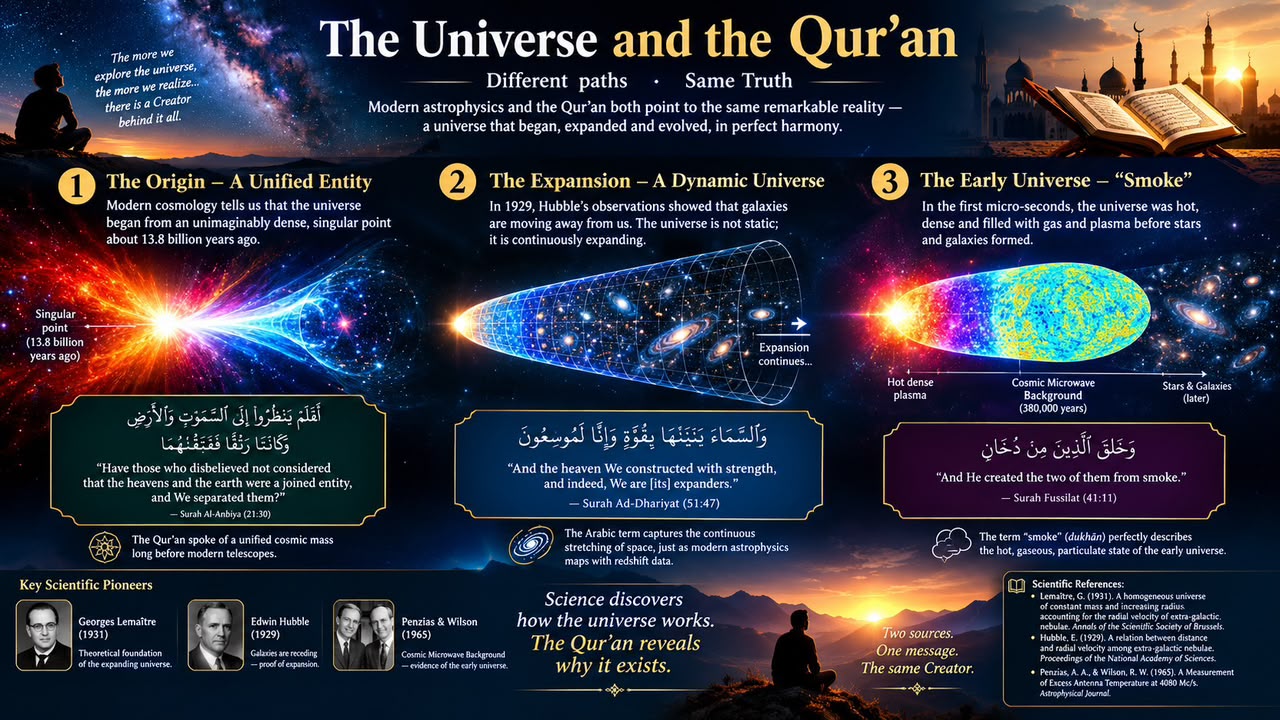
Modern cosmology, pioneered bytheoretical insights from figures such as Georges Lemaître and cemented by empirical observations, dictates that the universe did notalways exist in its current vast state; rather, it burst into being from anunimaginably dense, singular point approximately 13.8 billion years ago.
This monumental scientific milestone finds an astonishing echo in Surah Al-Anbiya, verse 30, where the text prompts reflection: “Have those who disbelieved not considered that the heavens and the earth were a joined entity, and We separated them and made from water every living thing? Then will they not believe?”
Long before the advent of modern telescopes, the Al-Qur’an articulated the foundational concept of a unified cosmic mass undergoing an initial separation event.
Building upon this origin, the dynamic nature of the universe became one of the twentieth century’s most revolutionary scientific revelations. In 1 929, astronomer Edwin Hubble published data demonstrating that distant galaxies are receding from us, proving that the universe is not static, but actively and continuously expanding a principle mathematically predicted by Albert Einstein’s general theory of relativity and quantified by Hubble’s Law.
This expanding reality is precisely depicted in Surah Ad-Dhariyat, verse 47, which declares: “And the heaven We constructed with strength, and indeed, We are [its] expanders.”
The Arabic terminology employed here captures the continuous action of spatial stretching that modern astrophysicists map using galactic redshift data.
Furthermore, looking back at the earliest microseconds and epochs of this expansion, contemporary astrophysics describes a primordial era dominated by hot, dense gaseous elements and opaque plasma before the formation of stable stars and galaxies, a phase studied extensively through the Cosmic Microwave Background radiation and primordial nucleosynthesis models.
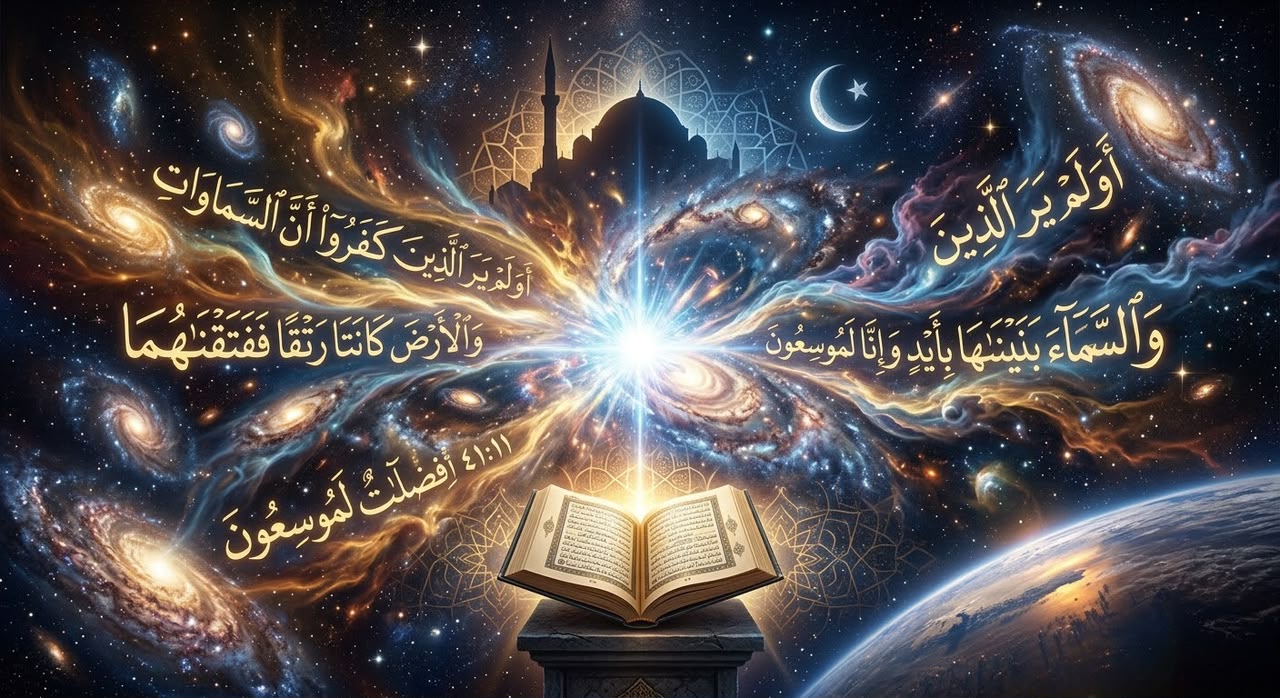
This scientific consensus mirrors the description in Surah Fussilat, verse 1 1, which refers to the nascent universe’s state as “smoke” (dukhăn), an apt term denoting a hot, gaseous, particulate haze. When we synthesize these insights, the alignment between empirical scientific discovery and the timeless verses of the Al-Qur’an transcends coincidence, offering an inspiring testament to a universal design where rigorous scientific inquiry and spiritual reflection beautifully converge.
Scientific References:
- Lemaître, G. (1 931 ). *A homogeneous universe of constant mass and increasing radius accounting for the radial velocity of extragalactic nebulae*. Annals of the Scientific Society of Brussels.
- Hubble, E. (1 929). *A relation between distance and radial velocity among extra-galactic nebulae*. Proceedings of the National Academy of Sciences.
- Penzias, A. A., & Wilson, R. W. (1 965). *A Measurement of Excess Antenna Temperature at 4080 Mc/s*. Astrophysical Journal (detailing the Cosmic Microwave Background and primordial gas/smoke phases).
About the Author:
A.S.M. Razan (Abdul Salam Mohamed Razan) writes on Islam and science, with particular interest in the relationship between Qur’anic revelation and discoveries in biology, astronomy and cosmology. He is a physiotherapy student at the Faculty of Medicine, University of Colombo, Sri Lanka, and has a background in Biological Sciences. He is a guest writer for PEACE Magazine.
SPONSORED

SPONSORED

SONSORED
