
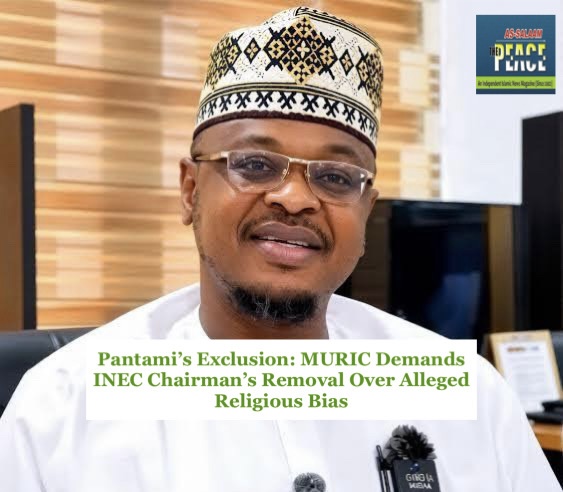
Pantami’s Exclusion: MURIC Demands INEC Chairman’s Removal Over Alleged Religious Bias
The Islamic rights group seeks the reinstatement of the former minister as the PDP’s Gombe governorship candidate, while INEC says the party failed to meet statutory membership-register requirements.
By Abdullahi Yusuf
The Muslim Rights Concern (MURIC) has demanded the reinstatement of Professor Isa Ali Pantami as the Peoples Democratic Party’s (PDP) governorship candidate in Gombe State and called on President Bola Tinubu to remove the Chairman of the Independent National Electoral Commission (INEC), Professor Joash Amupitan, over what it described as religious bias.
MURIC’s Founder and Executive Director, Professor Ishaq Akintola, made the demands at a press conference in Lagos on Tuesday, 13 October, following the omission of Pantami’s name from INEC’s final list of candidates for the 6 February 2027 governorship election.
However, INEC has said the omission of Pantami and the PDP’s governorship candidate in Ogun State, Ladi Adebutu, resulted from the party’s failure to comply with statutory requirements for submitting its membership register. The commission cited Sections 77(5)–(7) of the Electoral Act 2026, which it said rendered the affected parties ineligible to sponsor candidates.
The commission said its decision followed a Supreme Court ruling that upheld the constitutionality of the membership-register requirements. It also stated that political parties disputing the omission of their candidates had until 24 October to notify it of alleged wrongful omissions.
The commission’s explanation places the dispute at the intersection of electoral law, party compliance and MURIC’s allegations of religious discrimination.
Pantami’s court-ordered primary
Pantami emerged as the PDP’s candidate after winning a fresh governorship primary on 29 September, following a Federal High Court judgment that nullified the party’s earlier primary and ordered a rerun within 30 days.
He polled 2,054 votes, defeating Khamisu Mailantarki, who scored 389, and Aliyu Garry, who received 112 votes.
MURIC said INEC officials monitored the rerun, with a team led by Gambo Umar Arabi, and that an official report was submitted after the exercise. Akintola questioned why the commission would subsequently omit Pantami from its final list after monitoring the process.
The fresh primary followed legal challenges to Pantami’s initial emergence. In its 24 September judgment, the Federal High Court ordered a new primary after nullifying the earlier exercise over procedural issues and directing the PDP to conduct a fresh contest in accordance with the party’s rules and applicable electoral provisions.
However, the dispute over Pantami’s candidacy extends beyond the conduct of the rerun. Mailantarki had also challenged Pantami’s eligibility, alleging that he joined the PDP after the deadline for submission of party membership registers to INEC.
The commission’s subsequent explanation has focused on compliance with the statutory membership-register requirements. Pantami’s victory in the court-ordered rerun does not, by itself, resolve the separate question of whether the PDP met those requirements.
MURIC alleges religious discrimination
Akintola described Pantami’s exclusion as unjust and alleged that Amupitan bore responsibility for the decision. MURIC argued that the circumstances raised concerns about the fair treatment of Muslim candidates ahead of the 2027 elections.
The organisation also questioned Amupitan’s suitability to lead the electoral commission, referring to an alleged 80-page legal brief on claims of Christian persecution in Nigeria that MURIC said was submitted to the United States and contributed to the country’s designation as a “Country of Particular Concern”.
MURIC’s claims about the brief and the INEC chairman’s alleged religious bias remain allegations made by the organisation. The material presented at the press conference did not independently establish that Pantami’s exclusion was motivated by religion.
The group also cited governors Umo Eno of Akwa Ibom, Bassey Otu of Cross River, Hyacinth Alia of Benue and Agbu Kefas of Taraba in its argument about religious representation in political leadership. It questioned why an Islamic scholar should face barriers to contesting a governorship election.
MURIC said it had previously opposed Amupitan’s appointment, alongside the Supreme Council for Shariah in Nigeria, and maintained that the handling of Pantami’s candidacy had reinforced its concerns about his leadership of INEC.
It subsequently passed a vote of no confidence in the chairman and called on Tinubu to appoint a replacement it considers impartial and free from religious or ethnic prejudice.
Legal challenge and INEC’s position
Pantami’s legal team has separately challenged his omission from the final list. In a letter to INEC dated 12 October, his lawyers gave the commission until 14 October to publish his name, arguing that the omission was unlawful despite his emergence from the court-ordered primary.
The lawyers maintained that the commission’s role in party primaries was to attend, observe and monitor the process, rather than disqualify a nominated candidate. They also argued that the earlier court judgments had affirmed Pantami’s PDP membership and eligibility while ordering a fresh primary because of procedural defects in the original exercise.
INEC, however, has relied on the statutory requirements governing party membership registers and the Supreme Court’s affirmation of the relevant provisions of the Electoral Act 2026. The commission said parties that believe their candidates were wrongly omitted have 14 days from publication of the list to notify it, with 24 October set as the deadline.
The competing positions leave the dispute unresolved: MURIC maintains that Pantami should be reinstated after winning the court-ordered primary, while INEC says the PDP’s failure to meet membership-register requirements rendered it ineligible to sponsor candidates.
MURIC insists that its intervention is not an endorsement of a political party. It describes itself as a non-partisan Islamic human rights organisation committed to protecting the rights of Nigerian Muslims regardless of their political affiliations.
SPONSORED

SPONSORED

SONSORED
