
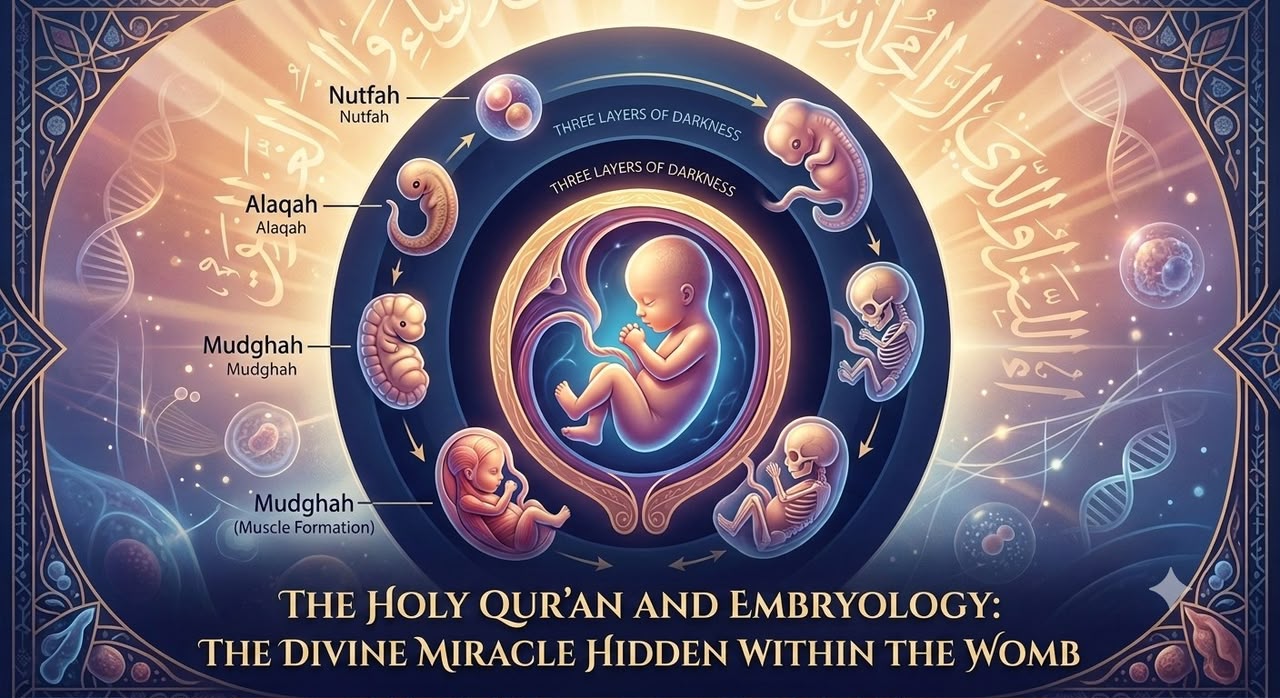
Science and Signs in the Quran
“And indeed, We created man from an extract of clay. Then We placed him as a sperm-drop in a firm resting place. Then We made the sperm-drop into an “Alaqah” (a leech-like clinging clot), and We made the “Alaqah” into a “Mudghah” (a chewed-like lump of flesh), and We made from the “Mudghah” bones, and We clothed the bones with flesh; then We developed him into another creation. So blessed is Allah, the best of creators.” (Quran 23:12-14)
The Quran and Human Creation: An Exploration of Embryological Stages
By A.S.M. Razan
Scientific advancement is often viewed as the pinnacle of human achievement. Through modern technology microscopes, high-resolution ultrasounds, and sophisticated scanning humanity has uncovered intricate details of life’s development. It is a subject of significant academic and theological interest that the Holy Quran, revealed in the 7th century, contains descriptions of human development that align with these modern observations.
Specifically, the Quranic depiction of the stages within the womb has prompted extensive study regarding the historical and scientific interplay between ancient scripture and modern embryology.
In the 23rd chapter of the Holy Quran (Surah Al-Mu’minun), the process of human creation is described in a sequential manner. The relevant verses state: “And indeed, We created man from an extract of clay. Then We placed him as a sperm-drop in a firm resting place. Then We made the sperm-drop into an “Alaqah” (a leech-like clinging clot), and We made the “Alaqah” into a “Mudghah” (a chewed-like lump of flesh), and We made from the *Mudghah* bones, and We clothed the bones with flesh; then We developed him into another creation. So blessed is Allah, the best of creators.” (Quran 23:12-14)
Modern embryology categorizes prenatal development through morphological observation. The Quranic terms used to describe these stages have been studied for their linguistic and descriptive accuracy. In the ‘Alaqah’ stage, early development involves the embryo attaching to the uterine wall. The Arabic term ‘Alaqah’ carries meanings of “a leech,” “a suspended thing,” or “a blood clot.” Biologically, the early embryo’s mode of attachment to the maternal tissue and its appearance during the first few weeks have led some to note a conceptual similarity to these descriptions.
As the embryo progresses, it develops somites segments along the back that give it a “chewed” appearance when viewed under magnification. This observation is frequently cited in discussions comparing the Quranic term ‘Mudghah’ (chewed lump) to the physical structure of an embryo at this stage. Furthermore, the Quranic sequence describes the formation of bones (Izam) followed by the “clothing” of these bones with flesh (Lahm). In modern human development, the differentiation of mesenchymal cells leads to the initial formation of a cartilaginous skeleton, followed by the development of muscles that surround these structures.
The alignment between these ancient descriptions and modern scientific nomenclature has sparked significant academic debate. For many, these verses serve as a profound testament to the divine origin of the Quran. For others, they represent a poetic and metaphorical reflection of the understanding of human life available in the pre-modern era, which modern observers interpret through the lens of current scientific discovery. Regardless of the perspective taken, the Quran remains a central text in the history of ideas, bridging the gap between faith and the empirical study of the human life cycle.
References:
1. Saadat, S. (2011).”Human Embryology and the Holy Quran: An Overview.” Journal of the British Islamic Medical Association. This study analyzes the alignment between embryological terminology in the Quran and modern scientific findings.
2. Husairi, A., et al. (2019). “Embryology In The Qur’an And Hadith: Expanded Multidisiplinary Perspective.” Proceedings of the Third International Conference on Sustainable Innovation.
3. Rashid, R. (2019). “Classical Muslim scholarly interpretations of when pregnancy begins.” Journal of the British Islamic Medical Association.
4. Saleem, S. M. (2024). “Exploring the Medical Knowledge Presented in the Quran: AnAnalysis of its Accuracy and Relevance.” ResearchGate.
5. The Holy Quran.Translation of the meaning by Sahih International.
About the Author: A.S.M. Razan (Abdul Salam Mohamed Razan) writes on Islam and science, with particular interest in the relationship between Qur’anic revelation and discoveries in biology, astronomy and cosmology. He is a physiotherapy student at the Faculty of Medicine, University of Colombo, Sri Lanka, and has a background in Biological Sciences. He is a guest writer for PEACE Magazine.

SPONSORED

SPONSORED

SONSORED
