
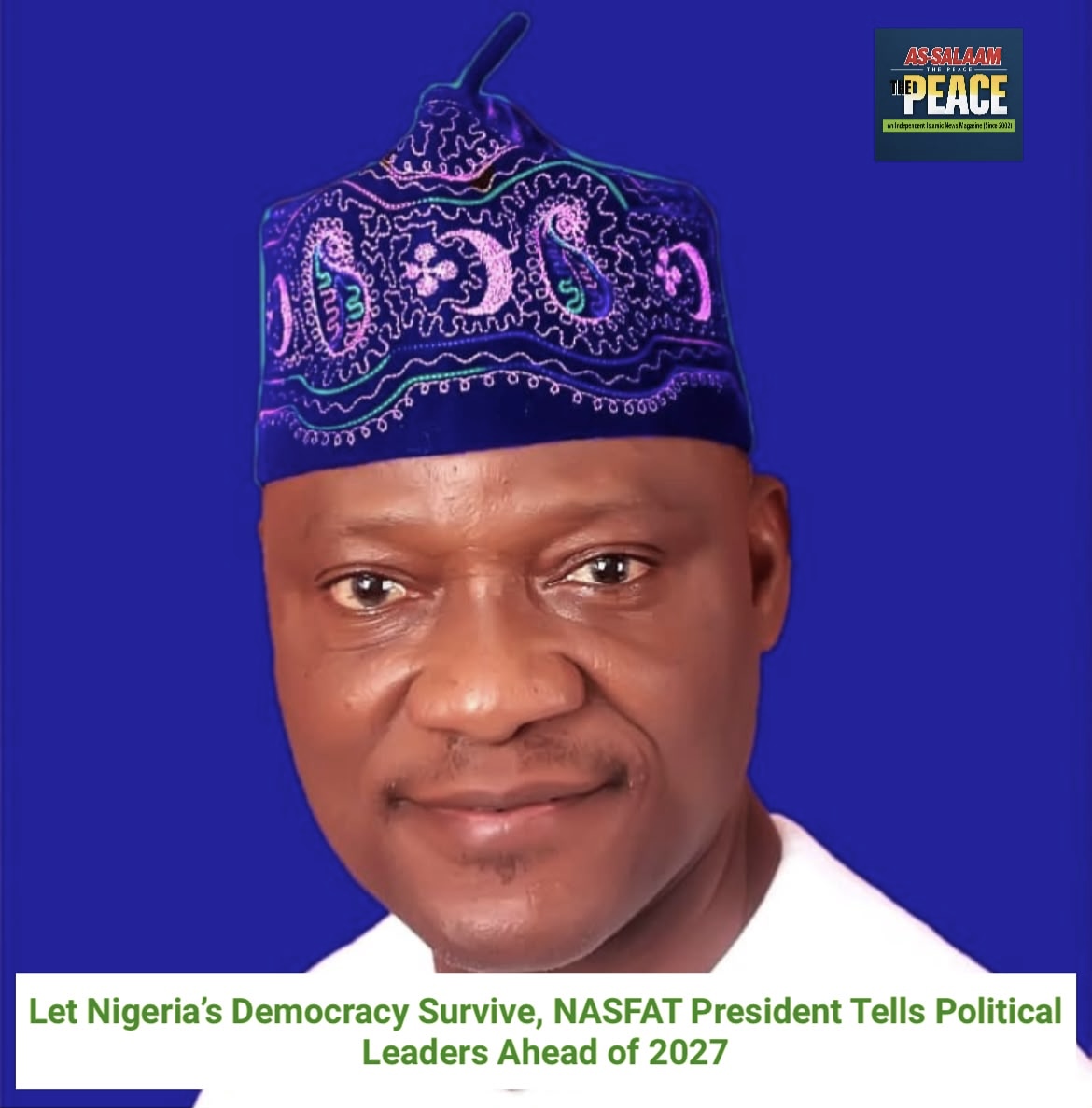
NASFAT President Warns Politicians Against Hollowing Out Nigeria’s Democracy as 2027 Polls Near
Alhaji Ayodeji AbdulRauf names judicial independence, independent journalism and political restraint among safeguards Nigeria needs before the January elections
By Abdullahi Yusuf
The President of the Nasrul-Lahi-L-Fatih Society (NASFAT), Alhaji Ayodeji AbdulWahid AbdulRauf, has urged Nigeria’s political leaders to protect democratic institutions as the 2027 general elections approach, warning that democracies today can be weakened from within rather than overthrown through military coups.
In a statement, AbdulRauf said sustaining democracy in a developing nation requires “democratic resilience”, which he defined as a political system’s capacity to absorb polarisation, economic stress and institutional erosion without sliding into autocracy.
The presidential and National Assembly elections are scheduled for 16 January 2027, while governorship and State House of Assembly elections are scheduled for 6 February, according to the Independent National Electoral Commission (INEC).
AbdulRauf argued that while democracies historically collapsed through sudden military takeovers, modern democratic systems could also be gradually hollowed out from within when elected leaders use legal and institutional mechanisms to weaken checks and balances.
Citing sociological research and the OECD’s Reinforcing Democracy Initiative, he set out what he described as the key ingredients of democratic survival.
On institutions, AbdulRauf said an independent judiciary was a critical safeguard against executive overreach, warning that compromising judicial independence could lead to what he described as a “legalistic” erosion of rights.
He said the civil service must remain non-partisan in areas including election administration, law enforcement and tax collection, arguing that state institutions should not be weaponised or professional personnel replaced with political loyalists.
Legislators at federal, state and local levels, he added, must use hearings, budgetary oversight and investigations to hold leaders accountable rather than become rubber-stamp bodies.
On the economy and information, AbdulRauf argued that material prosperity is a major factor in democratic survival, saying structural inequality, stagnant wages and severe economic shocks can weaken citizens’ confidence in democratic institutions and leave them vulnerable to populist appeals.
He called for independent journalism to counter misinformation and disinformation, and urged the protection of freedom of speech and access to information.
AbdulRauf said written constitutions were not enough without unwritten democratic norms, urging INEC and other democratic institutions to uphold them.
He identified two such norms as mutual toleration, treating political opponents as legitimate competitors rather than existential enemies and forbearance, which he described as the conscious decision by leaders not to use their full legal powers to completely crush their opposition.
He also called for active civic engagement, including the participation of faith-based organisations, civil society groups, legal defence bodies and local watchdogs capable of bridging social and ethnic divides and keeping citizens connected to public life.
AbdulRauf urged greater civic education to help Nigerians understand how government works, recognise political manipulation and algorithm-driven radicalisation, and appreciate the importance of democratic processes.
He said democracy could not be treated as permanent even in wealthy and stable societies, arguing that without continuous civic and institutional maintenance, democratic systems could gradually deteriorate.
“Nigeria must not toe the path of degradation,” he appealed.
The statement did not name any politician or political party.
It follows an August appeal by AbdulRauf urging Nigerians to uphold civility and respect across political differences as the country approaches the 2027 elections.
NASFAT, which marked its 30th anniversary in 2025, describes itself as a global organisation with more than 360 locations and operates primary and secondary schools, hospitals and Fountain University.
SPONSORED
SPONSORED

SPONSORED

SPONSORED
