
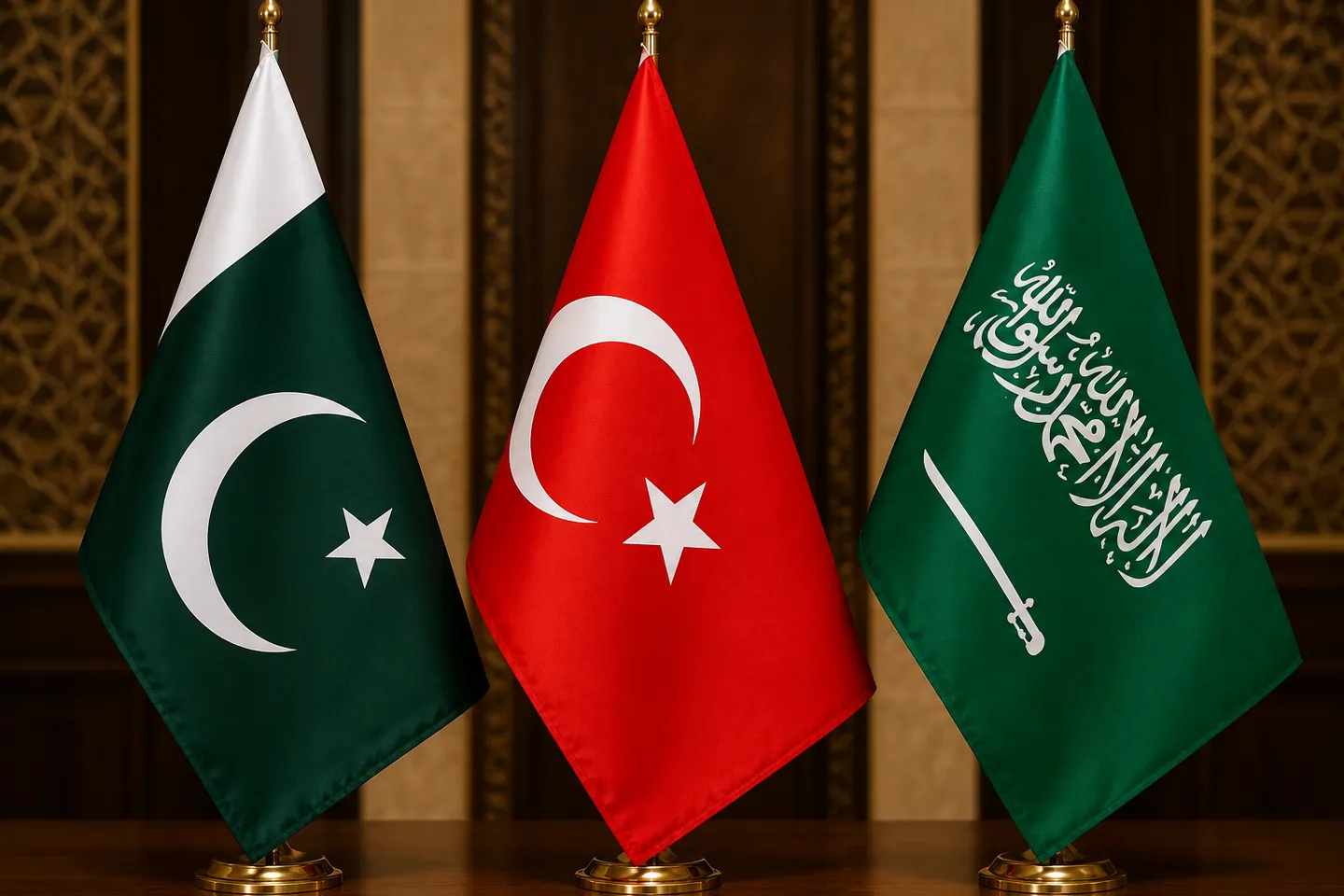
Türkiye Committee Clears Mecca Defence Pact with Saudi Arabia and Pakistan
The trilateral agreement provides for collective defence and expanded military cooperation, with Ankara insisting it will complement Türkiye’s NATO commitments.
By Abdullahi Yusuf
Türkiye’s parliamentary Foreign Affairs Committee has approved a bill to ratify a joint defence agreement with Saudi Arabia and Pakistan, moving the trilateral pact a step closer to final parliamentary approval.
The Mecca Joint Defence Agreement was signed in Mecca on 7 August 2026 by Turkish President Recep Tayyip Erdoğan, Saudi Crown Prince and Prime Minister Mohammed bin Salman, and Pakistani Prime Minister Shehbaz Sharif.
The committee approved the ratification bill on Tuesday, 27 October, following deliberations during which Deputy Foreign Minister Levent Gümrükçü briefed lawmakers on the agreement and answered their questions. The bill must still pass through the Turkish parliament’s General Assembly before Türkiye completes its domestic ratification process.
Gümrükçü told the committee that Saudi Arabia and Pakistan had completed their domestic ratification procedures and submitted the required official notifications.
Describing the agreement as a response to the need for greater regional responsibility in addressing security challenges, he said it built on the three countries’ longstanding relations and established a framework for collective defence.
“The Mecca agreement is not only an extension of the special friendly relations between the three countries, but also a concrete product of the regional ownership increasingly needed in our region,” Gümrükçü said.
The agreement’s collective-defence provision treats an armed attack against one signatory as an attack against all three. The provision establishes a mutual-assistance obligation, although the steps taken must be considered within the agreement’s terms and the parties’ applicable legal and constitutional procedures.
Beyond collective defence, the framework envisages regular security consultations, exchanges of military personnel, joint training programmes and military exercises. It also provides for closer defence-industry cooperation, including joint production and technology sharing, counterterrorism efforts and logistical support.
Gümrükçü stressed that the agreement was defensive in nature and did not target any country. He said it was open to regional states that respect international law, including sovereignty and territorial integrity, the peaceful settlement of disputes and non-interference in other countries’ internal affairs.
He described the arrangement as an inclusive regional security framework rather than an effort to create opposing blocs.
The Turkish deputy foreign minister also said the agreement would neither replace nor undermine Türkiye’s existing international alliances and commitments. He presented it as complementary to the country’s participation in multilateral platforms, particularly NATO, arguing that stronger regional cooperation could contribute to security in the wider Middle East and Europe.
Foreign Affairs Committee Chairman Fuat Oktay also rejected suggestions that the agreement was intended to create an alternative to NATO.
“There were questions about whether an alternative to NATO was being created. Absolutely not,” Oktay told reporters.
He said the pact would not undermine the sovereignty or territorial integrity of the three countries or invalidate their existing international commitments.
The committee’s deliberations also exposed concerns among some lawmakers about the potential military obligations and security risks arising from the agreement. Opposition representatives questioned whether its commitments could expose Türkiye to conflicts involving other signatories, while ruling-party lawmaker Zafer Sırakaya argued that the framework extended beyond military cooperation to include intelligence, cybersecurity and the security of trade routes.
The committee’s approval is a legislative step, not the completion of Türkiye’s ratification. The bill must still be considered by the General Assembly of the Turkish parliament, and no date for the final vote was announced in the committee report.
SPONSORED
SPONSORED

SPONSORED

SPONSORED
