
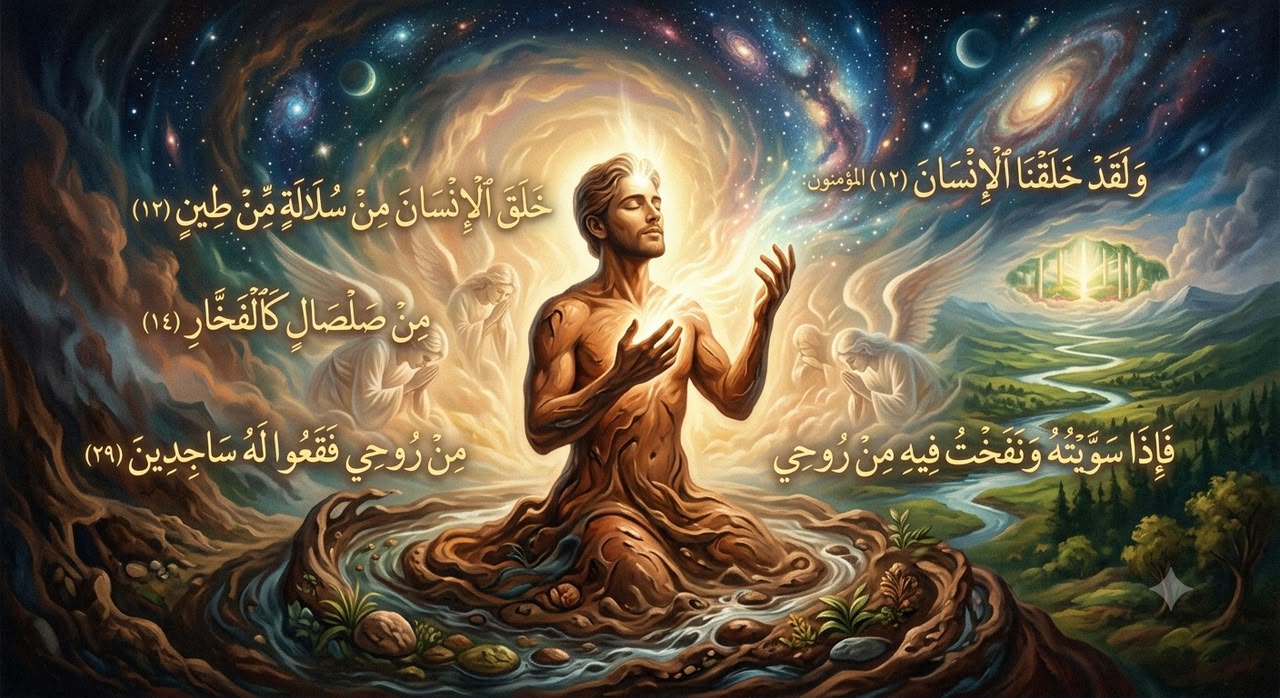
Science and Signs in the Qur’an
“He is the One Who created you from clay, then appointed a term for your death and another known only to Him ˹for your resurrection yet you continue to doubt!” (Al-An’am 6:2)
The Secret of Dust: Human Origin in the Qur’an
By A.S.M Razan
The Holy Qur’an presents remarkably clear and profound insights regarding the origin of humanity and the miracle of creation. Amidst the universe’s rapid transformations, the answer the Almighty provides in the Qur’an to the question of what human beings were created from is truly awe-inspiring. The Qur’an beautifully describes in several verses how the father of mankind, Adam (peace be upon him), was created from clay. It is worth reflecting that the simplicity of the human physical structure and the elevation of the soul breathed into him both trace back to this humble raw material: clay.
The material God chose to create human beings from was clay, a mixture of simple soil and water. The verse, “And indeed, We created man from an extract of clay” (Al-Mu’minun: 1- 2), elegantly highlights the chemical connection between the human body and the earth’s soil. What was mere dirt mixed with water to become malleable clay; it then assumed a specific form, becoming dried clay that produces a ringing sound like pottery. The Qur’an refers to this state: “He created man from clay like that of pottery” (Ar-Rahman: 1 4). The human form, perfected after passing through infinite wisdom.
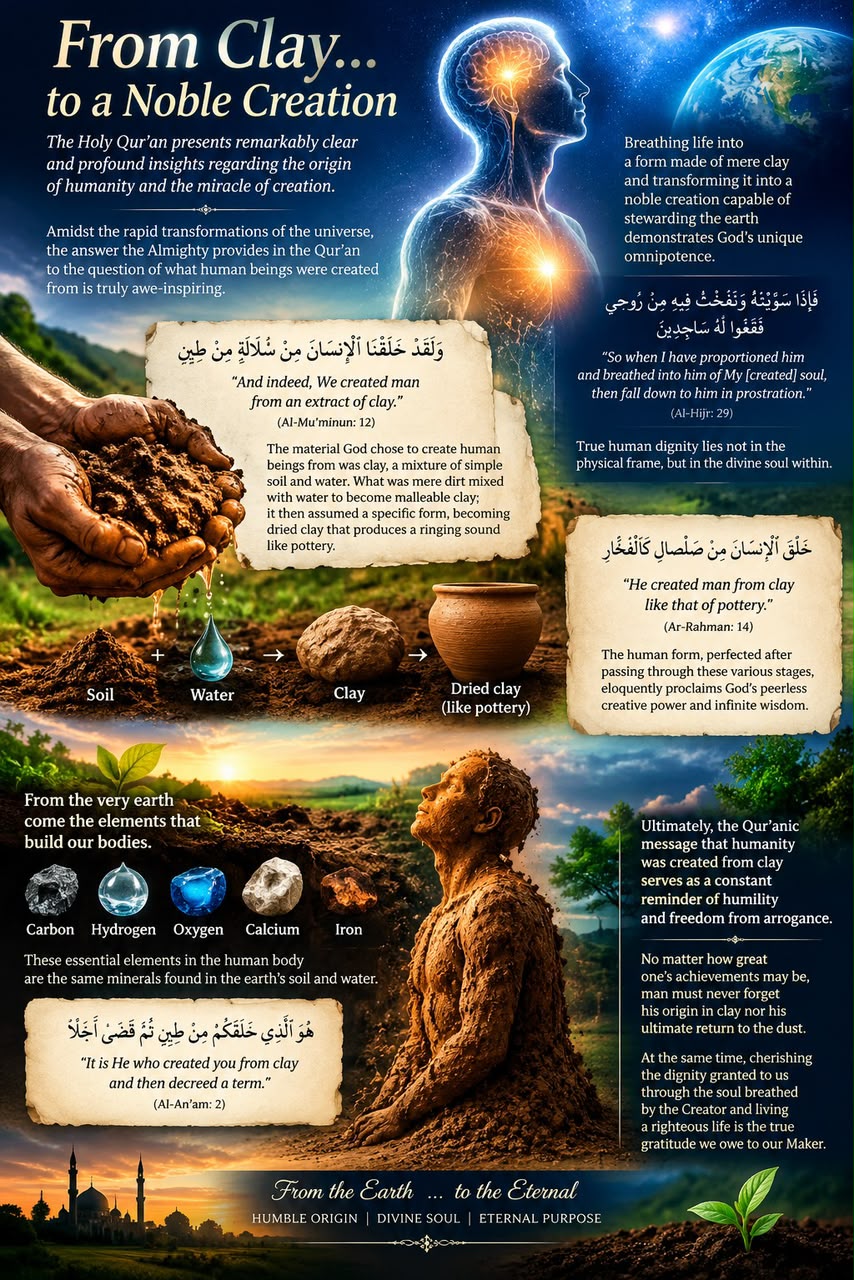
Breathing life into a form made of mere clay and transforming it into a noble creation capable of stewarding the earth demonstrates God’sunique omnipotence. When God describes commanding the angels: “So when I have fashioned him and had a spirit of My Own creation breathed into him, fall down in prostration to him.” (Al-Hijr: 29), it becomes clear that true human dignity lies not in the physical frame but in the divine soul within. Born from humble clay, man was granted knowledge and honor that surpassed even that of the angels.
From a scientific perspective, it has been established that essential elements in the human body—such as carbon, hydrogen, oxygen, calcium, and iron—are the very same minerals found in the earth’s soil and water. The verse, “He is the One Who created you from clay, then appointed a term for your death and another known only to Him ˹for your resurrection yet you continue to doubt!” (Al-An’am 6:2), clarifies both the creation of man and the boundary of his earthly lifespan. The reality that the miraculous human body was fashioned from the ordinary clay we tread upon every day reaffirms the truth of the Qur’an.
Ultimately, the Qur’anic message that humanity was created from clay serves as a constant reminder of humility and freedom from arrogance.No matter how great one’s achievements may be, man must never forget his origin in clay nor his ultimate return to the dust. At the same time, cherishing the dignity granted to us through the soul breathed by the Creator and living a righteous life is the true gratitude we owe to our Maker.
References:
Emsley, J. (2011 ). Nature’s Building Blocks: An A-Z Guide to the Elements. Oxford University Press.
Chang, R. (2010). Chemistry (1 0th ed.). McGraw-Hill Education.
Ferris, J. P., et al. (1996). Synthesis of long prebiotic oligomers on mineral surfaces. Nature, 381 (6577), 59–61.
Ertem, G., & Ferris, J. P. (1 996). Synthesis of RNA oligomers on montmorillonite: Clay-catalyzed formation of phosphodiester bonds.Nature, 379(6562), 238–240.
Joshi, P. C., et al. (2009). Montmorillonite-catalysed formation of RNA oligomers. Chemical Communications, 3438–3440.
Yang, D., et al. (201 3). Clay hydrogels as a platform for prebiotic protein synthesis. Scientific Reports, 3, 31 65.
Oliver, M. A. (1 997). Soil and human health: A review. European Journal of Soil Science, 48(4), 573–592.
About the Author:
A.S.M. Razan (Abdul Salam Mohamed Razan) writes on Islam and science, with particular interest in the relationship between Qur’anic revelation and discoveries in biology, astronomy and cosmology. He is a physiotherapy student at the Faculty of Medicine, University of Colombo, Sri Lanka, and has a background in Biological Sciences. He is a guest writer for PEACE Magazine.
SPONSORED

SPONSORED

SONSORED
