
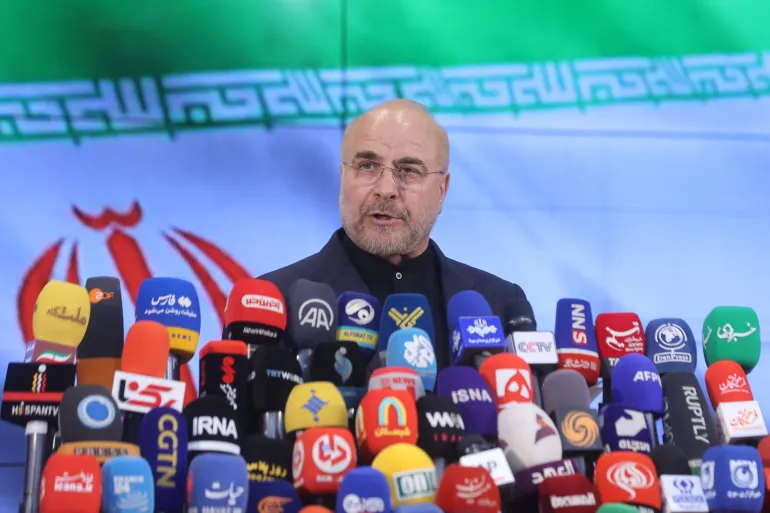
Qalibaf Warns US: Strike Our Assets and You Get Struck
Iran’s parliament speaker warns that American oil and gas interests across the Gulf are exposed to retaliation if Washington attacks Iranian energy assets, as the confrontation over the Strait of Hormuz intensifies.
By Abdullahi Yusuf
Iranian Parliament Speaker Mohammad Baqer Qalibaf has warned the United States that any attack on Iran’s oil and gas assets would trigger retaliation against American energy interests across the region, sharpening an already dangerous confrontation over the Strait of Hormuz.
“It’s simple: the oil and gas production chain here is sprawling, accessible, and exposed. American oil and gas companies across these waters and facilities share that exposure. Strike our assets and you get struck,” Qalibaf wrote on X on Monday.
He added: “We’ve already proven it. Ask the bases that are no longer viable.”
Qalibaf’s warning followed US Defence Secretary Pete Hegseth’s threats against Iran’s oil tanker fleet after US forces struck three Iranian oil tankers on September 5. Hegseth said that if Iran attacked US ships, Washington would destroy and sink Iranian oil tankers, describing the fleet as “defenceless” and saying US aircraft, ships and submarines could strike them.
The exchange marks a further expansion of the confrontation, with both sides now threatening assets linked to the other’s energy trade as military tensions intensify around the Strait of Hormuz.
The strategic waterway has become a central pressure point in the conflict. Shipping through the strait has fallen sharply amid the fighting and restrictions, while reciprocal attacks on vessels have added to concerns over the security of one of the world’s most important energy routes.
The dispute is also tied to the June 17 Islamabad Memorandum of Understanding between Iran and the United States, whose Article 5 addressed commercial passage through the strait.
Under the provision, Iran agreed to make its best efforts to facilitate the safe passage of commercial vessels between the Persian Gulf and the Sea of Oman for 60 days. It also provided for the removal of technical and military obstacles and required Iran to hold discussions with Oman and other Gulf littoral states over the future administration and maritime services of the Strait of Hormuz.
The agreement subsequently unravelled amid disputes over the interpretation and implementation of its provisions. The United States and Iran have since traded accusations over restrictions on shipping, military activity and control of the strategic waterway. Reuters reported in August that the MoU had effectively collapsed, with Iran maintaining that the strait would remain closed until Washington met conditions including an end to its blockade and military operations against Iran.
The latest confrontation follows the September 5 attacks on Iranian tankers. US Central Command said its forces targeted three Iranian crude-oil carriers after Iranian forces launched missiles towards two US Navy vessels near Iranian waters. Iran subsequently threatened further retaliation and said American energy interests in the Gulf were vulnerable.
Qalibaf’s warning therefore carries the confrontation beyond naval vessels and tanker traffic to the wider energy infrastructure linking the Gulf to global markets.
Iranian officials have also signalled tighter controls around the Strait of Hormuz. Senior Iranian official Mohsen Rezaei said Tehran would announce a new restricted zone in the Gulf and approve maps for a new shipping corridor through the strait, while Iran has continued to insist that its position on reopening the waterway is tied to US compliance with the conditions Tehran says emerged from the June agreement.
With the two sides now exchanging threats against energy assets as well as military targets, the latest warning raises the prospect that further attacks could widen the confrontation across the Gulf’s oil and gas infrastructure, adding another layer of risk to an already disrupted global energy corridor.
SPONSORED

SPONSORED

SONSORED
