
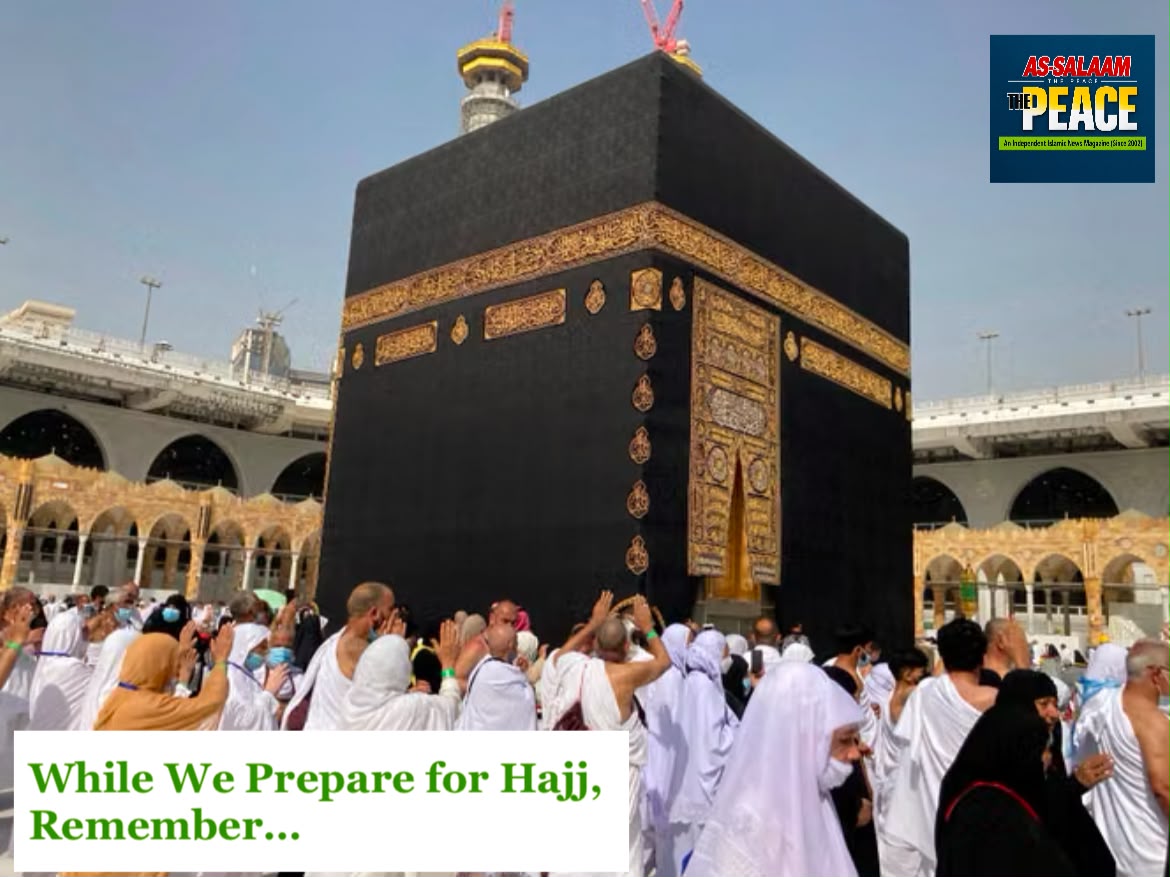
While We Prepare for Hajj, Remember
Seek Knowledge…
By Yunusa Muhammad Makarfi
There is a beautiful principle in Islam that should guide every intending pilgrim as preparations for Hajj begin: the believer cannot take any action except on the basis of knowledge and he cannot acquire knowledge unless he asks (Jami’ Bayan al ilm wa fadlihi -1/52-56). Worship is not something we approach by guesswork. We first seek to know what Allah requires, and then we strive to do it correctly.
Umar Ibn Abdul Aziz the 8th Umayyad Caliph warned “whoever worships Allah without knowledge will cause more harm than good… (Sunan al-Dārimī 308).
The Qur’an gives us a powerful reminder “And do not pursue that of which you have no knowledge. Indeed, the hearing, the sight and the heart – about all those [one] will be questioned” [al-Isra’ 17:36]. Knowledge is therefore something the believer continues to seek throughout life.
This principle is particularly relevant to Hajj. Imagine preparing to undertake a journey that may consume years of savings, considerable personal sacrifice and weeks away from home, yet spending very little time learning about the worship for which the journey is being made. It would be like preparing every detail of a journey except learning where you are going.
The money spent on Hajj is precious. So is the opportunity. Invest in knowledge before investing in the journey. A prepared mind helps the heart receive Hajj’s lessons.
Before the pilgrim says Labbayk, there should be an effort to understand what that response means. Before entering Ihram, there should be knowledge of its requirements and restrictions. Before Tawaf, there should be an understanding of what is required. Before travelling to Mina, Arafat and Muzdalifah, the pilgrim should know the significance of these places and what is expected at each stage.
The Prophet (SAW) placed great emphasis on beneficial knowledge. In a well-known hadith, he said that whoever travels a path in search of knowledge, Allah will make easy for that person a path to Paradise. What better journey, then, to combine with the search for knowledge than the journey to the House of Allah?
This is why the lecture and enlightenment programmes being organised across the states are important. They bring together religious guidance and practical information needed by the pilgrim. They provide an opportunity for intending pilgrims to hear from scholars and Hajj educators, understand the rites and ask questions before they find themselves in the middle of the pilgrimage.
For the intending pilgrim, seeking knowledge should begin before boarding the aircraft. Learn from qualified teachers, ask questions, read reliable materials, understand the manasik and seek proper guidance where matters are unclear.
There is also practical knowledge that every pilgrim needs. Hajj involves pilgrims from many countries and operates through organised systems for accommodation, transportation, identification, health, safety and movement. Understanding these systems and official procedures can protect the pilgrim from confusion and poor decisions.
An informed pilgrim is easier to guide. Such a pilgrim understands why certain instructions are given and is more likely to cooperate with those responsible for managing the Hajj operation. This makes knowledge relevant not only to the spiritual success of the pilgrimage but also to its orderly administration.
When pilgrims understand official instructions and know where to seek authentic information, rumours have less room to thrive and cooperation with group leaders, guides and authorities becomes easier.
Knowledge therefore serves both worship and order.
But perhaps the greatest benefit is that knowledge changes the way the pilgrim sees Hajj.
Without knowledge, Hajj can become a series of movements: Tawaf, Sa’i, Arafat, Muzdalifah, Mina and Jamarat. With knowledge, those movements begin to acquire meaning. The pilgrim understands that this is not tourism. It is an act of worship that carries lessons about submission, sacrifice, patience, equality, humility and obedience.
Knowledge can also change how we behave towards other pilgrims. When we understand that Hajj is a test of patience and character, we become more conscious of our conduct. We learn to control anger, avoid arguments, respect personal space, protect the environment and consider the needs of the elderly, sick and vulnerable.
The Qur’an says: “Allah will raise those who have believed among you and those who were given knowledge by degrees.” (Qur’an 58:11). For the intending pilgrim, this should be encouragement enough to take learning seriously.
This is why every intending pilgrim should make time for the education programmes provided in his or her state. Come with questions. Come ready to listen. Come with the humility to discover that there may be things you did not know.
And after learning, practise what you have learnt.
Knowledge that does not influence action has not achieved its full purpose. The aim is not merely to know the names of the rites or memorise instructions. The aim is to worship Allah correctly and to allow the experience of Hajj to improve the person who returns home.
The Prophet (SAW) gave a beautiful example of beneficial knowledge by comparing the guidance and knowledge with which he was sent to rain falling on different kinds of land. Some land absorbs the water and produces vegetation; other land retains the water from which people benefit; while barren land produces nothing. May we be like the land that receives beneficial knowledge and allows it to produce good deeds.
So, as you prepare for Hajj, prepare your body, prepare your essentials. But above all, prepare your understanding. Your Hajj opportunity may be just this once, it is too precious to be left to assumption.
May Allah grant every intending pilgrim beneficial knowledge, sincere intention, correct understanding, an accepted Hajj. May He make the knowledge acquired before the journey a source of guidance during the pilgrimage and a lasting benefit long after the pilgrim returns.
Makarfi was former PRO Kaduna Pilgrims Welfare Agency
SPONSORED

SPONSORED

SONSORED
