
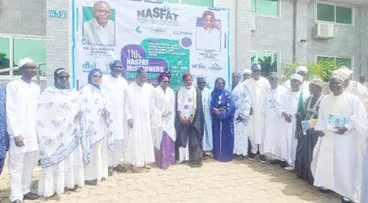
NASFAT: Da’wah Should Not Come at the Cost of Health, Family
NASFAT Chief Missioner calls for sustainable service without burnout or neglect of family duties
By Sadiq Abdulfatah
The growing financial and family responsibilities of Imams and Missioners have highlighted the need for Muslim religious leaders to plan for the future while remaining committed to Da’wah, the Chief Missioner of the Nasrul-Lahi-l-Fatih Society (NASFAT), Imam Abdul-Azeez Morufu Onike, has said.
Onike spoke at the 11th NASFAT Missioners’ Conference in Cotonou, Benin Republic, where he urged religious leaders to think about how their families would be supported if they could no longer preach or work.
He identified irregular income, rising living costs, healthcare bills, children’s education and retirement insecurity as some of the financial challenges facing many Imams and Missioners.
“These are not merely financial questions; they are questions of amānah, stewardship, and responsible leadership,” he said.
The Chief Missioner said religious service should be sustainable and should not come at the cost of a person’s health, family or ability to continue serving Allah effectively.
He drew from his personal experience of illness in 2009 to warn against seeing excessive workloads as a measure of commitment. According to him, Missioners need healthy boundaries that allow them to continue their work without burning out.
“The real question is: How do we serve Allah faithfully without destroying ourselves? How do we remain passionate without burning out, neglecting our families, compromising our health, or diminishing the quality of our service?” he asked.
Onike said Islamic leadership requires neither exhaustion nor complacency. Instead, he called for consistent and sincere excellence, or Iḥsān, in the service of Allah.
He also challenged Missioners to examine how they spend their time and how much of their potential they are using.
He noted that while some Missioners are genuinely overstretched, others may be working at a sustainable level, while some could be doing more.
He asked participants to consider whether some of their activities could be reduced without causing significant harm, how much Da’wah they had personally initiated in recent months, and whether describing themselves as “too busy” was always due to genuine responsibilities or sometimes poor prioritisation.
He further urged them to make better use of the knowledge, skills, opportunities and time entrusted to them by Allah.
The NASFAT leader also encouraged participants to assess their own performance through muḥāsabah, or self-examination.
He commended those who completed the Pre-Conference Capability Assessment Test, describing it as an important step towards measuring and improving their capacity.
He urged the participants to study their results and use them to identify areas for personal development.
Onike stressed that the call for sustainability should not become an excuse for complacency. Rather, he said Missioners should remain dedicated to Da’wah while protecting their health, family life and long-term ability to serve.
The conference therefore focused on helping religious leaders find a balance between their responsibilities to Allah, their communities and their families, while maintaining the quality of their Da’wah.
SPONSORED

SPONSORED

SONSORED
