
NAPAIS Launches 60-Day Census of Islamic Schools, Unveils Almajiri Reform Plan
The association says the exercise will establish a national database of Qur’anic, Arabic and Islamic schools, providing a basis for planning, improved recognition and teacher welfare.
By Abdullahi Yusuf
The National Association of Proprietors of Arabic and Islamic Schools (NAPAIS) has launched a nationwide census of Qur’anic, Arabic and Islamic schools, setting a 60-day target to build a database it says will help address decades of limited institutional recognition, poor planning and inadequate support for the sector.
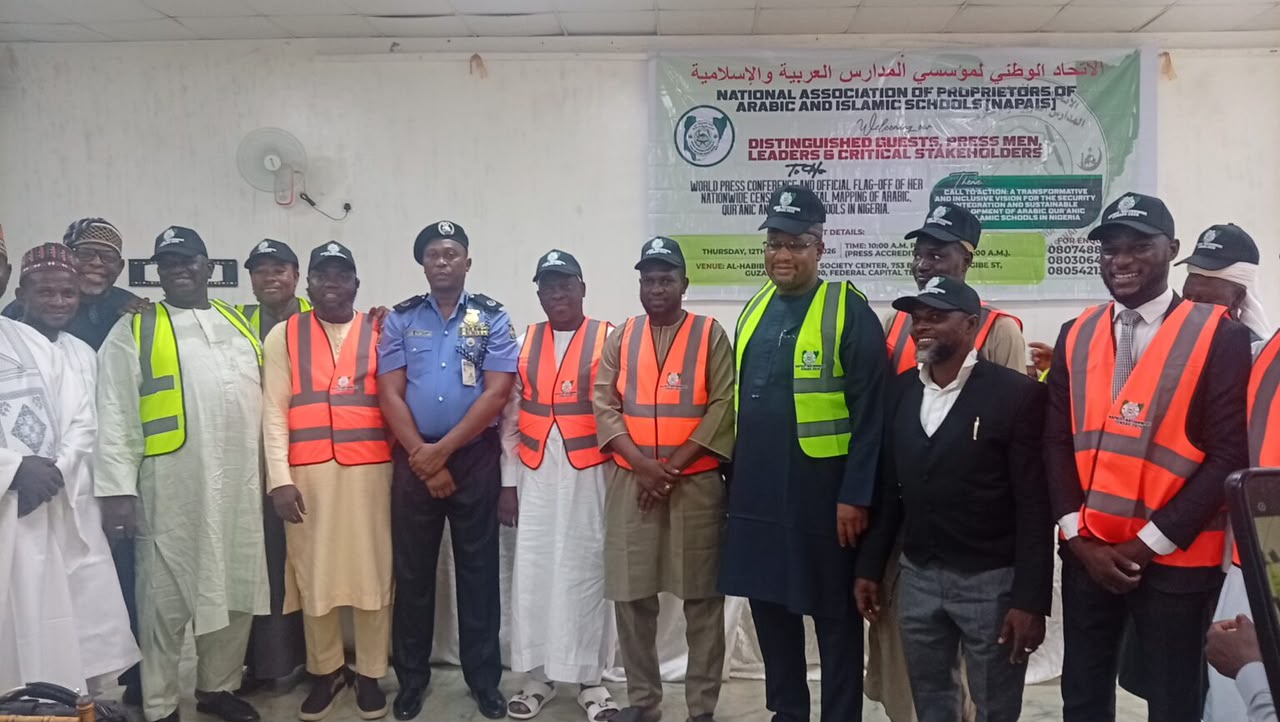
The exercise was formally launched at a world press conference at Al-Habibiyah Mosque in Abuja, attended by representatives of the Inspector-General of Police, IGP Olatunji Rilwan Disu, and the Minister of Education, Dr Maruf Tunji Alausa.
NAPAIS National President, Sheikh Muhammed Jamiu AbdulGafar, described the initiative as a major step towards repositioning Islamic education through four priorities: databasing, planning, implementation and sustainability.
Speaking under the theme, “From Darkness to Data: Building a Database for Planning, Implementation and Sustainability,” AbdulGafar said the absence of reliable records had made it difficult to establish the number, locations and needs of Arabic and Islamic schools across the country.
He argued that without credible data, the sector would continue to face difficulties in securing effective policy attention, development support and institutional recognition.
Under the proposed exercise, participating schools will receive NAPAIS identification numbers, while proprietors will be profiled using their National Identification Numbers (NINs). Schools will also be GPS-tagged and photographed, with information collected on enrolment, teaching staff, classrooms, water, sanitation and other facilities.
The association intends to use the information to develop a five-year strategic plan covering 2027 to 2031, identifying gaps and priorities across states. AbdulGafar said the exercise would also inform plans for a unified curriculum combining Qur’anic, Arabic and Islamic studies with English Language, Mathematics, digital education and vocational training.
A significant part of the association’s reform agenda concerns the Almajiri education system, which AbdulGafar said should be reformed rather than abolished. He attributed its present challenges to years of neglect, inadequate funding, parental abandonment, exploitation by some school proprietors and political interference.
He proposed a five-point restoration plan centred on registering and identifying Almajiri pupils, establishing community-supported boarding arrangements, integrating conventional and vocational subjects into the curriculum, regulating and certifying teachers, and strengthening parental responsibility.
Under the proposed arrangement, children would be linked to identifiable schools, while parents would be expected to provide their details and undertake greater responsibility for their welfare. NAPAIS also intends to discourage schools from sending pupils to beg, with AbdulGafar saying institutions that engage in the practice could lose their association membership.
The association is also proposing a cooperative scheme, a Waqf endowment fund, teacher certification and pension arrangements to improve the financial stability of Islamic schools and the welfare of their teachers.
AbdulGafar directed coordinators across Nigeria’s six geopolitical zones to complete the enumeration within 60 days, urging proprietors to make their institutions available for the exercise.
In a goodwill message, the representative of the Inspector-General of Police, ACP Yaqub Alhassan, described the initiative as a potential security intervention, saying a reliable database could help address information gaps surrounding non-formal education institutions.
He said the information could assist security agencies in identifying legitimate schools, improving intelligence gathering and responding to emergencies through location data. He also pledged the Nigeria Police Force’s institutional partnership with NAPAIS, saying the Force would participate as a co-official observer and adviser on the security component of the census methodology.
Representing the Minister of Education, Dr Balarabe Shehu Kakale, Senior Special Assistant to the minister on Almajiri and Out-of-School Children’s Education, stressed the importance of reliable educational data in policy formulation, resource allocation and efforts to address the country’s out-of-school children challenge.
Kakale called for stronger collaboration between government and non-formal education providers, particularly to ensure that Almajiri children and other vulnerable learners are included in national education planning. He also highlighted the need to incorporate conventional subjects and vocational skills into non-formal education.
AbdulGafar said the association hoped the exercise would strengthen the case for greater recognition, protection and support for Islamic schools, as well as engagement with government and international development partners, including UNESCO, UNICEF and the Islamic Development Bank.
“Being counted is being recognised. Being counted is being protected. Being counted is being funded,” he said.
He added that NAPAIS hoped to make Nigeria the first country in West Africa to establish a comprehensive and verifiable database of Islamic schools.
The event brought together NAPAIS state, zonal and local government coordinators, representatives of Islamic organisations and faith-based groups, as well as officials from government and security agencies.
SPONSORED
SPONSORED

SPONSORED

SPONSORED
