
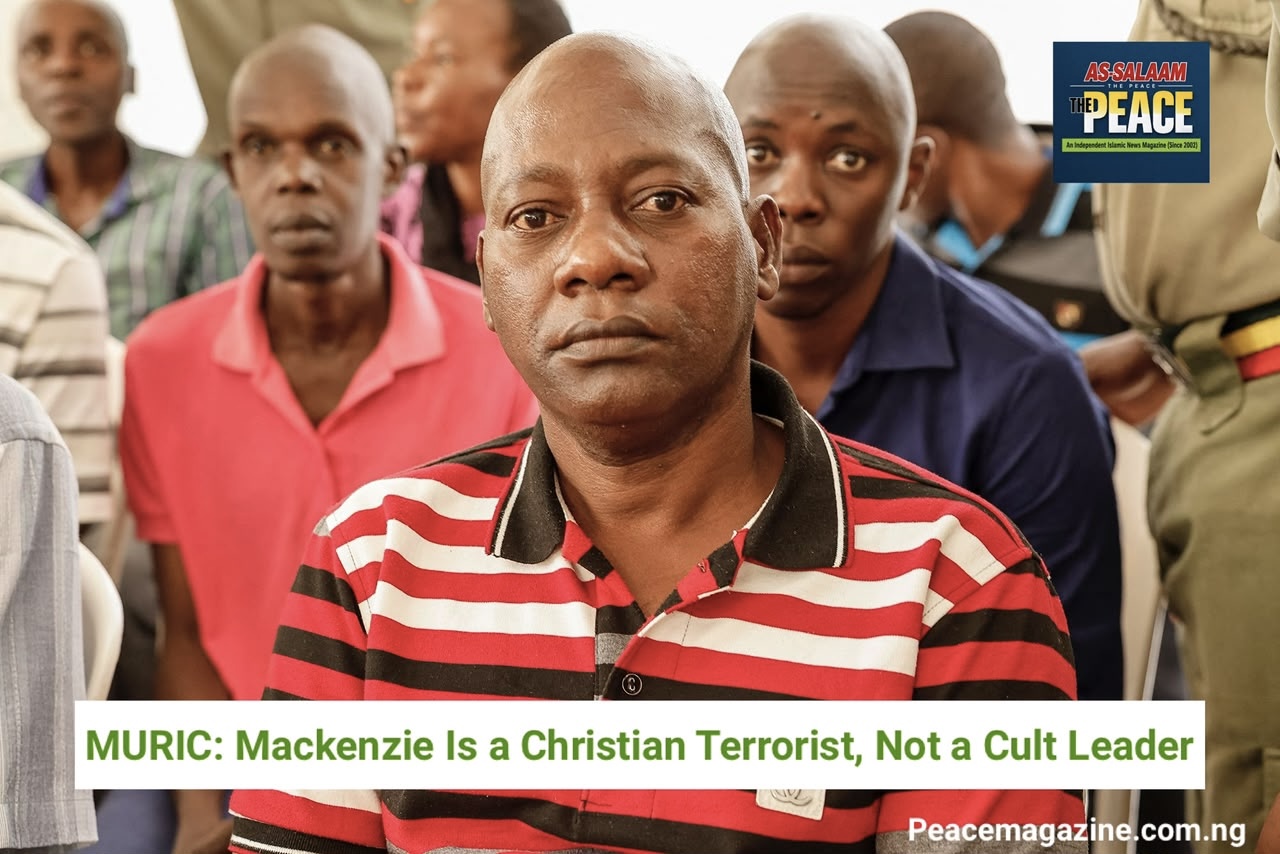
MURIC: Mackenzie Is a Christian Terrorist, Not a Cult Leader
The Muslim rights organisation says media outlets apply different standards when reporting religiously motivated violence involving Muslim and Christian perpetrators.
By Abdullahi Yusuf
The Muslim Rights Concern (MURIC) has accused international and Nigerian media organisations of applying double standards in their coverage of religiously motivated violence, describing convicted Kenyan preacher Paul Nthenge Mackenzie as a “Christian terrorist” rather than a cult leader.
MURIC’s position follows Mackenzie’s sentencing to 200 years in prison by Kenya’s High Court on November 6 for the murders of 191 people, including 190 children, in the Shakahola Forest killings.
In a statement issued on Thursday, November 12, the organisation’s Executive Director, Professor Ishaq Akintola, argued that describing the killings as a cult incident obscures the religious identity of the group led by Mackenzie and reflects what it considers a wider media bias against Muslims.
Mackenzie founded and led the Good News International Church, whose followers were among those killed in the tragedy. The Kenyan court found that he directed followers to fast to death, beginning with children, and that the instructions were enforced through violence and confinement.
MURIC said the media’s description of Mackenzie as a cult leader contrasted with what it described as the tendency to label Muslim perpetrators of comparable crimes as terrorists, extremists or fanatics.
“The critical mind must interrogate the story from a different angle,” Akintola said, arguing that the killings should be recognised as an act of Christian terrorism.
The organisation specifically criticised CNN, BBC and France 24, alongside some Nigerian media outlets, for what it called selective judgement in their reporting.
It questioned why Mackenzie’s position as a church pastor had not received the same attention in media descriptions as the religious identities of Muslim individuals accused of violence.
MURIC also cited the 1978 Jonestown massacre in Guyana, led by American preacher Jim Jones, in which more than 900 people died, and the 2019 Christchurch mosque attacks in New Zealand, in which Australian white supremacist Brenton Tarrant murdered 51 Muslim worshippers.
The organisation argued that major media outlets did not routinely describe those perpetrators as Christian terrorists, using the examples to support its allegation of unequal treatment in the language of religious violence.
Rejecting what it called the “asymmetric stereotyping” of Muslims as fanatics and terrorists, MURIC said criminal violence should be judged consistently, irrespective of the religious identity of those responsible.
“Had Mackenzie been a Muhammad or an Ibrahim, the narrative would have been different,” Akintola said.
The organisation called for what it described as a level playing field in media coverage, insisting that religious affiliation should neither shield perpetrators from scrutiny nor be used to stigmatise an entire community.
Mackenzie was sentenced to consecutive prison terms of 100 years for murder by starvation and another 100 years for direct homicide. Twenty-six co-convicts received prison terms ranging from 100 to 160 years, while two others who entered plea agreements were each sentenced to 10 years. His defence lawyer has said the sentence will be challenged.
SPONSORED
SPONSORED

SPONSORED

SPONSORED
