
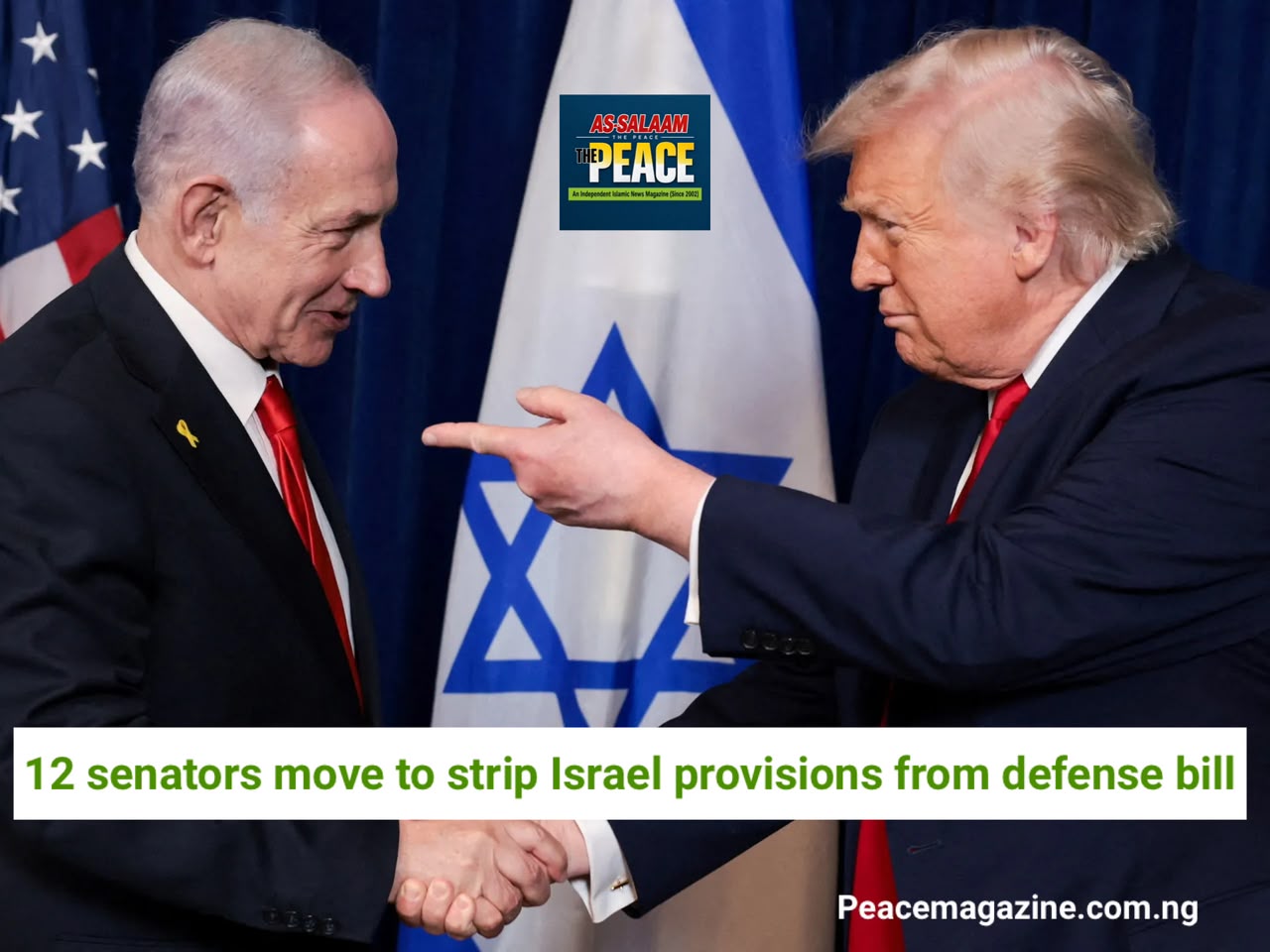
12 US Senators Challenge Plan to Deepen Military, Intelligence Ties With Israel
Led by Chris Van Hollen, the lawmakers want three provisions removed from the 2027 defence and intelligence legislation, warning they could limit Washington’s freedom to make independent security decisions.
By Abdullahi Yusuf
Twelve US senators have urged congressional leaders to remove three provisions from pending 2027 defence and intelligence legislation that would expand military technology cooperation and intelligence sharing with Israel, warning that the measures could deepen Washington’s strategic dependence on the Israeli government.
In a letter dated November 10, the lawmakers called on the leadership of both chambers of Congress to exclude the provisions from the final version of the Fiscal Year 2027 National Defense Authorization Act (NDAA) and its associated intelligence legislation.
The letter was led by Democratic Senator Chris Van Hollen and signed by 10 other Democrats and independent Senator Bernie Sanders. The other signatories were Elizabeth Warren, Patty Murray, Ron Wyden, Jeff Merkley, Brian Schatz, Ed Markey, Tammy Duckworth, Tina Smith, Peter Welch and Andy Kim.
The senators argued that the proposed measures would entrench aspects of the US-Israel defence and intelligence relationship, potentially restricting the administration’s ability to make independent national security decisions in response to changing regional circumstances and concerns about Israeli government actions in Gaza, the occupied West Bank and elsewhere in the Middle East.
“As you prepare to conference the Fiscal Year 2027 National Defense Authorization Act (NDAA), we respectfully urge you to exclude three provisions from the final bill that would further entrench concerning aspects of the U.S.-Israel defense and intelligence relationship,” the lawmakers wrote.
At the centre of their objection are Section 1217 of the Senate Armed Services Committee’s version of the legislation and Section 219 of the House-passed bill. Both provisions would establish a United States-Israel Defense Technology Cooperation Initiative to expand joint research, development, technology transfers and industrial cooperation.
The proposed initiative covers strategically sensitive areas, including artificial intelligence, quantum technology, cyberwarfare, biotechnology and autonomous weapons systems.
The senators questioned why Congress should mandate such extensive cooperation, arguing that the United States does not routinely establish comparable arrangements in these sensitive fields, even with some of its closest treaty allies.
They also maintained that the executive branch already has the authority to negotiate bilateral defence agreements without Congress imposing long-term institutional commitments through the annual defence authorisation legislation.
More significantly, the lawmakers warned that embedding Israeli technology in the US defence industrial base could create long-term dependencies and give Israel greater leverage over American military decisions.
They cited an earlier dispute involving the co-production of Iron Dome missile defence systems, arguing that the Israeli government had used its position in the arrangement to prevent the transfer of US-owned Iron Dome batteries to Ukraine.
For the senators, the episode illustrates how bilateral defence agreements could constrain Washington’s ability to redirect military resources in line with its own foreign policy priorities.
They warned that expanding such arrangements could make future changes to US policy more difficult and costly, potentially allowing the interests of a foreign government to influence decisions involving American military capabilities.
The letter also raised concerns about Israeli Prime Minister Benjamin Netanyahu’s proposal to shift the framework of US-Israel defence cooperation from traditional military assistance towards a deeper partnership.
The lawmakers argued that the transition could move parts of the relationship away from more transparent Foreign Military Financing arrangements and towards less visible defence procurement and technology-sharing programmes, reducing congressional oversight.
They further cited Netanyahu’s longstanding advocacy for confrontation with Iran, arguing that the resulting conflict had become a strategic setback for American interests. The senators warned against expanding defence commitments in ways that could further entangle Washington in regional confrontations that do not necessarily advance its national security priorities.
The third provision targeted by the lawmakers is Section 618 of the Senate Intelligence Authorization Act for fiscal year 2027. The measure would require the executive branch to expand and enhance intelligence sharing with Israel while stipulating that such cooperation should not be suspended, reduced or otherwise materially limited.
The senators argued that the provision would restrict the president’s ability to reassess intelligence cooperation when necessary to protect US national security or respond to changing political and security circumstances.
They also cited public reports that the Defence Intelligence Agency had raised the counterintelligence threat from Israel to its highest level, describing the proposed restriction on executive authority as particularly troubling.
The dispute highlights growing scrutiny within the US Congress of the strategic, political and security implications of Washington’s relationship with Israel, particularly over the extent to which military and intelligence cooperation should be subject to independent executive judgment and congressional oversight.
The lawmakers are seeking to prevent the three provisions from becoming part of the final NDAA conference report, arguing that defence and intelligence commitments should not limit the United States’ ability to determine its own national security priorities.
SPONSORED

SPONSORED

SPONSORED

SPONSORED
