
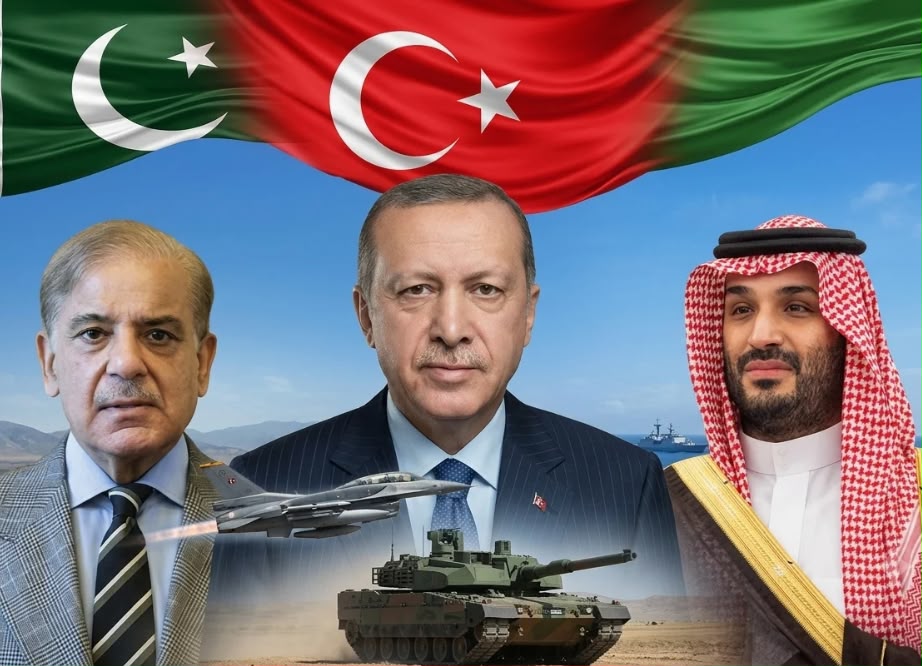
How Does Iran View the New Mecca Defence Pact Between Turkey, Pakistan and Saudi Arabia?
Iran has responded cautiously to the new defence agreement between Saudi Arabia, Turkey and Pakistan, with officials calling for greater regional self-reliance while some Iranian voices warn that the alliance could deepen security tensions with Tehran.
By Abdullahi Yusuf
Iran has reacted cautiously to the Mecca Joint Defence Agreement signed by Saudi Arabia, Turkey and Pakistan, as officials and analysts in Tehran debate whether the pact represents an opportunity for greater cooperation among Muslim countries or a new security arrangement that could eventually be directed against Iran.
The agreement, signed in Makkah on Friday, establishes a mutual-defence framework under which an armed attack against any one of the three signatories is to be treated as an attack against all. Turkish Foreign Minister Hakan Fidan has described the arrangement as technically comparable to NATO’s collective-defence principle, while stressing that it is not directed against Iran or any other country.
The pact comes amid heightened regional tensions involving Iran, Saudi Arabia and Iranian-aligned groups, and at a time when Riyadh has been seeking additional security arrangements following attacks and uncertainty over the reliability of existing security partnerships.
The first official Iranian response came from Ibrahim Rezaei, a member of the Iranian parliament’s National Security Committee, who criticised Riyadh’s reliance on external security agreements.
In a post on X, Rezaei argued that agreements with Turkey and Pakistan would not provide Saudi Arabia with lasting security, saying Riyadh should instead reconsider its regional policies.
More senior Iranian officials adopted a more diplomatic tone.
Iranian Foreign Minister Abbas Araghchi did not directly name the Mecca agreement in a message posted on X, but called on neighbouring countries to pursue greater self-reliance and what he described as “true brotherhood” in the region.
At the same time, Araghchi signalled that Iran did not consider new regional defence arrangements sufficient to deter it, saying Iranian armed forces were capable of confronting even the world’s most advanced military powers.
Ali Akbar Velayati, adviser to Iran’s Supreme Leader on international affairs, similarly argued that regional countries could establish security through cooperation among themselves. He also called for the withdrawal of foreign forces, which he described as a major source of instability in the region.
Not all Iranian voices opposed the agreement.
Abdullah Ramezanzadeh, a former spokesman for the reformist government of Mohammad Khatami, argued that Iran should consider joining the pact, particularly because its signatories have said that the agreement is not directed against any specific country.
Different interests behind the pact
Iranian analyst Salah al-Din Khodro told The New Arab that the choice of Makkah as the venue carried significant symbolism, but cautioned that the extent of the commitments created by the agreement and the seriousness with which its members would implement them remained unclear.
He said the pact brought together three major Muslim powers with different strategic interests.
For Saudi Arabia, Khodro identified security concerns linked to Iran-allied Houthi forces and doubts over the effectiveness of the existing US security umbrella as major considerations.
Turkey, he said, viewed the agreement through the broader question of regional balance, including concerns about Israel’s expanding regional role and the possibility of Ankara being marginalised in emerging Middle Eastern security arrangements.
Pakistan, meanwhile, had its own strategic calculations, including its rivalry with India and concerns about growing cooperation between India, Israel and some Arab states. Khodro also pointed to Turkish and Pakistani interests in Saudi investment.
The agreement has been described by its signatories as open to other countries. Egypt, which has so far remained outside the arrangement, could add significant Arab and military weight if it eventually joined, Khodro said.
Iran or Israel?
Another Iranian analyst, Hamid Asfi, offered a different assessment, arguing that the agreement should primarily be understood through Saudi Arabia’s security concerns.
According to Asfi, attacks linked to the Houthis, threats to Saudi shipping and oil infrastructure, and concerns about Iran-linked groups in Iraq have encouraged Riyadh to seek additional security guarantees.
He argued that the immediate purpose of the agreement was less about confronting Israel than establishing a mechanism for dealing with threats from Iran and groups aligned with Tehran.
Riyadh, he said, is seeking to reduce the attacks it faces while increasing the potential cost of any future assault.
Asfi also suggested that other Arab states, including Bahrain and Jordan, could become interested in similar arrangements or eventual participation.
The differing Iranian interpretations underline the uncertainty surrounding the strategic direction of the new pact.
For some in Tehran, the agreement could become part of a wider regional security architecture that reduces dependence on outside powers. For others, its combination of Saudi Arabia’s security concerns, Turkey’s regional ambitions and Pakistan’s military capabilities could create a new balance that places greater pressure on Iran.
The agreement also comes as the three signatories have sought to emphasise that their cooperation is defensive rather than directed against a particular state. Turkish officials have said the pact is intended to strengthen mutual security and deterrence, while the agreement’s collective-defence provision gives it a significance beyond a conventional bilateral security partnership.
For Iran, the immediate response has therefore been a mixture of calls for Muslim solidarity, warnings against dependence on foreign security guarantees and efforts to signal that the new arrangement will not alter Tehran’s military calculations.
The longer-term question is whether the Mecca pact develops into a broader regional security framework or remains primarily a mechanism for the three founding states to address their separate strategic concerns.
Its significance for Iran may ultimately depend not only on who joins the alliance, but on how its members define the threats they intend to confront and how far their new security partnership reshapes the balance of power across the region.
SPONSORED

SPONSORED

SONSORED
