
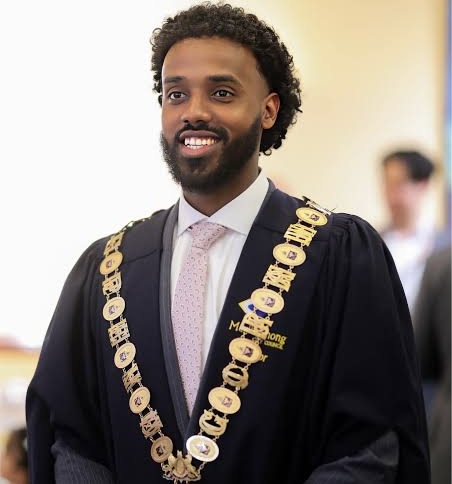
From Sudanese Refugee Child to Australia’s Youngest Muslim Mayor
Born in Sudan and raised by a refugee mother in Melbourne, Mohamed Semra overcame poverty, racism and a severe speech impediment to become one of Australia’s youngest political leaders and its first mayor of sub-Saharan African heritage.
By Abdullahi Yusuf
When Mohamed Semra was elected mayor of the City of Maribyrnong in Melbourne last year, it was hailed by many as a defining moment for multicultural Australia.
At just 27 years old, the son of Sudanese refugees became not only one of the country’s youngest serving mayors but also the first Australian of sub-Saharan African heritage to hold a mayoral office, marking a milestone that resonated far beyond local government.
Yet behind the symbolism lies a story shaped by displacement, hardship and an enduring belief that leadership should be accessible to everyone, regardless of race, religion or background.
For Semra, the foundations of public service were laid long before politics entered the picture.
One of his earliest formative memories dates back to a childhood visit to Sudan, the country his mother had fled years earlier in search of safety. Raised in Melbourne, he found himself suddenly immersed in a vastly different reality.
At the age of ten, an uncle tasked him with transporting water across a remote desert landscape. Sitting atop a donkey loaded with barrels, he was instructed to travel alone to a distant well and return without abandoning his responsibility.
On the journey back, the donkey veered towards a thorn-covered tree. Faced with the choice of jumping to safety or remaining on the animal to protect the precious water supply, Semra chose to stay.
“I had a lot of scratches on my face, but the water made it home,” he later recalled.
The lesson, he says, stayed with him: service sometimes demands personal sacrifice. Today, he often cites that experience as a metaphor for leadership.
Born in Sudan, Semra arrived in Australia as a young child after his mother, Samira, fled political instability with her six children.
His father, a tribal elder in eastern Sudan, had been imprisoned during a government crackdown targeting Indigenous communities. Although he was eventually released, he remained in Sudan while the family began rebuilding their lives in Australia.
Relatives say signs of leadership emerged early.
While other children spent their free time watching cartoons, Semra was drawn to current affairs programmes, documentaries and history. His older sister, Engi, recalls a child who consistently spoke about changing the world around him.
But his ambitions faced a significant obstacle. For much of his early life, Semra struggled with a severe stutter that made communication difficult and often left him unable to participate fully in activities he enjoyed. The frustration frequently affected his confidence and sometimes manifested in disruptive behaviour at school.
A breakthrough came when an English teacher recognised his potential and encouraged him to enrol in an intensive speech therapy programme at La Trobe University.
The intervention transformed his life. “That gave me back my voice,” Semra said.
What followed was a dramatic reversal. The student who once struggled to speak began participating in debating competitions, developing the communication skills that would later become central to his political career.
His determination was tested again during secondary school. When he announced plans to contest for school captain, a fellow student dismissed the idea, telling him leadership was “a white thing”.
The comment left a lasting impression. “When did leadership become a white thing?” Semra later reflected.
Rather than retreat, he pressed ahead with his campaign and won. Years later, another incident would thrust him into the international spotlight.
At the age of fifteen, Semra and several friends visited an Apple Store to view a newly released iPhone. According to Semra, the group quickly became the focus of intense scrutiny from security staff.
Suspecting they were being racially profiled, the teenagers recorded the interaction on their phones.
The footage captured employees expressing concerns that the group might steal merchandise despite no evidence of wrongdoing.
When the video circulated online, it triggered widespread debate about racial profiling and discrimination, drawing international media attention.
The controversy eventually prompted an apology from Tim Cook, while Apple announced additional staff training focused on inclusion and customer engagement.
For Semra, the episode reinforced the importance of challenging injustice. “If we let this go, it’s going to happen to so many other people that have done nothing wrong,” he later said.
Today, as mayor of Maribyrnong, Semra occupies a position that carries both influence and scrutiny.
His election has been celebrated by many migrant communities as evidence of Australia’s changing social landscape. At the same time, he says he has faced racist abuse online, much of it linked to his identity as a Black Muslim public official.
Rather than responding with anger, he says he views the hostility as part of the challenge of leadership.
“There are people out there that are not comfortable with a Black man, a Muslim, in the position I’m in today,” he said. “And it’s my job to make them more comfortable.”
For Semra, however, public office is not primarily about breaking barriers. Having spent two decades living in Maribyrnong, he describes his motivation as a desire to serve the community that offered his family a chance to rebuild after fleeing conflict.
As one of Australia’s most visible young political leaders, he continues to navigate the opportunities and pressures that come with being a pioneer.
SPONSORED
SPONSORED

SPONSORED

SPONSORED
