
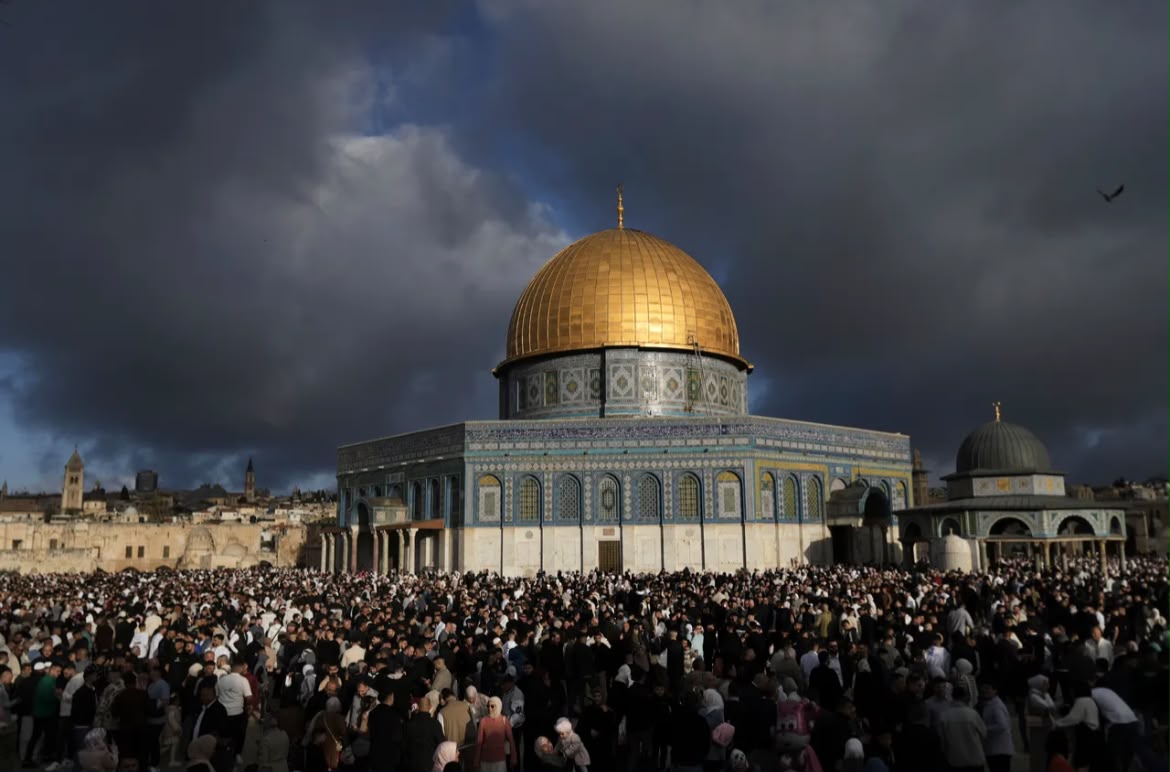
Türkiye Accuses Israel of Violating Al-Aqsa Status Quo
Foreign ministers from Türkiye, Saudi Arabia, Qatar, Egypt, Jordan, Pakistan, Indonesia and the UAE accuse Israel of violating the historic status of Jerusalem’s holy sites and call for an immediate halt to what they describe as provocative actions at Al-Aqsa Mosque.
By Abdullahi Yusuf
The foreign ministers of eight Muslim-majority countries have jointly condemned recent Israeli actions at the Al-Aqsa Mosque compound, warning that continued incursions and provocations risk deepening regional instability and undermining international efforts towards peace.
In a coordinated statement, the foreign ministers of Türkiye, United Arab Emirates, Indonesia, Qatar, Egypt, Pakistan, Saudi Arabia and Jordan condemned what they described as repeated raids on the Al-Aqsa Mosque compound by extremist Israeli settlers under the protection of Israeli security forces.
The ministers also criticised the raising of Israeli flags within the mosque’s courtyards, describing the act as a provocation that infringes upon the longstanding arrangements governing one of Islam’s holiest sites.
According to the joint statement, the actions constitute “a clear violation of international law, relevant United Nations resolutions, and the historical and legal status of the holy sites in occupied East Jerusalem.”
The ministers further accused Israel, as the occupying power, of pursuing policies aimed at altering the historical, legal and demographic character of East Jerusalem, while undermining the sanctity and established status of both Muslim and Christian holy sites in the city.
At the centre of the dispute is the sensitive status of the Al-Aqsa Mosque compound, known to Muslims as Al-Haram Al-Sharif and revered as Islam’s third holiest site. The location also holds profound religious significance for Jews, who refer to the area as the Temple Mount.
The eight countries reiterated their rejection of any attempts to alter the existing arrangements governing Jerusalem’s holy places, insisting that the historical and legal status quo must be preserved.
They also reaffirmed support for Jordan’s historic custodianship over Islamic holy sites in Jerusalem, a role recognised in multiple regional agreements and long regarded as central to the administration of the Al-Aqsa compound.
The ministers stressed that the entire 144-dunum Al-Aqsa Mosque complex remains an exclusively Muslim place of worship and maintained that authority over its administration rests solely with the Jerusalem Awqaf and Al-Aqsa Mosque Affairs Department, which operates under Jordan’s Ministry of Awqaf and Islamic Affairs.
In their statement, the foreign ministers held Israeli authorities directly responsible for the recent developments, warning that repeated actions at the site risk inflaming tensions, encouraging extremism and complicating efforts to achieve a peaceful resolution to the Israeli-Palestinian conflict.
They called for the immediate cessation of what they termed “illegal and provocative practices” and urged full respect for the historical and legal arrangements governing the mosque compound.
Beyond the immediate dispute over Al-Aqsa, the ministers used the statement to reaffirm their broader support for Palestinian national aspirations.
They expressed solidarity with the Palestinian people and reiterated backing for the establishment of an independent Palestinian state based on the pre-1967 borders, with East Jerusalem serving as its capital.
The ministers also renewed support for a negotiated two-state solution, describing it as the most viable framework for achieving a just, lasting and comprehensive peace. They said any future settlement should be grounded in international law, relevant United Nations resolutions and the principles of the Arab Peace Initiative.
The joint intervention reflects growing concern among regional powers that tensions surrounding Jerusalem’s holy sites could further destabilise an already volatile Middle East, where the status of Al-Aqsa remains one of the most sensitive and politically charged issues in the Israeli-Palestinian conflict.
SPONSORED
SPONSORED

SPONSORED

SPONSORED
