
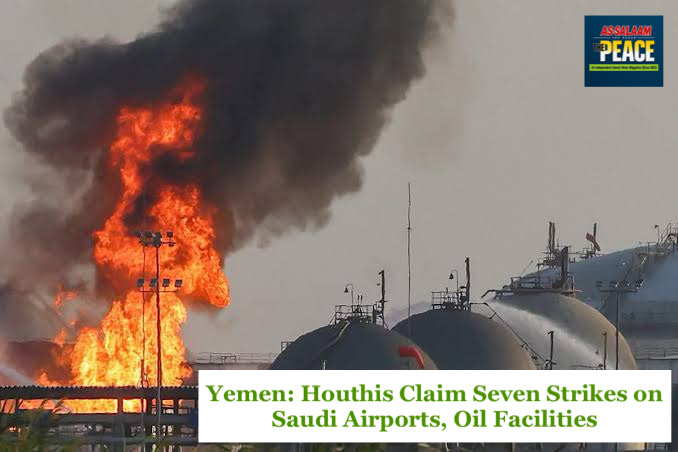
Yemen: Houthis Claim Seven Strikes on Saudi Airports, Oil Facilities
Yemeni group says missiles and drones targeted Riyadh airport, Aramco facilities and an oil refinery as Saudi Arabia reports intercepting missiles
By Abdullahi Yusuf
Yemen’s Houthi movement has claimed seven military operations against Saudi Arabia, saying it targeted major airports, oil facilities and military installations with ballistic missiles and drones as fighting between the two sides intensifies.
The group’s military spokesman, Brigadier General Yahya Saree, said on Saturday that the operations targeted King Khalid International Airport in Riyadh, an Aramco facility in Yanbu, the Rabigh oil refinery, crude oil pumping stations and the East-West crude oil pipeline. He also named King Fahd International Airport in Dammam, Najran Airport and Khamis Mushait Air Base as targets.
The claims have not been independently verified. Saudi authorities did not comment directly on the Houthi statement, although the Saudi-led coalition reported intercepting two ballistic missiles launched towards Yanbu and Taif, according to Reuters. It was not immediately clear whether any of the reported attacks had struck their targets or had been intercepted.
Saree said the first operation targeted King Khalid International Airport in two phases, while the second targeted Aramco facilities in Yanbu and the third the Rabigh refinery. He said the fourth operation targeted crude oil pumping stations and the pipeline linking oil-producing areas in eastern Saudi Arabia to the Red Sea coast.
The remaining operations, he said, targeted King Fahd International Airport in Dammam, Najran Airport and Khamis Mushait Air Base. The group claimed the operations had achieved their objectives and said the attack on King Fahd International Airport disrupted air traffic. That claim has not been independently confirmed.
Saree described the operations as retaliation for what he called Saudi aggression against Yemen. He alleged that Saudi forces had carried out 100 airstrikes in the preceding 24 hours, targeting civilian infrastructure in Sanaa and other provinces and leaving dozens dead or wounded.
He put the cumulative number of airstrikes and missile attacks against Yemen since the latest escalation began at 3,123. The figures and allegations were issued by the Houthi side and have not been independently verified.
The spokesman said the group would continue operations deep inside Saudi territory under what he called a policy of “blockade for a blockade” and “escalation for an escalation” until attacks on Yemen cease and restrictions on the country are lifted.
The Houthi announcement came amid reports of further missile activity over Saudi Arabia. Saudi Civil Defence said two ballistic missiles launched towards the Makkah and Madinah regions had been intercepted on Saturday, with debris falling in Wadi Al-Mughammas in Makkah, Al-Nuzha in Jeddah, Wadi Jalil in Taif and Masturah in Rabigh. The statement did not report casualties or provide further details of damage.
In a separate development, Yemen’s internationally recognised government said the Houthis had fired three ballistic missiles at coast guard sites in the southern port city of Aden. Its Interior Ministry said two missiles struck a coast guard headquarters and a third hit a coast guard building in the Tawahi district.
Saree gave a different account, saying Houthi forces had targeted Saudi-backed military gatherings at Al-Nasr military camp and a naval base in Aden. He alleged that the facilities were being used to mobilise and equip forces under the supervision of Saudi officers, including Brigadier General Badr Salah Al-Harbi, for operations against Yemen and Houthi forces. The Saudi-led coalition had not immediately commented on that claim.
Saree also urged Yemenis not to respond to Saudi recruitment efforts, accusing Riyadh of using financial incentives to draw them into fighting fellow Yemenis.
Saudi Arabia intervened in Yemen’s civil war in 2015 at the head of a coalition supporting the internationally recognised government, after the Houthis seized the capital, Sanaa, in 2014. The conflict has since involved repeated cross-border attacks, shifting front lines and efforts to secure a lasting ceasefire.
The latest escalation has raised concerns over security around Saudi airports and energy infrastructure, as well as the wider region. Yemen’s Red Sea coast lies near the Bab al-Mandeb Strait, a strategic maritime passage linking the Red Sea to the Gulf of Aden and a vital route for international shipping.
SPONSORED

SPONSORED

SONSORED
