
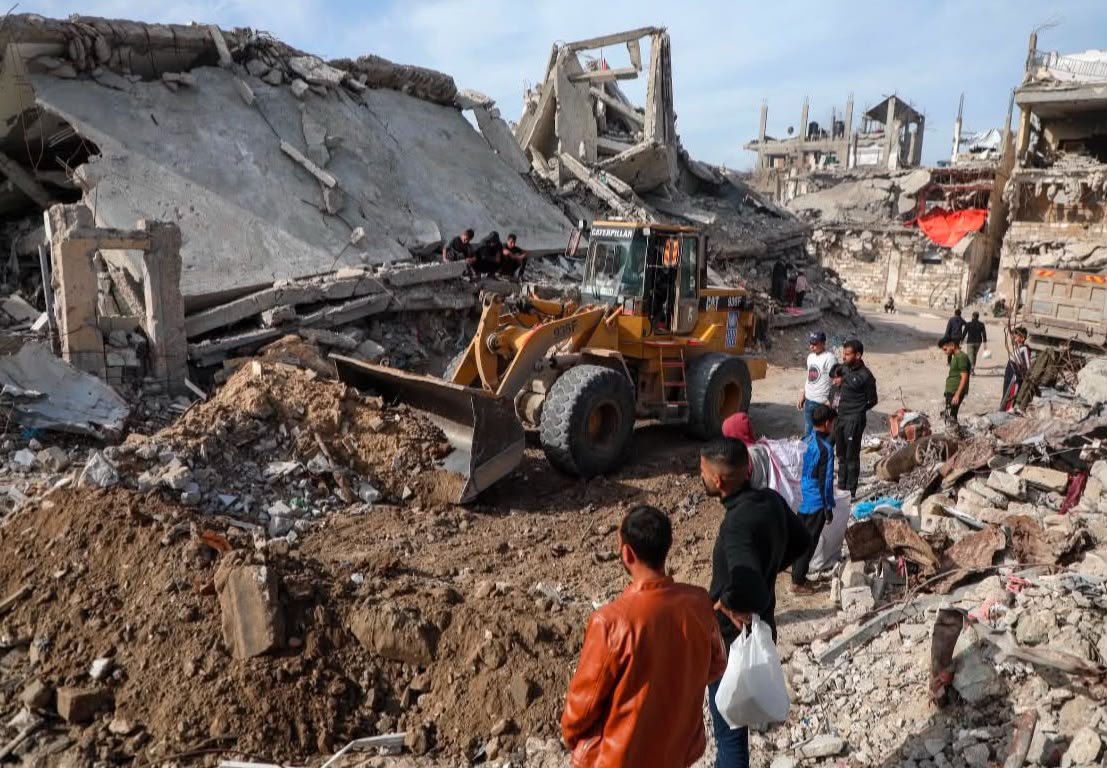
Before Gaza’s Rubble Is Cleared, the Dead and the Evidence Must Be Found
UN special rapporteur Francesca Albanese warns that crushing and removing debris could hinder the recovery of thousands of Palestinians and destroy evidence needed for investigations into alleged international crimes.
By Abdullahi Yusuf
Gaza’s rubble is becoming the next battleground in a different kind of struggle: between the urgent need to rebuild a devastated territory and the demand to preserve evidence of what happened beneath its ruins.
Francesca Albanese, the UN special rapporteur on the situation of human rights in the occupied Palestinian territory, warned on Monday that large-scale efforts to remove, crush or relocate rubble in areas of Gaza under Israeli military control could destroy evidence relevant to investigations into alleged international crimes and make it harder to recover and identify human remains.
Her warning comes as Gaza faces a debris-clearance operation on an extraordinary scale. A UN Development Programme estimate put the amount of rubble generated by the destruction of buildings at about 57.5 million tons, while a joint UN-EU-World Bank assessment has placed Gaza’s recovery and reconstruction needs at $71.4 billion over the next decade. More than 371,000 housing units have been damaged or destroyed.
But Albanese’s argument is that the ruins cannot be treated simply as waste.
Beneath the concrete and twisted remains of buildings may be the bodies of Palestinians who have never been recovered. Palestinian authorities have estimated that more than 10,000 people remain buried beneath the rubble.
The debris may also contain physical evidence that could become important to future investigations into alleged violations of international humanitarian and criminal law, including allegations of genocide.
Albanese said human remains must first be recovered and identified, while potential forensic evidence should be systematically documented and preserved before debris is permanently removed or crushed. She called for international criminal investigators to participate in overseeing the collection of evidence.
“Destroying evidence of atrocity crimes is illegal,” she said.
The warning comes against the backdrop of a reconstruction challenge unlike anything Gaza has faced in recent decades.
Clearing the ruins is not optional. Roads need to be reopened. Water and electricity networks have to be restored. Homes, schools and public facilities need to be rebuilt. Humanitarian operations cannot function normally while vast areas remain buried beneath collapsed structures.
UNDP said it had already cleared nearly 630,000 tons of debris and crushed more than 231,000 tons of concrete for reuse in roads, shelters and public facilities.
Yet the clearance itself carries dangers.
The rubble can contain unexploded ordnance, asbestos and other hazardous material, as well as human remains and material that could have evidentiary value. A new EU-UNDP initiative launched in July has therefore combined debris removal with support for Palestinian forensic capacity and the dignified recovery and identification of human remains.
For Albanese, that distinction is critical.
She said any future clearance operation should follow a plan designed by Palestinians and carried out with the involvement of actors trusted by the affected population.
The issue extends beyond the machinery clearing the ruins.
Albanese warned governments, contractors and private companies involved in removing Gaza’s debris that they could face legal consequences if they knowingly participate in the destruction of evidence of international crimes.
That puts reconstruction and accountability on a potential collision course.
The more rapidly Gaza’s ruins are cleared, the sooner communities can begin rebuilding. But the same process, if carried out without adequate forensic safeguards, could permanently remove the physical record that investigators may later need.
Gaza’s destruction is already at the centre of international legal proceedings and investigations concerning the conduct of Israeli forces and Palestinian armed groups. Albanese has previously argued in UN reporting that the scale of destruction and the treatment of Palestinians warrant scrutiny under international law.
The April 2026 UN-EU-World Bank assessment described the destruction of housing and infrastructure as being on an historic scale, recording more than 371,000 damaged or destroyed housing units and estimating more than $71 billion in reconstruction and recovery needs.
Now the question is what happens to the ruins before that reconstruction begins in earnest.
SPONSORED

SPONSORED

SONSORED
