
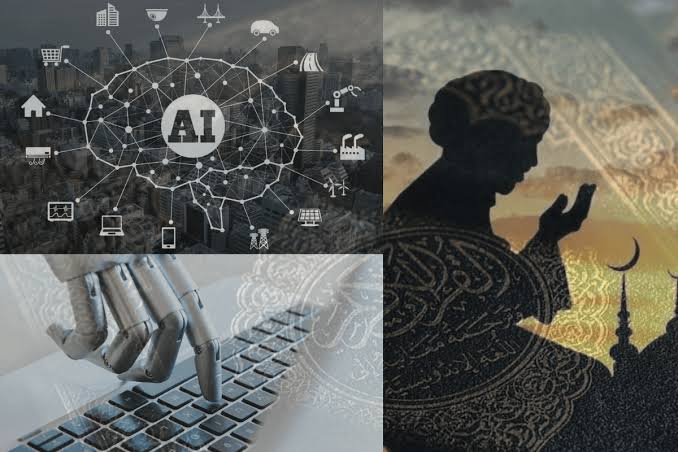
Artificial Intelligence: A Tool, Not a Religion
By Sheikh Khalid Yasin
In the Name of Allah, the Most Compassionate, the Most Merciful
There is a growing discussion within the Muslim community about Artificial Intelligence (AI). Some embrace it with excitement. Others approach it with hesitation. Still others reject it altogether, believing it to be a conspiracy or something inherently opposed to Islam.
As Muslims, our first responsibility is not to react emotionally, but to respond with knowledge, wisdom, and evidence.
Throughout history, every major technological advancement has been met with fear by some people.
The printing press was opposed. The telephone was suspected. Radio was condemned.
Television was denounced.
The internet was feared. Smartphones were criticized. Artificial Intelligence has become the latest subject of suspicion.
Yet history repeatedly shows that technology itself is neither righteous nor evil. It is a tool.
The moral value of any tool depends upon the intention and conduct of the one who uses it.
A knife may prepare food or commit murder. Electricity may illuminate a hospital or power a weapon. The technology is not moral or immoral; the human being is accountable for how it is used.
Allah says: “Read in the Name of your Lord Who created.”
(Qur’an 96:1)
The very first revelation to humanity through Prophet Muhammad (peace be upon him) was not “fear,” “withdraw,” or “avoid.” It was “Read.” It was a command to seek knowledge.
Allah also says: “Say, ‘Are those who know equal to those who do not know?’” (Qur’an 39:9)
And He says: “Allah will raise those who believe among you and those who have been given knowledge by many degrees.”
(Qur’an 58:11)
Knowledge is not the enemy of faith. Ignorance is.
Allah reminds us: “He has subjected to you whatever is in the heavens and whatever is on the earth, all from Him. Surely in that are signs for people who reflect.” (Qur’an 45:13)
This verse establishes an important principle: the resources, the discoveries, and laws of creation exist for humanity to understand, benefit from, and use responsibly, not to fear without evidence.
The Messenger of Allah (pbuh) taught us: “The strong believer is better and more beloved to Allah than the weak believer, though there is good in both.”
(Sahih Muslim)
Strength includes spiritual strength, intellectual strength, economic strength, scientific strength, and technological competence.
He also said: “Allah loves that when one of you performs a task, he perfects it.”
(Reported by al-Bayhaqi)
Excellence (ihsān) requires us to use the best lawful means available to improve our work and serve humanity.
The Prophet (pbuh) even instructed the believers: “You are more knowledgeable about the affairs of your worldly life.”
(Sahih Muslim)
This profound statement distinguishes between divine guidance in matters of worship and morality, and human expertise in agriculture, medicine, commerce, engineering, and technology.
Islam encourages Muslims to become leaders not spectators in the beneficial sciences.
Artificial Intelligence is already transforming medicine, education, engineering, transportation, agriculture, manufacturing, finance, communications, disaster response, scientific research, language translation, accessibility for people with disabilities, and countless other fields.
The question is not whether
AI exists.
The question is whether Muslims will help shape it ethically, or abandon that responsibility to others.
If righteous people withdraw from every new technology because some people misuse it, then only the irresponsible will remain to develop and control the future.
Islam has never taught retreat from beneficial knowledge. Rather, it teaches responsibility.
Yes, AI can be abused. So can wealth. So can political power.
So can speech. So can social media.
Islam does not prohibit these because they can be abused. Instead, Islam establishes moral principles that govern their proper use.
As believers in Allah’s Divine Decree (Qadar), we also recognize that nothing comes into existence outside His Knowledge and Permission.
This does not mean that everything humanity creates is automatically good, but it does mean that believers should respond to new realities with wisdom, discernment, and moral leadership not fear, rumor, or conspiracy theories without evidence.
Our predecessors did not become the world’s leading civilization by rejecting mathematics, astronomy, medicine, navigation, architecture, or engineering.
They embraced knowledge because they understood that discovering the laws of Allah’s creation is itself a form of appreciating His signs.
Today, Artificial Intelligence presents another opportunity.
Will Muslims become ethical scientific innovators?
Will we use AI to educate children, improve healthcare, alleviate poverty, preserve knowledge, strengthen families, and spread beneficial guidance?
Or will we stand on the sidelines while others determine the future?
The Qur’an repeatedly calls believers to reflect, observe, think, travel, learn, and understand. It never glorifies ignorance.
Our responsibility is neither blind acceptance nor blind rejection.
Our responsibility is informed judgment.
Artificial Intelligence is not our religion. It is not our guide. It is not our Lord. It is a tool.
Like every tool, it must remain under the guidance of revelation, ethics, justice, and accountability.
Let us therefore approach this new era with confidence instead of fear, with knowledge instead of rumor, with leadership instead of retreat, remembering the words of Allah: “…Race with one another in good works.”
(Qur’an 2:148)
May Allah grant us beneficial knowledge, righteous wisdom, and the courage to use every lawful means to serve humanity and to fulfill our responsibility as witnesses to truth and mercy.
SPONSORED

SPONSORED

SONSORED
