
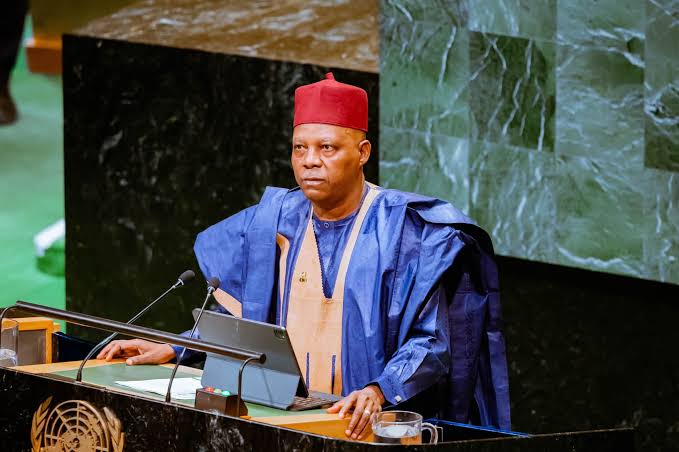
UNGA81: Nigeria Omits Palestine From National Statement After 2024, 2025 References
Tinubu’s address, delivered by Shettima, focuses on terrorism, Sahel insecurity and UN reform after Nigeria backed Palestinian independence and a two-state solution in its 2024 and 2025 statements.
By Abdullahi Yusuf
President Bola Ahmed Tinubu has told the United Nations that the global power structure established in 1945 can no longer define international decision-making in 2026, demanding at least two permanent Security Council seats for Africa with full membership rights, including veto power for as long as the veto exists.
Tinubu made the demand in his national statement to the 81st United Nations General Assembly in New York on Thursday, delivered on his behalf by Vice President Kashim Shettima. The address also called for five non-permanent seats for Africa and a stronger international response to terrorism, organised crime, cyberattacks, illicit finance and conflicts.
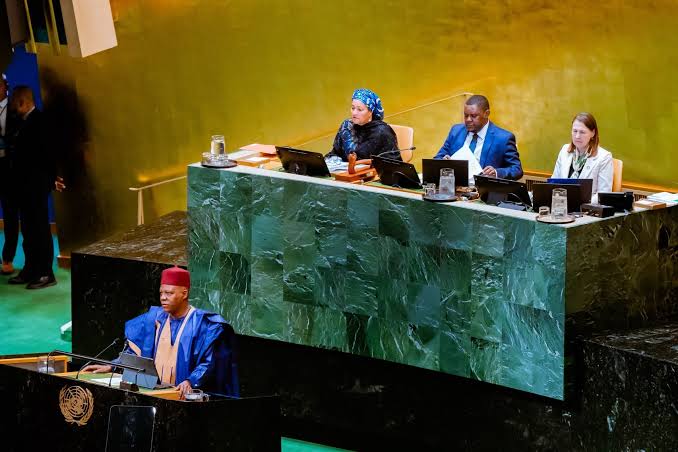
“The reform of this institution must begin with the reconstitution of the Security Council, for the world of 2026 cannot remain captive to the distribution of power in 1945,” the President said.
“Africa cannot continue to fill the Council’s agenda while remaining absent from its permanent membership,” he added, arguing that the authority to speak for humanity carries an obligation to represent it.
Nigeria said its demand was consistent with the Ezulwini Consensus and Sirte Declaration, the continent’s common position on Security Council reform. The country called for at least two permanent African seats with all the rights and responsibilities of permanent membership, including the veto for as long as it remains in existence, alongside five non-permanent seats.
Tinubu also pointed to Nigeria’s record in international peace and security, citing its involvement in peacekeeping and regional efforts through the Economic Community of West African States, the African Union and partnerships in the Gulf of Guinea.
On security, the President warned that no country could fully protect itself from threats sustained beyond its borders, identifying terrorism, organised crime, cyberattacks and illicit finance as interconnected dangers that exploit gaps between national responses.
“No nation, however formidable its defences, can secure itself completely against dangers sustained beyond its borders,” he said.
Nigeria’s prolonged fight against Boko Haram, ISWAP and other armed groups, he said, had shown that military victories alone could not establish lasting peace.
The President said lasting security required education, economic opportunity, accountable governance and communities whose rights and dignity were protected, adding that development could not take root where violence repeatedly destroyed livelihoods.
He called for stronger international cooperation in intelligence sharing, institutional capacity building, disrupting the financing of violence and preventing weapons from crossing national borders.
The address also highlighted insecurity in the Sahel, with Nigeria warning that instability in one country could spread across borders through displacement, disrupted trade and weakened democratic governance.
“As a founding member of ECOWAS, Nigeria upholds regional solidarity and African leadership in resolving these challenges, reinforced by principled international partnerships,” Tinubu said.
He also called for urgent diplomacy to address conflicts, including in Sudan and other war-torn countries, while urging greater protection for civilians and respect for international humanitarian and human rights law.
Beyond security, Nigeria’s 24-point statement addressed development financing, climate action, artificial intelligence, the African Continental Free Trade Area and reforms to the international financial system.
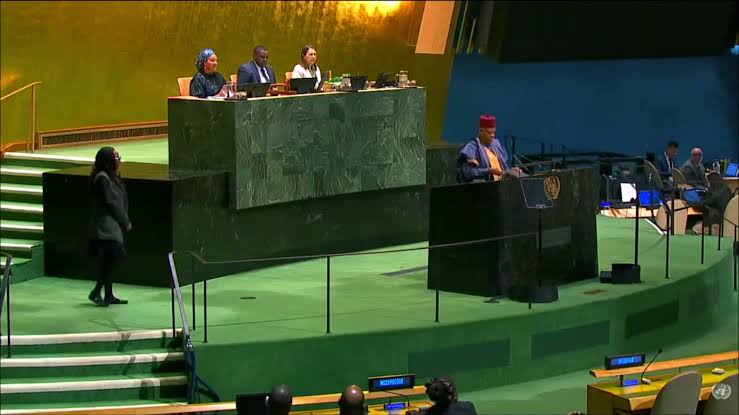
The President argued that AfCFTA could strengthen regional value chains, expand intra-African trade, promote industrialisation and attract investment, while calling for Africa to move from exporting raw materials towards greater value addition, manufacturing, technological innovation and knowledge-driven growth.
The statement did not contain a direct reference to Palestine, Gaza, Israel or the Israeli-Palestinian conflict.
That marks a departure from the Nigerian statement delivered by Shettima at the 79th UN General Assembly in 2024, which explicitly said that Palestinians deserved independence and reaffirmed Nigeria’s support for a two-state solution. Nigeria’s 2025 UNGA statement, also delivered by Shettima on Tinubu’s behalf, referred to violence against civilians in Gaza and again backed a two-state solution, according to UN official documents.
The 2026 statement focused its security discussion on terrorism, transnational crime, the Sahel, international conflicts and reform of the global institutions responsible for addressing them.
Tinubu concluded by reaffirming Nigeria’s commitment to a reformed and inclusive United Nations, saying the organisation remained indispensable to building a peaceful, just and sustainable world.
SPONSORED

SPONSORED

SONSORED
