

Total lunar eclipse – First major astronomical event of March to occur during Ramadan
The wait is nearly over! In just one week, skywatchers across North America will witness a spectacular total lunar eclipse, also known as a Blood Moon.
By Abdullahi Yusuf
A rare astronomical event is set to occur during Ramadan, with a total lunar eclipse to occur during the middle of the holy month – the first of its kind this year.
This event will be seen in the sky across most of the Western Hemisphere. The total lunar eclipse will be not visible in Saudi Arabia, but it will be seen in its partial form in the countries of the Maghreb, like Morocco, Algeria, Tunisia, Libya, Mauritania and other countries.
This will be the first total lunar eclipse since November 2022 and the first of three sets to occur between 2025 and 2026. With just one week to go, now is the perfect time to prepare to catch a good view of the ‘Blood Moon’.
During a total lunar eclipse, Earth moves directly between the sun and the moon, blocking sunlight and casting a shadow over the lunar surface. As this happens, the moon takes on a reddish hue, earning it the name “Blood Moon.” This effect occurs because Earth’s atmosphere scatters shorter wavelengths of sunlight while allowing longer wavelengths — red and orange light — to bend into Earth’s shadow and illuminate the moon. It’s the same phenomenon that gives sunrises and sunsets their rich colours.
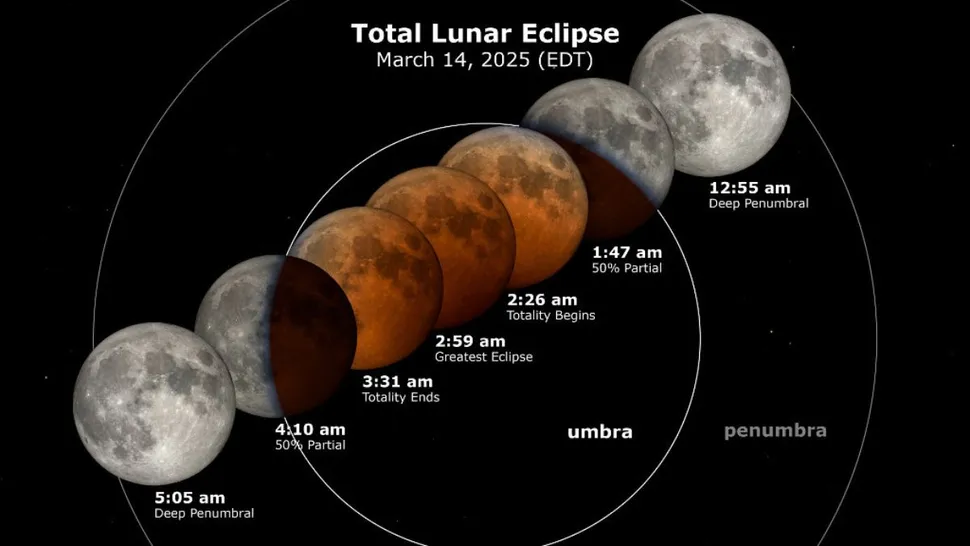
The total lunar eclipse will unfold overnight between March 13 and March 14, 2025. Observers in North and South America will have the best view, while those in parts of Western Europe may catch a glimpse of totality before moonset.
Totality, the period when the moon is completely engulfed in Earth’s shadow — will last for approximately 65 minutes. Key viewing times across different time zones include:
- Eastern Time (ET): 2:26 a.m. — 3:31 a.m. (March 14)
- Central Time (CT): 1:26 a.m. — 2:31 a.m. (March 14)
- Mountain Time (MT): 12:26 a.m. — 1:31 a.m. (March 14)
- Pacific Time (PT): 11:26 p.m. (March 13) — 12:31 a.m. (March 14)
- Alaska Time (AKDT): 10:26 p.m. — 11:31 p.m. (March 13)
- Hawaii Time (HST): 8:26 p.m. — 9:31 p.m. (March 13)
For the full experience, it’s worth heading outside about 75 minutes before and after these times to see the moon gradually enter and exit Earth’s shadow.
Unlike solar eclipses, lunar eclipses are completely safe to observe with the naked eye. No special equipment is needed, but using binoculars or a telescope can enhance the experience, revealing intricate details on the moon’s surface. The best way to watch is from a location away from city lights with an unobstructed view of the sky.
Source – Space.com
‼️‼️‼️
Do you want to share a story with us? Do you want to advertise with us? Do you need publicity for a product, service, or event? Contact us on WhatsApp +2347035616202 Email: thepeacemag@gmail.com
We represent Islamic advocacy and News Reporting. The primary objective is to use our platform to promote a better-informed society and the sanctity of the peaceful co-existence of man. It remains the flagship of Nigeria’s Islamic News magazines.
Kindly donate here;
PEACE MAGAZINE NIGERIA LIMITED,
TAJBank
0009931319
SPONSORED

SPONSORED

SONSORED
