
The Qur’an and Mathematics
“But if you count the favours of Allah, you will never be able to number them.” (Q14:34)
By Abdullahi Yusuf
Adapted from Sheikh Ahmed Mohammed A. Wal’s Islam & Science
Encouraged and stimulated by Qur’anic studies, Muslims began with the science of numbers (Ilm al-Adad) and the science of accounting (Ilm al-Hisab), which occupied prominent positions in Islamic science. But the source of mathematical studies, as with other sciences in Islam, is the concept of Tawhid, the Oneness of God. Therefore, Mathematics is, in an uncompromising way, intertwined with faith.
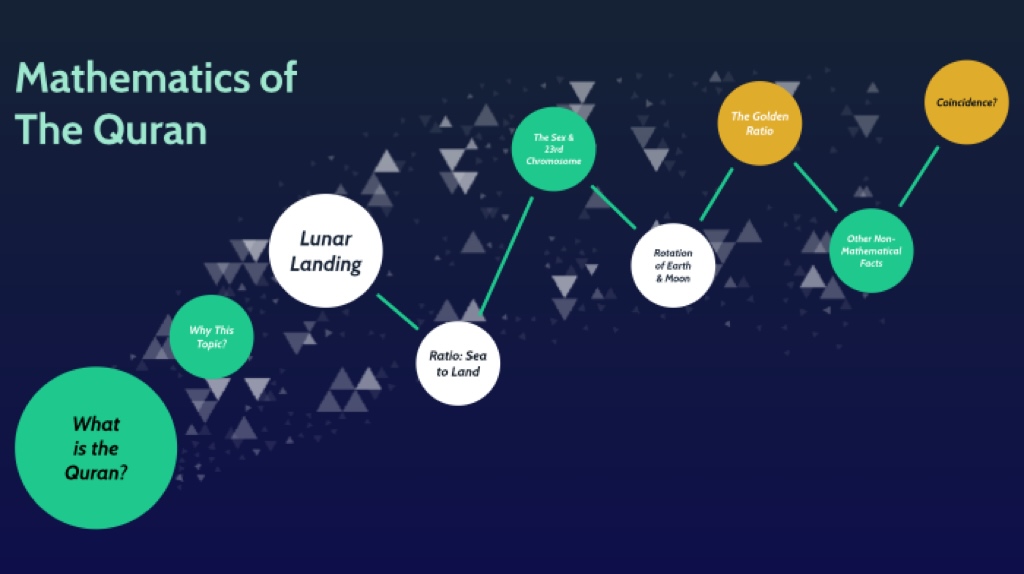
Number one is unlike any other number, a ladder by which man ascends as his faith progresses. The science of numbers is the root of the elements of wisdom stemming from the presence [of the Creator]. The symbolic role of numbers played a dominant part in the study of Mathematics in the early period of Islamic history.
Muslims contributed greatly to the science of Mathematics for nearly a millennium, and the study of numbers received encouragement from the Qur’an, which opened up vast horizons of learning in the field of Mathematics. In other words, man’s ignorance is replaced by knowledge, thus improving the condition of man materially as well as spiritually. As the Qur’an says: “My Lord, increase me in knowledge.” (Q20:114)
The Qur’an mentions numbers in different contexts: “Then We drew a veil over their ears in the Cave for a number of years. Then We roused them, in order to test which of the two parties would best calculate the length of time they had remained there.” (Q18:11–12)
Again, in the same Surah, we read: “Some will say, ‘They were three, their dog being the fourth,’ while others will say, ‘They were five, their dog being the sixth,’ guessing blindly. And others will say, ‘They were seven and their dog was the eighth.’ Say, ‘My Lord knows best their number.’” (Q18:22)
In Surah al-Mu’minun, there are these words: “He will say, ‘How many years did you remain on earth?’ They will say, ‘We remained a day or part of a day.’ He will say, ‘You remained only a little, if you had only known.’” (Q23:112–114)
And regarding the blessings of God: “But if you count the favours of Allah, you will never be able to number them.” (Q14:34)
The use of numbers in Islam is also mentioned in regard to some forms of worship: “Fasting is prescribed for a fixed number of days, but if any of you is ill or on a journey, the prescribed number should be made up from later days… Allah desires ease for you, not hardship, so that you may complete the prescribed period.” (Q2:184–185)
And with regard to instructions about divorcing women: “O Prophet! When you ˹and the believers˺ divorce women, divorce them with concern for their waiting period, and count it accurately… Then when they have almost reached the end of their waiting period, either retain them honourably or separate from them honourably.” (Q65:1–2)
The Qur’an mentions calculation and counting on various occasions and in different contexts: “So do not hasten ˹to punish˺ them. We are only counting for them a limited number of days.” (Q19:84)
The Qur’an refers to the punishment of disbelievers in these words: “And they say, ‘The Fire will not touch us except for a few days.’” (Q2:80)
Reckoning is also referred to in the Qur’an in the story of Yusuf (Joseph): “And they sold him for a cheap price, a few silver coins, for they considered him to be of little value.” (Q12:20)
All such verses, and many more, must have inspired Muslim mathematicians to work on the two aspects of Mathematics: the Science of Numbers (Ilm al-Adad) and the Science of Reckoning (Ilm al-Hisab), and to solve delicate problems relating to social matters in the light of divine guidance.
In reference to the multiplicity of God’s creation, the Qur’an states: “Indeed, your Lord is Allah, Who created the heavens and the earth in six days…” (Q7:54)
And in Surah al-Sajdah, we read: “Allah is the One Who created the heavens and the earth and everything in between in six days…” (Q32:4)
These verses have given new dimensions to the meaning of time and space, which contemporary science continues to explore. They clearly show that numerical magnitudes in the sight of God are not necessarily perceived in the same way as they appear to us. Thus, the six days mentioned in the creation narrative should not simply be assumed to correspond to the ordinary measurement of human days.
“And they urge you to bring about the punishment. Allah will never fail in His promise. And indeed, a day with your Lord is like a thousand years of your counting.” (Q22:47)
Without a doubt, these verses encouraged early Muslims to go deeper into the world of numbers and figures and to find new methods and techniques to obtain answers to their problems. The Qur’an guided them to strive, penetrate into the truth and understand its significance.
This naturally led them to discover new fields and ideas in the world of Mathematics, in line with their pursuit of knowledge. Albert Einstein is widely associated with the statement: “Science without religion is lame, religion without science is blind.”
On the question of Mathematics in the Qur’an, we have not tackled 8 per cent yet. With time, I will devote a whole book to the miracle of numbers in the Qur’an and deal with it extensively, Insha-Allah, in my future publications. I also believe there are incentives for research into mathematics as well as statistical problems in conjunction with the Majesty of the Creator.
Man, while engaged in scientific work, must keep a constant link with his Creator. The duty of the Messenger is to convey the message, but the accounting is in the hands of God.
“You are not accountable for them in anything, nor are they accountable for you in anything.” (Q6:52)
The Qur’an has given incentives to study our surroundings, and that led to great work of research in the field of Mathematics and enabled Muslim scientists to make major contributions to the discipline. They developed and transmitted the Hindu-Arabic numeral system, including the use of zero, and made major advances in algebra and mathematical computation.
Among the notable mathematicians were Al-Khwarizmi, Abu’l-Hasan al-Uqlidisi, al-Nasawi, Jabir ibn Hayyan, Shams al-Din, al-Karaji, al-Biruni, Ghiyath al-Din al-Kashi, Baha al-Din al-Amili, Abu Nasr al-Farabi, Abu Mahmud al-Khujandi, Abdul Hasan al-Basri, Ali ibn Umar al-Khatib, Thabit ibn Qurra, Qutb al-Din al-Shirazi and Jabir ibn Aflah, among many others whose contributions cannot possibly all be included here.
SPONSORED

SPONSORED

SONSORED
