
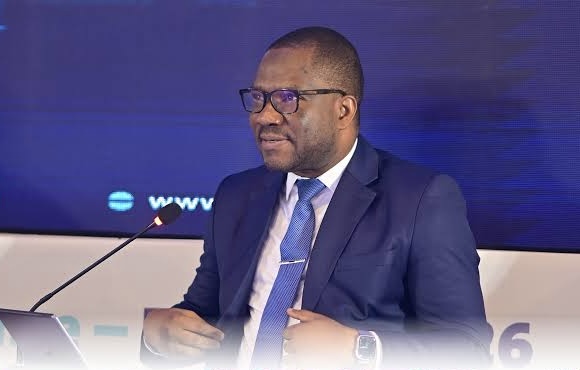
‘The North is not capital poor; the North is capital idle’ – Dr Umar Oseni
The North is not capital poor; the North is capital idle.’ Addressing the Arewa Islamic Finance Forum in Kano, Dr Umar Oseni argued that expanding non-interest finance is essential to bringing millions of excluded Nigerians into the formal economy while unlocking dormant investment across the region.
By Abdullahi Yusuf
Islamic finance should be treated as a national economic strategy rather than a niche banking alternative if Nigeria is to tackle financial exclusion and unlock the economic potential of its northern region, the Secretary-General of the Organisation of Islamic Cooperation Arbitration Centre (OIC-AC), Dr Umar A. Oseni, has said.
Delivering the keynote address at the Arewa Islamic Finance Forum in Kano, Oseni said nearly half of adults in North-West Nigeria remained outside the formal financial system, not because banking services were unavailable, but because millions continued to reject interest-based financial products on ethical and religious grounds.
He said Nigeria could not realistically achieve the Central Bank of Nigeria’s financial inclusion target of 95 per cent without confronting what he described as the region’s disproportionately high exclusion rate.
“In a country where 26 per cent of adults are locked out of the financial system and where the exclusion rate in the North-West stands at 47 per cent, non-interest finance is not a niche. It is the missing infrastructure of enduring economic policy and a growth strategy for this nation,” he said.
According to Oseni, while financial exclusion in the South-West has fallen to about five per cent, the North-West continues to lag behind because many prospective customers remain unwilling to participate in conventional banking systems that rely on interest.
“The problem is not that people refuse finance,” he said. “The problem is that finance has refused to meet people where they are.”
He argued that expanding financial inclusion would require institutions capable of accommodating people’s deeply held convictions rather than expecting them to abandon those beliefs.
“You do not argue a man out of his faith to bring him into your bank. You build a bank he can walk into without leaving his faith,” he added.
Oseni rejected suggestions that Islamic finance was a foreign or recently imported concept, describing it instead as a continuation of commercial traditions that had shaped Northern Nigeria’s economy for centuries.
He said Kano’s reputation as one of West Africa’s historic trading centres had long been built on trust-based partnerships, profit-sharing arrangements and trade financing principles that closely resemble modern Islamic finance.
Those same principles, he argued, could now be strengthened through contemporary regulation, financial technology and stronger institutions to support regional commerce and investment.
The OIC Arbitration Centre chief also linked financial exclusion to persistent economic losses among farmers and small-scale traders across Northern Nigeria.
Without access to Shariah-compliant financing, he said, many producers are forced to sell crops immediately after harvest, when market prices are at their lowest, simply to meet urgent financial needs.
He said Islamic financial instruments such as Mudarabah, Salam financing and warehouse receipt systems could enable farmers to retain produce until prices improve, increasing incomes while reducing avoidable losses.
Women, he added, remain among those most affected by financial exclusion despite their significant contribution to agriculture, food processing, tailoring, textiles and petty trading.
With around 30 per cent of adult women still outside the formal financial system, Oseni said Islamic finance offers partnership-based financing models that could better serve entrepreneurs who lack conventional forms of collateral, including land titles.
Beyond financial inclusion, Oseni urged policymakers and investors to recognise the industry’s growing international significance.
He said the global Islamic finance market is now valued at about $6 trillion, presenting Nigeria with an opportunity to attract greater investment through Sukuk issuances and other non-interest financial instruments if the right regulatory and investment environment is created.
He also challenged business leaders and wealthy individuals across Northern Nigeria to mobilise dormant capital into productive sectors of the economy instead of allowing wealth to remain tied up in cash holdings, property and inventories.
“The North is not capital poor; the North is capital idle. Those are two completely different conditions requiring different remedies,” he said.
Addressing participants at the forum, Oseni called for greater collaboration between investors and entrepreneurs through equity partnerships and professionally managed investment funds capable of supporting businesses beyond the start-up stage.
He said broadening access to ethical finance would not only reduce financial exclusion but also strengthen enterprise, expand investment opportunities and contribute to more inclusive economic development across Northern Nigeria.
SPONSORED
SPONSORED

SPONSORED

SPONSORED
