
US naval blockade of Iran in Strait of Hormuz explained
By Abdullahi Yusuf
Oil prices have surged to their highest level since 2022 after reports that US President Donald Trump is being briefed on potential military escalation against Iran, including options for further strikes linked to the ongoing maritime confrontation in the Gulf.
Brent crude briefly spiked above $126 (£94) a barrel before retreating, continuing a sustained upward trend driven by fears that stalled US-Iran negotiations could collapse completely.
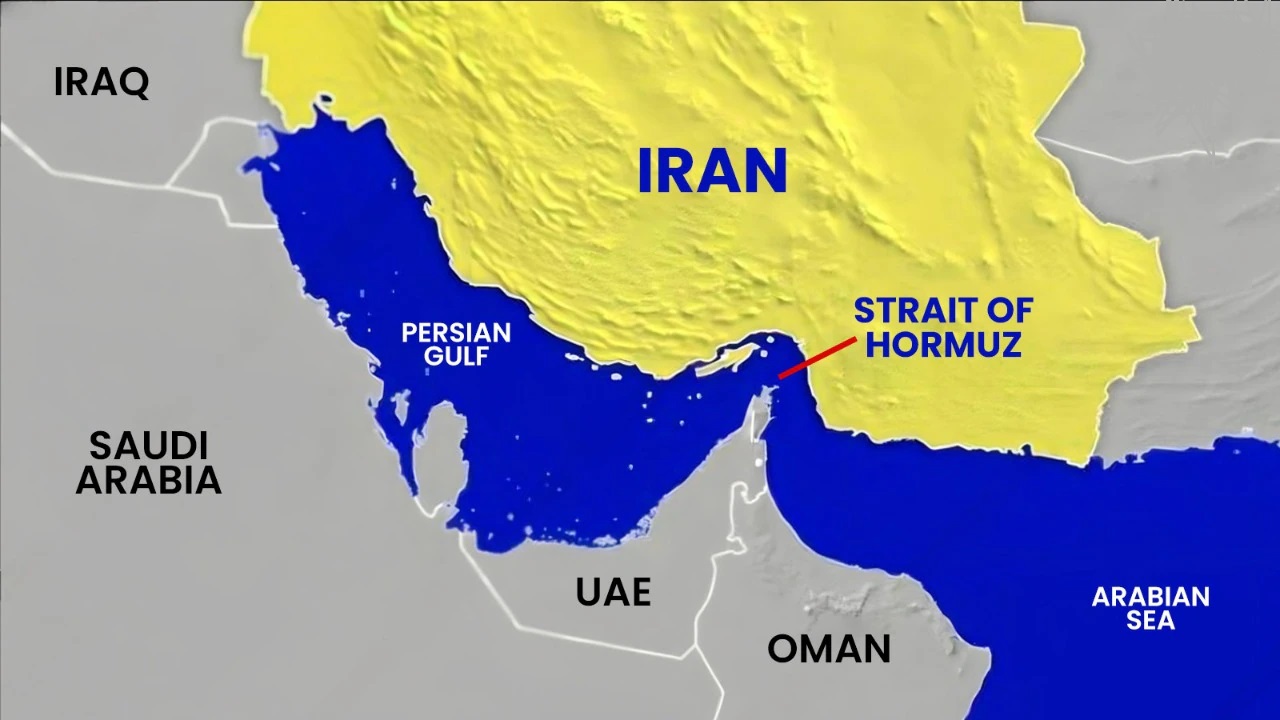
At the centre of the crisis is the Strait of Hormuz, a critical global energy chokepoint off Iran’s southern coast, where a US naval blockade has now effectively restricted Iranian maritime activity and triggered what analysts describe as a “war of blockades”.
US enforcement of maritime restrictions
In early April, US forces announced they would intercept, divert or turn back vessels travelling to or from Iranian ports, in an effort to choke Tehran’s oil exports and limit its revenue base.
Washington’s stated objective is to prevent Iran from profiting from oil sales while under sanctions pressure, particularly in a context where diplomatic talks have stalled without resolution.
President Trump has publicly framed the policy as an economic containment strategy, saying Iran should not be allowed to “make money on selling oil” under current conditions.
US officials have indicated that enforcement operations include surveillance, interception and seizure of commercial vessels suspected of violating restrictions.
Military escalation options under consideration
According to reporting by Axios, US Central Command (CENTCOM) has prepared operational options described as “short and powerful” strikes against Iran.
These reportedly include infrastructure targeting designed either to force a diplomatic breakthrough or to deliver a decisive military setback before de-escalation.
A second plan under discussion involves temporarily taking control of parts of the Strait of Hormuz to reopen it for commercial shipping, an operation that could require deployment of ground forces alongside naval units.
Iran has warned that any renewed strikes would trigger a forceful response. A statement attributed to Supreme Leader Mojtaba Khamenei said Tehran would respond with “long and painful strikes” and move to secure the Strait of Hormuz itself, accusing Washington of abusing the waterway for political pressure.
Legal dispute over blockade
The legal basis of the US action remains contested internationally.
The International Maritime Organisation (IMO) has reiterated that no state has the legal authority to block straits used for international navigation, even in times of conflict.
IMO Secretary-General Arsenio Dominguez told the BBC that while conflict conditions are acknowledged, international law does not permit obstruction of global shipping corridors.
However, international law scholar Donald Rothwell of the Australian National University argues that in wartime conditions, the US, Iran and Israel may be classified as “belligerents”, which under naval warfare law can permit blockades under certain conditions.
Where the blockade is being enforced
The exact positioning of US naval forces remains undisclosed for operational reasons, but analysts believe enforcement is concentrated outside Iranian coastal waters to avoid missile and drone exposure.
The Gulf of Oman is understood to be the primary interception zone, where vessels exiting Iranian ports enter wider international waters.
US Central Command says more than 12 warships and over 100 aircraft are involved in surveillance and enforcement.
Satellite imagery analysed by BBC Verify shows the USS Abraham Lincoln positioned at the eastern edge of the Gulf of Oman, approximately 200km south of Iran’s coastline, alongside vessels consistent with guided-missile destroyers.
How interceptions are carried out
CENTCOM says it has intercepted dozens of vessels it accuses of violating the blockade, including tankers carrying tens of millions of barrels of oil.
In one documented operation, US forces seized an Iranian-flagged cargo vessel in the Gulf of Oman. Marines reportedly boarded the ship after approaching by helicopter and rappelling onto its deck.
Officials say humanitarian cargo, including food and medical supplies, is exempt but subject to inspection.
The US has also said it is targeting suspected naval mines it attributes to Iran, in what it describes as efforts to secure maritime safety.
Iran’s response and continued exports
Iran has condemned the measures as “piracy” and has threatened retaliation against regional shipping infrastructure, including ports in Gulf States.
Despite the blockade, Iran has continued limited oil exports, benefiting from elevated global prices. March was one of its strongest export months in the past year and a half.
China remains the largest purchaser of Iranian crude, accounting for around 90% of exports, and has described the US measures as “dangerous” and “irresponsible”.
Global economic consequences
The disruption has already had wider economic effects.
Energy prices have risen globally, with knock-on impacts on transport, food and industrial supply chains.
The International Monetary Fund (IMF) has warned that prolonged disruption linked to the conflict could push the global economy towards recession, with advanced economies including the UK particularly exposed to energy price shocks.
Strategic chokepoints under pressure
The Strait of Hormuz typically sees around 3,000 vessels a month carrying oil, gas and goods. That flow has dropped sharply since the escalation began.
The strait is also a critical import route for food, medicine and industrial supplies into the Middle East, meaning disruption is now affecting broader humanitarian and commercial supply chains.
Regional security and UK position
Prime Minister Keir Starmer has said British forces are not involved in enforcing the blockade, though UK naval units remain deployed in the region for mine clearance and maritime security operations.
The US has reportedly invited allies to participate in a future maritime coalition aimed at restoring free navigation once hostilities end.
A confrontation with no clear endpoint
Analysts say the situation has now shifted into a prolonged strategic confrontation, where economic pressure, naval enforcement and diplomatic deadlock reinforce each other.
Iran insists it will not negotiate under coercion, while Washington maintains that restricting oil exports is central to its pressure strategy.
For now, both sides appear locked in a standoff that is already reshaping global energy markets, with the risk of escalation still firmly present on both sides of the Gulf.
With additional information from BBC
SPONSORED

SPONSORED

SONSORED
