
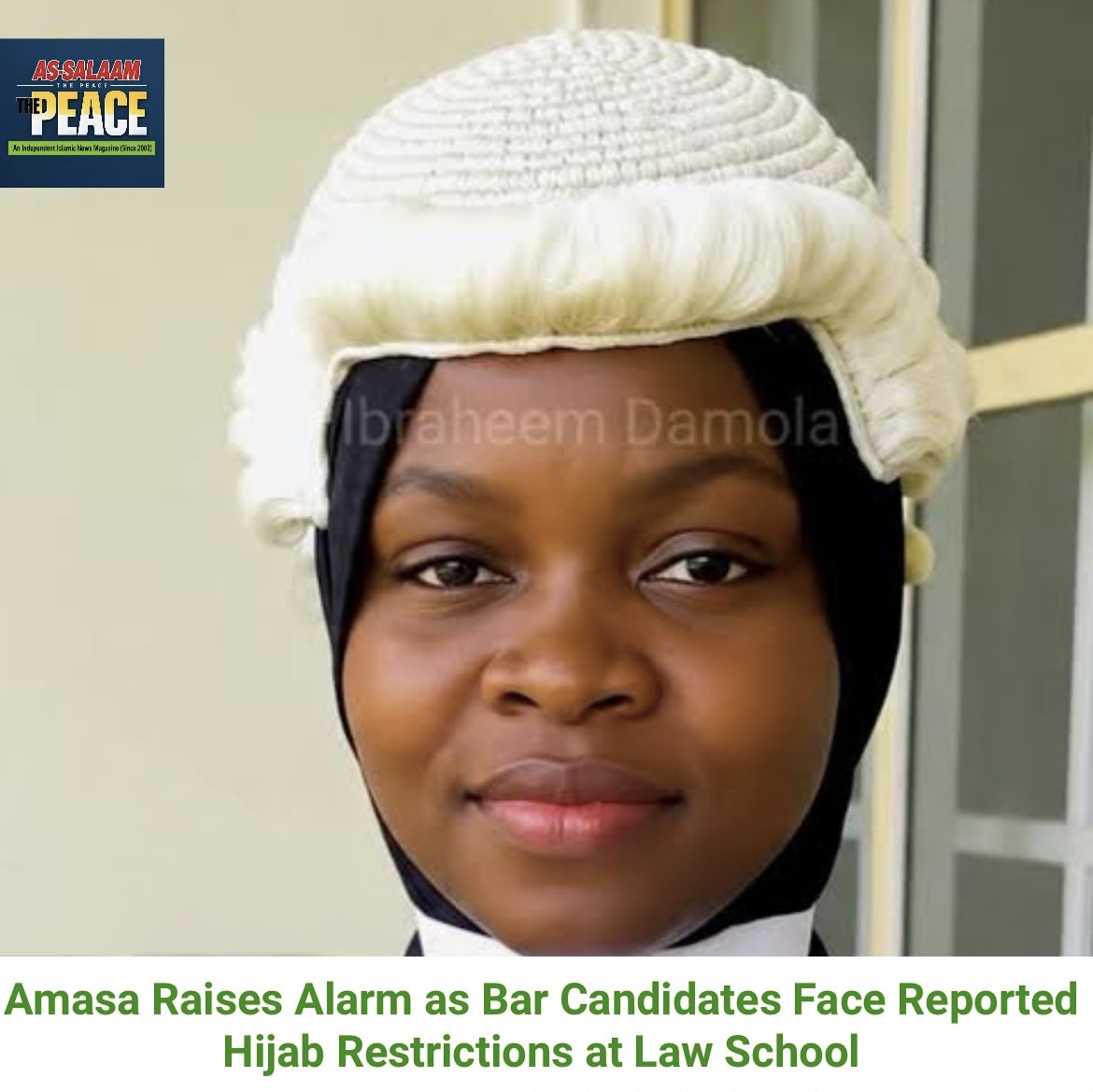
Bar Exams: Hijab Rights Advocate Firdausa Amasa Demands Action Over Bwari Restrictions
Lawyer who challenged hijab restrictions at her 2017 Call to Bar says two candidates cried after being made to rewrap their hijabs at Bwari examination hall
By Abdullahi Yusuf
Nearly a decade after her own hijab dispute at the Nigerian Law School, lawyer Firdausa Amasa has called for urgent intervention over what she described as harassment of Muslim female candidates during the ongoing 2026 Bar Final Examinations at the institution’s Bwari Campus, Abuja.
Amasa, who was eventually called to the Nigerian Bar in 2018 wearing her hijab after the controversy surrounding her exclusion from the previous year’s Call to Bar ceremony, said she witnessed two female candidates crying at the entrance of the Main Multipurpose Hall after they were allegedly compelled to remove and rewrap their hijabs like turbans before being allowed into the examination hall.
In an incident report dated Saturday, 31 October 2026, Amasa said she visited the Bwari Campus to observe compliance with a circular permitting candidates to sit the Bar Part II examinations while wearing hijab.
According to her, she visited five examination halls and found that hijab-wearing female candidates were admitted without hindrance in four of them. She said the situation was different at the Main Hall, also known as the Multipurpose Hall, where candidates wearing hijab were stopped at the entrance and asked to remove their head coverings and rewrap them in a turban-like manner before entry.
“I personally witnessed two female candidates crying at the entrance as a result of this harassment,” Amasa stated.
She said the incident caused visible distress among the affected candidates shortly before an examination, warning that such treatment could have implications for their concentration and performance.
Amasa described the reported conduct of the supervisors as contrary to the Law School’s circular and the constitutional protections relating to freedom of religion. She cited Sections 38(1) and (2) of the 1999 Constitution, as amended, which protect freedom of thought, conscience and religion, including the freedom to manifest and practise one’s religion.
She also cited Section 42 on protection against discrimination and Section 34, which guarantees the dignity of the human person.
Amasa further referenced the Supreme Court’s 2022 judgment in Lagos State Government & Ors v. Asiyat AbdulKareem & Ors (SC/910/2016), a case concerning the wearing of hijab by Muslim students in Lagos public schools. The judgment considered constitutional questions relating to freedom of religion and protection against discrimination.
The case is separate from the current examination dispute, but Amasa invoked the judgment in arguing that the reported treatment of candidates was inconsistent with constitutional protections.
The latest intervention also recalls Amasa’s own confrontation with hijab restrictions at the Nigerian Law School in 2017. She was denied entry to the International Conference Centre in Abuja for the Call to Bar ceremony after refusing to remove her hijab, triggering a national debate over religious freedom and dress requirements at the ceremony.
The controversy continued into 2018 before Amasa was eventually called to the Nigerian Bar in July that year while wearing her hijab.
Amasa is now urging the Nigerian Law School management to ensure that the reported restriction at the Multipurpose Hall is stopped and that the directive permitting hijab is implemented consistently across all examination halls for the remaining papers.
She called for a clear and unconditional instruction to be issued to all invigilators confirming that candidates wearing hijab should be allowed to enter and write their examinations in accordance with the applicable directive.
She also asked the authorities to assure candidates that no Muslim woman would be victimised or disadvantaged for exercising her constitutional rights.
The intervention comes amid wider concerns raised by Muslim organisations over the treatment of Muslim candidates during the 2026 Bar examinations. The Muslim Students’ Society of Nigeria, B-Zone, and the Muslim Public Affairs Centre have separately called for urgent action over reported restrictions involving hijab and modest dress.
The Hijab Rights Advocacy Initiative has separately stated that female Muslim candidates are permitted to wear hijab for the Bar examinations, provided the hijab complies with the applicable dress requirements.
The Nigerian Law School had not issued an official response to Amasa’s incident report at the time of publication.
SPONSORED
SPONSORED

SPONSORED

SPONSORED
