
Science and Signs in the Quran
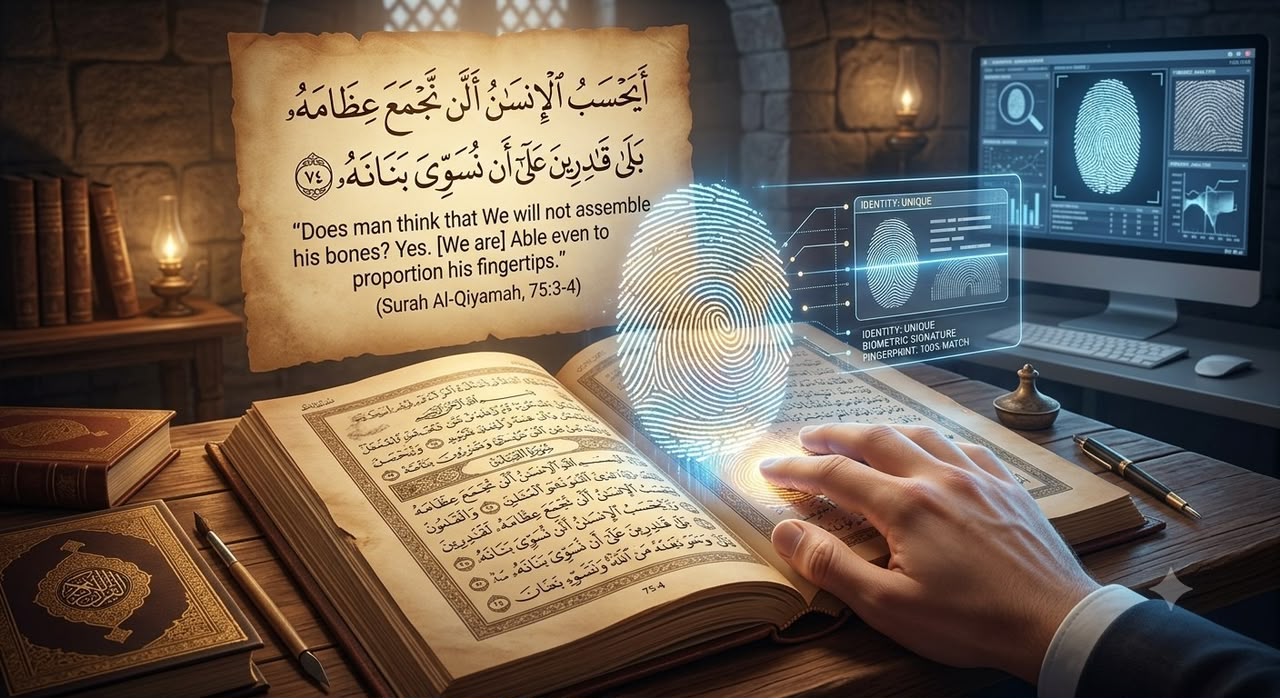
“Does man think that We will not assemble his bones? Yes. [We are]Able even to proportion his fingertips.” (Al-Qur’an 75:3-4)
The Secret Hidden in Fingertips: Modern Forensic Science and the Al-Qur’an
By A.S.M. Razan
Every single day, across the globe, billions of people utilize the microscopic ridges on their fingertips to engage with the modern world. From unlocking advanced smartphones and securing private financial data to serving as the gold standard for crossing international borders and identifying individuals in legal proceedings, the fingertip has become humanity’s ultimate, unforgeable identity card.
In the field of forensic science, these friction ridges are recognized as a biological signature so profoundly unique that even identical twins, who share the exact same genetic code possess distinct, non-replicable patterns. These intricate loops, whorls, and arches are formed permanently in the womb during the early stages of gestation, persisting throughout an individual’s life and regenerating flawlessly even after superficial injuries.
While the revolutionary power of fingerprinting as a definitive source of personal identification was only fully unlocked and standardized by scientists in the late nineteenth century, a profound reference to this biological marvel was explicitly detailed nearly fourteen centuries ago in the Al-Qur’an.
To truly appreciate the significance of this alignment, one must consider the historical context of seventh-century Arabia, a time when human knowledge regarding skin anatomy and microscopic biological patterns was virtually non-existent. During this era,skeptics frequently mocked the concept of bodily resurrection, questioning how a human being could possibly be reassembled after their bones had decayed into dust.
The divine response to this skepticism did not merely offer a vague promise of spiritual revival; instead, it provided a counter-argument grounded in anatomical precision that challenged the limits of human understanding. In the 75th chapter of the Al-Qur’an, Surah Al-Qiyamah, the text declares: “Does man think that We will not assemble his bones? Yes. [We are] Able even to proportion his fingertips.” (Al-Qur’an 75:3-4)
The choice of the Arabic word “bananah,” specifically referring to the fingertips, is profoundly significant. Out of all the massive organs, complex skeletal frameworks, or vital systems of the human body, the Al-Qur’an deliberately highlights the absolute periphery of human anatomy.
Why focus on the tip of the finger?
This selection is theologically and scientifically brilliant. The verse frames the reconstruction of the fingertip not just as a display of divine power, but as the ultimate restoration of individual identity. By promising to reconstruct the most minute and intricate detailing of the human body, down to the specific ridge patterns of the fingers, this ancient revelation presented a biological truth that aligns seamlessly with the discoveries of modern embryology.
Long before the invention of the microscope or the rise of forensic laboratories, the Al-Qur’an illuminated a microscopic reality that characterizes the uniqueness of every human soul. The implications of this are vast; it suggests that even in the process of resurrection, the Creator preserves the distinct signature of every individual.
This alignment between the text of the Al-Qur’an and the findings of modern science serves as more than just a historical curiosity, it is a testament to a timeless wisdom that transcends human authorship. In an age where forensic science has become the final arbiter of truth in justice systems worldwide, the fact that a seventh-century scripture explicitly singled out the “fingertips” as the marker of human re-creation remains a subject of deep reflection for scientists and believers alike. Ultimately, this passage bridges the gap between ancient revelation and modern biological reality, demonstrating that the design of the human body is a deliberate, divine craft, preserved in its smallest details.
References:
1. The Al-Qur’an: Surah Al-Qiyamah (Chapter 75), Verses 3-4.
2. Galton, F. (1892): Finger Prints– The foundational scientific study that established the uniqueness of fingerprints as a reliable method of human identification.
3. Embryological Development of Friction Ridges: Modern anatomical research confirms that fingerprint patterns (dermatoglyphics) are formed during the first trimester of pregnancy and remain permanent and unique throughout the human life cycle.
4. Forensic Science History: The use of dactyloscopy (fingerprint identification) for criminal investigation and civil identification began to be adopted globally only in the late 19th and early 20th centuries, proving the historical foresight of the Quranic text
About the Author:
A.S.M. Razan (Abdul Salam Mohamed Razan) writes on Islam and science, with particular interest in the relationship between Qur’anic revelation and discoveries in biology, astronomy and cosmology. He is a physiotherapy student at the Faculty of Medicine, University of Colombo, Sri Lanka, and has a background in Biological Sciences. He is a guest writer for PEACE Magazine.

SPONSORED

SPONSORED

SPONSORED

SPONSORED
