
Science and Signs in the Qur’an
“Say, ‘It is He who has produced you and made for you hearing and vision and hearts; little are you grateful.'” (67:23).
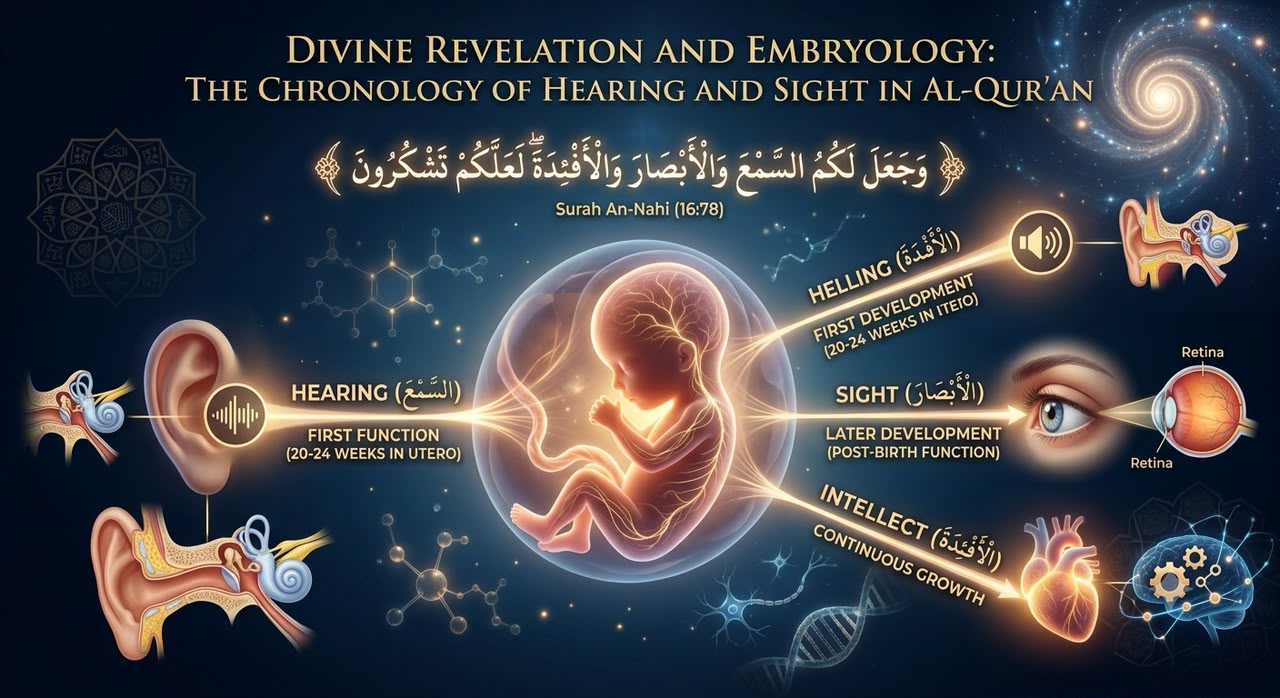
Divine Revelation and Embryology: The Chronology of Hearing and Sight in Al-Qur’an
By A.S.M Razan
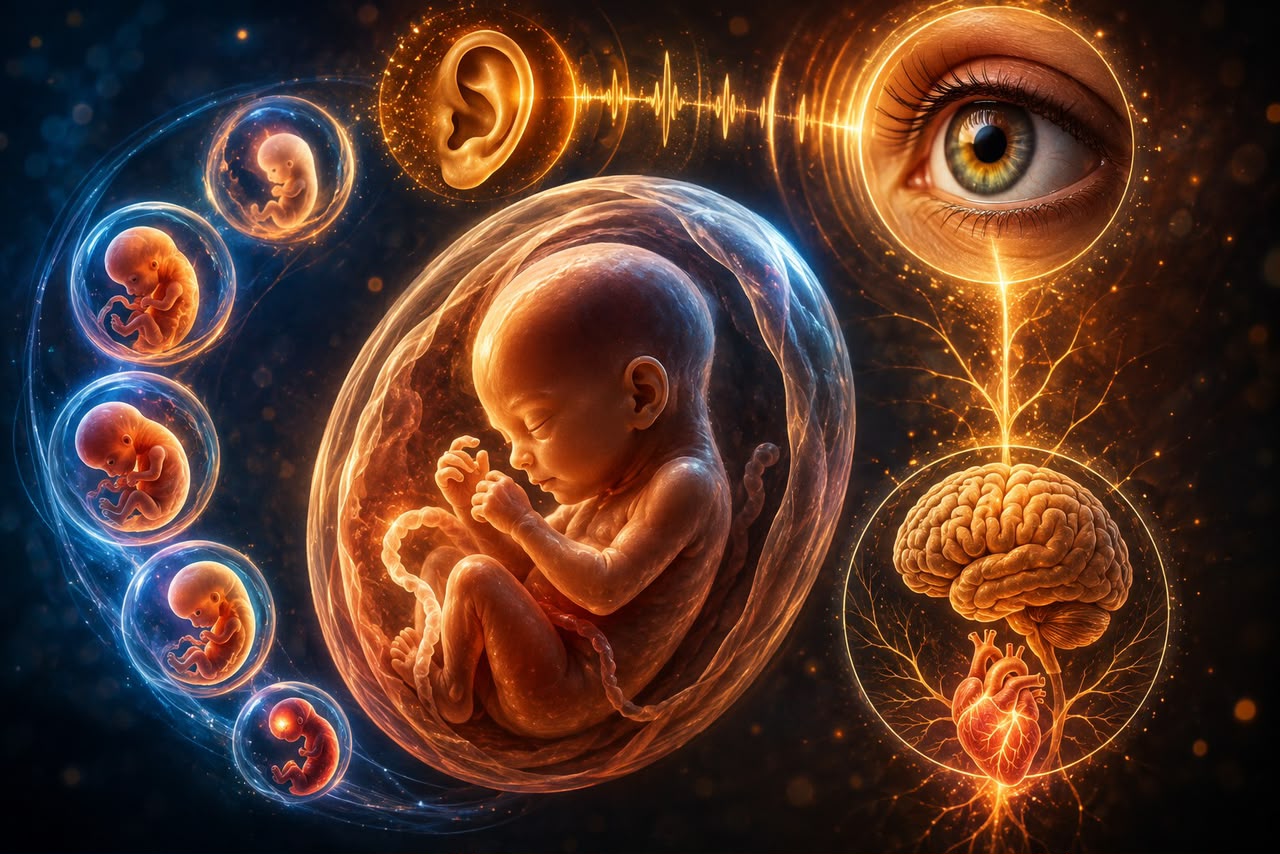
The human body’s embryonic creation contains profound signs of divine design, particularly in the formation of sensory organs. Long before modern embryology mapped the sequential development of human senses, the Holy Qur’an laid out the exact chronological order in which these faculties emerge in the womb: hearing develops first, followed by sight, and finally the heart and mind.
The precise sequence is explicitly established across multiple chapters of the Holy Qur’an. In Surah An-Nahl, Allah says: “And Allah has extracted you from the wombs of your mothers not knowing a thing, and He made for you hearing and vision and intellect that perhaps you would be grateful.” (16:78).
This exact progression is repeated in Surah Al-Mu’minun: “It is He who created for you hearing and sight and hearts; little are you grateful.” (23:78).
The scriptures reinforce this specific order again in Surah As-Sajdah: “Then He proportioned him and breathed into him from His created soul and made for you hearing and vision and hearts; little are you grateful.” (32:9).
Furthermore, Surah Al-Mulk reminds humanity of these precise gifts: “Say, ‘It is He who has produced you and made for you hearing and vision and hearts; little are you grateful.'” (67:23).
Modern medical embryology reveals that the auditory system is indeed the very first sensory apparatus to form and function in a human fetus. By the fourth to fifth week of gestation, the primary auditory structures appear, and by the twentieth to twenty-fourthweek, the inner ear is fully formed, allowing the fetus to hear internal sounds like the mother’s heartbeat as well as external voices. Hearing is unambiguously the first sense activated in the womb.
Conversely, while eye structures begin early, the eyelids remain fused shut until around the twenty-sixth to twenty-eighth week. Retina and optic nerve pathways mature significantly later, and full visual perception only becomes active after birth upon exposure to light. The higher brain regions responsible for processing these sensory inputs into understanding, referenced in the Qur’an as hearts or intellect, mature continuously throughout late pregnancy and early childhood as the child interacts with the world.

The consistent repetition of this precise order—hearing, sight, then intellect—throughout the Holy Qur’an highlights an undeniable harmony between divine revelation and scientific fact. Revealed at a time when embryonic development was entirely unknown to science, these Qur’anic passages offer clear proof of divine origin, reminding humanity to reflect upon their own creation and remain grateful for the priceless gifts of perception.
Qur’anic & Scientific References:
1. Surah An-Nahl (1 6:78): Allah mentions hearing, vision, and intellect.
2. Surah Al-Mu’minun (23:78), As-Sajdah (32:9), and Al-Mulk(67:23): These verses similarly mention hearing before vision.
Scientific References
Embryology studies indicate that the fetal auditory system becomes functional before visual maturation. Research by Moore et al., Hepper and Shahidullah, and Birnholz and Benacerraf documents fetal responses to sound around 1 9–24 weeks, supporting the earlier functional development of hearing compared with vision.
About the Author:
A.S.M. Razan (Abdul Salam Mohamed Razan) writes on Islam and science, with particular interest in the relationship between Qur’anic revelation and discoveries in biology, astronomy and cosmology. He is a physiotherapy student at the Faculty of Medicine, University of Colombo, Sri Lanka, and has a background in Biological Sciences. He is a guest writer for PEACE Magazine.

SPONSORED
SPONSORED

SPONSORED

SPONSORED
