
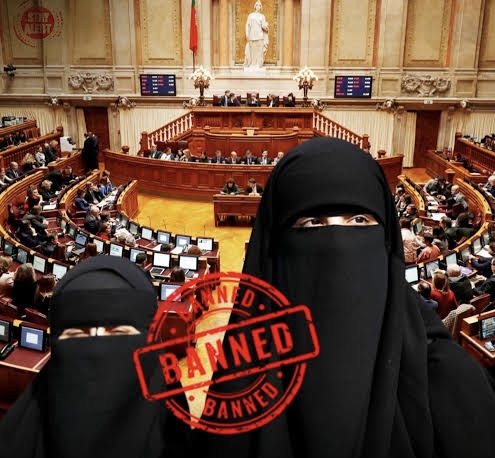
Portugal’s Veil Ban Puts Muslim Women Back in Europe’s Crosshairs
Portugal’s new face-covering ban puts Muslim women who wear the niqab under fresh legal pressure, intensifying concerns over religious freedom and discrimination
By Abdullahi Yusuf
Portugal has joined a growing list of European countries restricting face coverings in public, after President António José Seguro signed into law legislation that does not mention Islam but is widely understood to affect Muslim women who wear the niqab.
Seguro promulgated the law on August 18 at the Belém Palace in Lisbon, saying the face was central to human identity and communication while acknowledging the “great social and cultural sensitivity” surrounding the measure.
The legislation prohibits clothing designed to conceal the face or prevent identification in public spaces. Those who violate the ban can face fines of between €150 and €3,000.
The law also criminalises forcing another person to cover their face on grounds linked to gender, religion, age or origin, with such coercion punishable by up to three years in prison.
But the law’s neutral wording has not removed concerns about its implications for Muslim women who wear the niqab. The final legislation does not refer to Islam, the niqab or the burqa.
That was not always the case.
The bill originated with the far-right Chega party, led by André Ventura, and earlier versions explicitly referred to Islamic veils. Those references were removed during the parliamentary process before the measure was recast as a general prohibition on concealing the face.
Portugal’s parliament approved the legislation on July 17, with backing from the governing centre-right coalition and far-right parties. Left-wing parties opposed it.
There are exceptions for health, professional, artistic and weather-related purposes. Face coverings are also permitted in places of worship, diplomatic missions and on aircraft.
The practical reach of the legislation is likely to be limited.
Full-face veiling is uncommon among Muslim women in Portugal, making the measure difficult to separate from its symbolic significance.
Criticism came from several Portuguese legal bodies during the legislative process, including the Portuguese Bar Association, the High Council of the Public Prosecutor’s Office and the Portuguese Association of Women Lawyers, which raised concerns about the law and its constitutionality.
Amnesty International’s Portugal office also criticised the measure, describing it as discriminatory and a threat to human rights.
For Muslim women who choose to wear the niqab, however, the debate is more personal.
A garment that may be understood by its wearer as an expression of faith, modesty or personal religious conviction has become the object of legislation in yet another European country.
Portugal’s decision places it alongside France, Belgium, Austria, Denmark and the Netherlands, which have introduced full or partial restrictions on face coverings.
The European Union Agency for Fundamental Rights has reported significant levels of discrimination experienced by Muslims across the bloc, with Muslim women who visibly practise their faith among those reporting discrimination in everyday life. Spain’s Balearic Islands is also considering similar proposals backed by the hard-right Vox party.
In Portugal, a law that began with explicit references to Islamic veils has now reached the statute book without mentioning Islam at all.
SPONSORED

SPONSORED

SONSORED
