
NSCIA Backs NAHCON Hajj Reforms, Calls for Security Overhaul
Sultan-led council adopts 2026 Hajj report, rejects genocide claim and expands national executive structure
By Abdullahi Yusuf
The Nigerian Supreme Council for Islamic Affairs (NSCIA) has endorsed the recommendations contained in the 2026 report of the National Hajj Commission of Nigeria (NAHCON), while calling for an urgent and comprehensive reform of Nigeria’s security architecture.
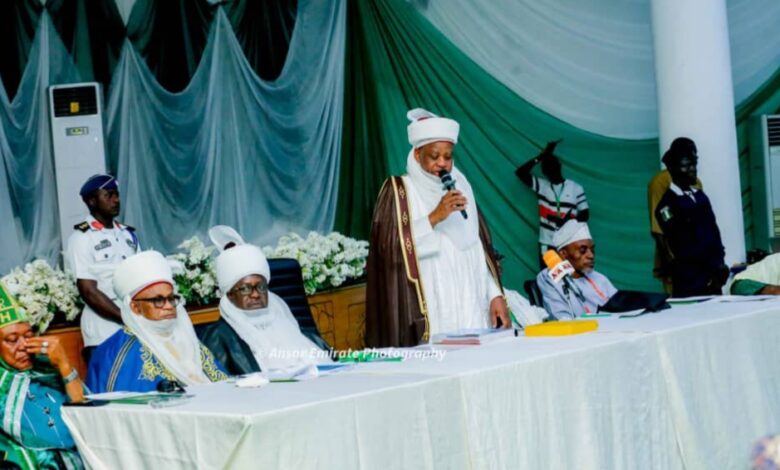
The resolutions were adopted at the Council’s General Assembly held on Thursday, October 1, 2026, at the National Mosque, Abuja, under the theme, “Nigerian Muslims and the Imperative of Nation-building.”
The Assembly, presided over by the Sultan of Sokoto and President-General of the NSCIA, Alhaji Muhammad Sa’ad Abubakar, adopted the 2026 NAHCON report and endorsed its recommendations for repositioning Hajj operations.
The Council also commended NAHCON and the Abuja National Mosque Management Board.
On national security, the NSCIA rejected claims that Christians or any religious community are facing genocide in Nigeria, saying insecurity affects Nigerians regardless of faith.
The Council backed decentralised policing but said any reform must be anchored on professionalism, constitutional safeguards, impartiality, accountability, sustainable funding, respect for fundamental rights and effective coordination between federal and state security institutions.
It also charged the Federal Government to expedite measures to reduce the cost of transportation and food, while acknowledging efforts to revive the economy.
The Council further declared that Islam has existed in Igboland for several decades and across generations, rejecting attempts to portray Muslims as non-indigenous to the region.
It condemned what it described as efforts to suppress or normalise attacks against Muslims in Igboland by denying their longstanding presence there.
On Muslim unity and conduct, the Assembly reaffirmed that Islam prohibits compulsion in religion and said Muslims do not force people to become Muslims.
It urged Muslim scholars to avoid attacking one another publicly and instead resolve disagreements through internal mechanisms.
The Council also cautioned against manipulating Islam to promote hatred, violence or attacks, urging Muslims to de-emphasise sectarian differences and strengthen unity.
It called for Tabayyun, verification and evidence, and urged Muslims to desist from circulating unverified messages, claims and accusations that could damage the reputation of leaders and others.
On education and community development, the NSCIA urged Muslim leaders to prioritise quality education combining sound Islamic knowledge with Science, Technology, Engineering, Arts and Mathematics (STEAM).
It also tasked Muslims with obtaining their National Identification Numbers (NINs) and Permanent Voter Cards (PVCs) and participating fully in the selection of leaders at all levels.
The Council encouraged Muslim organisations to pursue economic independence through lawful investments, cooperation and effective administration of Zakat and Waqf as tools for sustainable poverty reduction.
The Assembly recognised Maryam Ibrahim Dan-Azumi for winning the female category of the King Abdulaziz International Qur’anic Competition in Makkah, Saudi Arabia, and recommended her for national recognition.
NSCIA expands national executive structure
The General Assembly also approved the renewal and expansion of the NSCIA National Executive Committee, creating dedicated portfolios across national, international, corporate and administrative affairs.
Professor Mahfouz A. Adedimeji was appointed Deputy Secretary-General (National Affairs), while Professor Salisu Shehu was appointed Deputy Secretary-General (International Affairs).
Abeni Obomeileh Mohammed, SAN, was appointed Deputy Secretary-General (Corporate Affairs), while Dr Bala Muhammad was appointed Deputy Secretary-General (Administration).
The Assembly also appointed Dr Umar Jibrilu Gwandu as Public Relations Officer (PRO) and Hajia Sekinah T. Lawal as Deputy Public Relations Officer (DPRO).
Dr Mairo Mandara was appointed Development Officer, while Arc. Abdullah Musa Abdul (PenAbdul) was appointed Deputy Development Officer (Technical). Professor Fatimah Abdulkareem was appointed Family Affairs Officer.
The expanded structure gives the Council designated officers for national and international affairs, corporate matters, administration, public communication, development, technical development and family affairs.
NSCIA honours Oloyede
The Assembly also honoured its Secretary-General, Professor Is-haq O. Oloyede, for his contributions to Islam, education and nation-building during his tenure as Registrar of the Joint Admissions and Matriculation Board (JAMB) from August 2016 to July 2026.
The Council described Oloyede as a good ambassador of Islam and recognised his contributions during his decade of service as JAMB Registrar.
The recognition came as Oloyede, who serves as Secretary-General of the NSCIA, participated in the Assembly alongside the Council’s President-General, the Sultan of Sokoto.
The General Assembly brought together Emirs, Obas, Chief Imams, Islamic scholars, leaders of major national Islamic organisations and delegates from all states and the Federal Capital Territory.
The communiqué containing the resolutions was signed by Sultan Muhammad Sa’ad Abubakar, President-General of the NSCIA, and Professor Is-haq Oloyede, Secretary-General.
SPONSORED

SPONSORED

SONSORED
