
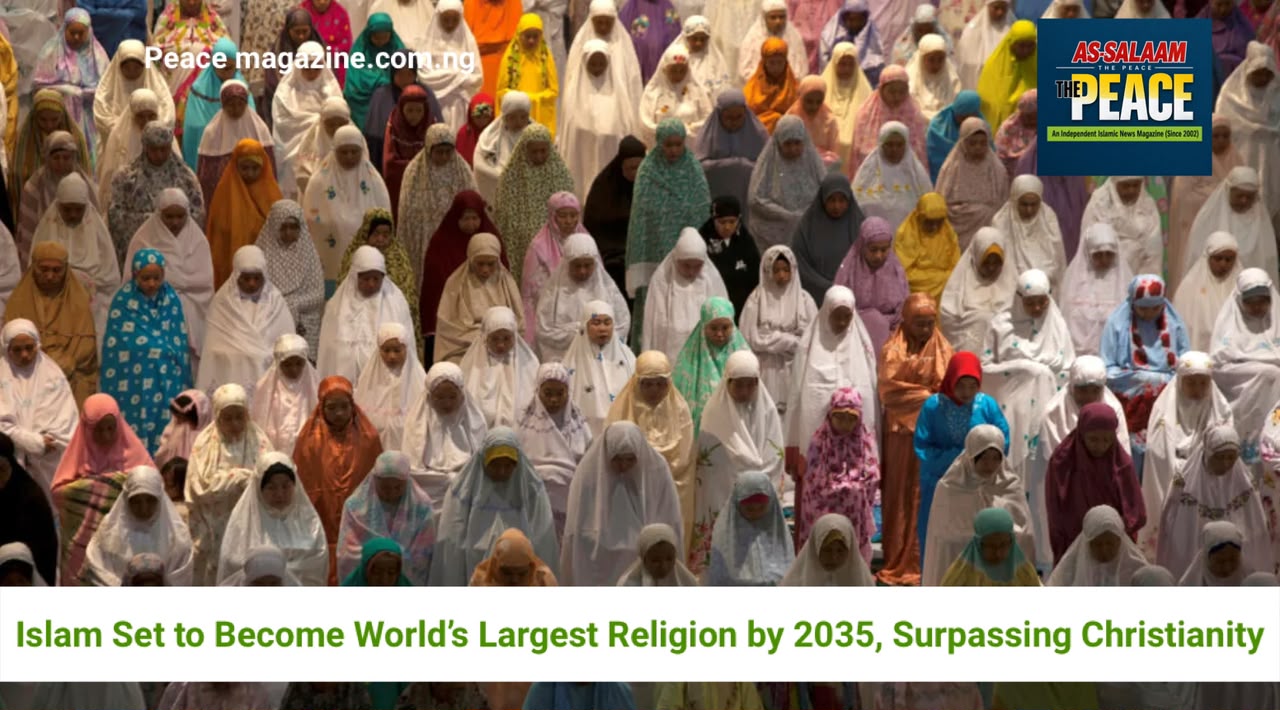
Islam Set to Become World’s Largest Religion by 2035, Surpassing Christianity
Muslims are projected to number 2.57 billion by 2035, edging past Christians as demographic trends point to a further expansion of Islam’s global population over the next five decades.
By Abdullahi Yusuf
Islam is projected to become the world’s largest religious group by 2035, surpassing Christianity, according to new global population projections.
The projections estimate that Muslims will number approximately 2.57 billion by 2035, compared with 2.52 billion Christians, marking a shift in the world’s religious composition if current demographic trends continue.
The projections further indicate that the Muslim population will grow to approximately 3.64 billion by 2070, representing about 36 per cent of the world’s population, while Christians are expected to number nearly three billion, accounting for about 29 per cent.
The figures are part of a global demographic study examining how the populations of major religious groups are expected to change between 2020 and 2070.
In 2020, Muslims numbered approximately 2.02 billion worldwide, representing 25.6 per cent of the global population, while Christians accounted for 2.27 billion, or 28.8 per cent.
The projected growth of the Muslim population is largely attributed to its younger age profile and higher fertility rates.
Between 2020 and 2025, Muslim women had an average of 3.1 children, compared with 2.5 among Christian women and 1.6 among women belonging to other religious groups.
Muslims also had a median age of 24 in 2020, compared with 33 among non-Muslims, a demographic difference expected to contribute to population growth over the coming decades.
Sub-Saharan Africa is projected to play a significant role in the expansion of both Muslim and Christian populations, as the region is expected to account for a substantial share of global population growth.
By 2070, approximately a quarter of the world’s Muslims are projected to live in sub-Saharan Africa, compared with 18 per cent in 2020. More than half of the world’s Christians are also expected to reside in the region by that time.
Asia-Pacific, currently home to approximately 59 per cent of the world’s Muslims, is projected to account for about half of the global Muslim population by 2070, although the number of Muslims in the region is expected to continue increasing.
Pakistan is projected to become the country with the largest Muslim population by 2070, overtaking Indonesia, with approximately 461 million Muslims. India is expected to follow with about 334 million, while Nigeria’s Muslim population is projected to reach approximately 282 million, nearly doubling from its 2020 level.

The study also projects changes in the distribution of other religious groups. The Democratic Republic of Congo is expected to surpass the United States as the country with the largest Christian population by 2070.
Christian populations in countries including the United States, Canada and Germany are also projected to lose their majority status over the coming decades.
While Hindu and Jewish populations are expected to grow in absolute numbers, their share of the global population is projected to decline. Buddhist populations are expected to decrease, while the proportion of people identifying as religiously unaffiliated is also projected to fall globally.
The projections are based on demographic trends, including fertility, mortality, migration and religious switching, and assume that these patterns continue over the period examined.
The researchers caution that the figures represent projections rather than certainty, with future demographic changes potentially altering the trajectory of religious populations worldwide.
Source: Pew Research Center’s global religious population projections.
SPONSORED
SPONSORED

SPONSORED

SPONSORED
