
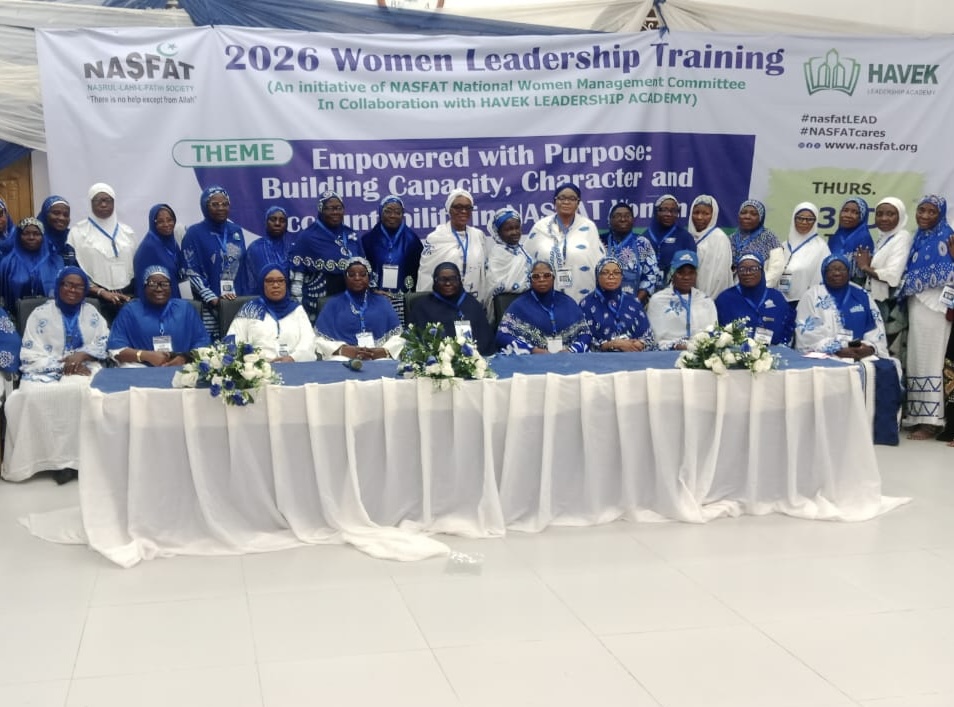
NASFAT ends women leadership training with call for service over status
Organisation concludes national leadership programme with renewed emphasis on accountability, entrepreneurship, AI literacy, modesty and Islamic values as women urged to lead through character rather than position.
By Abdullahi Yusuf
Leadership is measured not by titles but by service, influence and accountability before Allah, the Nasrul-Lahi-L-Fatih Society (NASFAT) has told its women leaders, as the Islamic organisation concluded its four-day 2026 National Women Leadership Training with a renewed call for values-driven leadership rooted in integrity, compassion and public service.
The training, organised by the NASFAT National Women Management Committee, ended on Sunday at the NASFAT Islamic Centre, Asese, along the Lagos-Ibadan Expressway in Ogun State, after bringing together women leaders and emerging female administrators from across the country for intensive sessions on leadership, entrepreneurship, artificial intelligence, organisational accountability, financial responsibility, personal conduct and modesty.
Held under the theme, “Empowered with Purpose: Building Capacity, Character and Accountability in NASFAT Women,” the programme sought to strengthen participants’ capacity to lead effectively within the organisation, their families and wider society.
Opening the programme, NASFAT’s National Women Affairs Secretary, Alhaja Ganiyat Omowumi Babalola, said the training reflected the organisation’s commitment to raising women who combine competence with character and service.
She described the turnout as evidence of members’ desire for continuous learning and urged participants to translate the knowledge acquired into practical leadership within their various communities.
“Leadership is not merely occupying a position,” she said. “Leadership is service. It is respect for others. It is showing consideration, understanding people’s actions before judging them, and choosing compassion over criticism.”
She encouraged participants to remain active throughout the sessions by asking questions, sharing experiences and applying the lessons beyond the training.
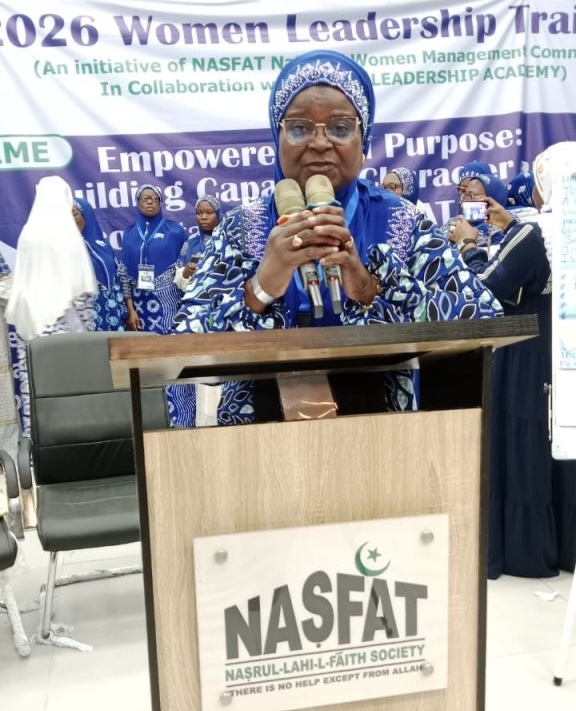
Delivering the keynote lecture, Professor Luqman Lekan Adedeji of the University of Lagos described leadership as an Amanah (trust) for which every leader would ultimately be accountable before Allah.
Quoting the saying of Prophet Muhammad (peace be upon him) that “The best among you are those who are most beneficial to mankind,” he argued that effective leadership is built on influence, service and integrity rather than official positions.
“Leadership is not about position. Leadership is about service. Leadership is about influence. Leadership is about accountability before Allah,” he said.
According to him, vision, character, service and influence remain the four pillars of enduring leadership, while justice, consultation, humility, transparency, patience and trust in Allah distinguish leaders who earn genuine public confidence.
“People follow leaders they trust, not merely leaders who hold positions,” he added.
The National Da’wah Officer of NASFAT, Imam Abdul Ganiyy Raji, reinforced that message, urging participants to view leadership as a daily responsibility rather than an official designation.
Speaking on “Leadership Through Service: Be the Woman People Want to Follow,” he said every Muslim would be accountable for those placed under his or her care, regardless of formal office.
“Leadership is more than the office or position you hold,” he said.
Drawing lessons from the life of Prophet Muhammad (peace be upon him), Imam Raji urged participants to embrace consultation, teamwork and mentorship while approaching disagreements as opportunities for problem-solving rather than assigning blame.
“When a conflict occurs, one leader asks, ‘Who started this fight?’ Another leader asks, ‘How do we solve it?’” he said.
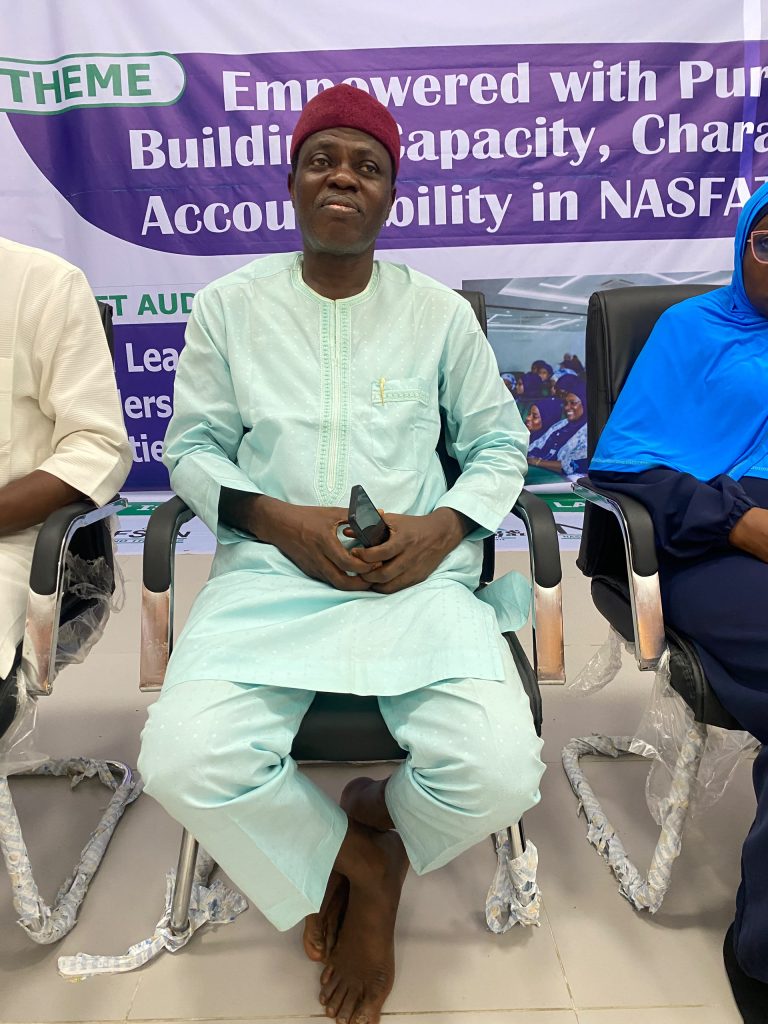
Describing leadership as practical service, he added: “A leader is like a doctor. He does not shout at the patient. He diagnoses the illness to know which medicine to use.”
Beyond leadership development, the training also examined personal conduct in an increasingly digital world.
Founder of Hopewell Initiatives for National Development, Alhaja Bilquees Aiyepola, challenged participants to uphold modesty not only in appearance but also in speech, relationships and online engagement.
Speaking on “Personal Conduct and Modesty in the Modern Age,” she described Haya as a comprehensive expression of moral discipline extending beyond clothing to every aspect of a Muslim’s public and private life.
“Our digital footprint is now part of our character,” she said, warning participants to exercise caution before sharing photographs, captions or comments on social media.
She also encouraged women to resist social pressures that compromise Islamic values, reminding them that modesty reflects dignity, self-respect and faith rather than restriction.
Throughout the four-day programme, participants also received training on entrepreneurship, financial responsibility, digital literacy, artificial intelligence and organisational accountability as part of NASFAT’s broader effort to prepare women for leadership in an increasingly changing society.
Organisers said the training reflects the organisation’s continuing commitment to developing women whose leadership is defined not by authority or recognition but by service, integrity and positive impact within their families, communities and the wider society.
SPONSORED
SPONSORED

SPONSORED

SPONSORED
