

Meet the Michigan-Born Muslim Democrat Making History in American Politics
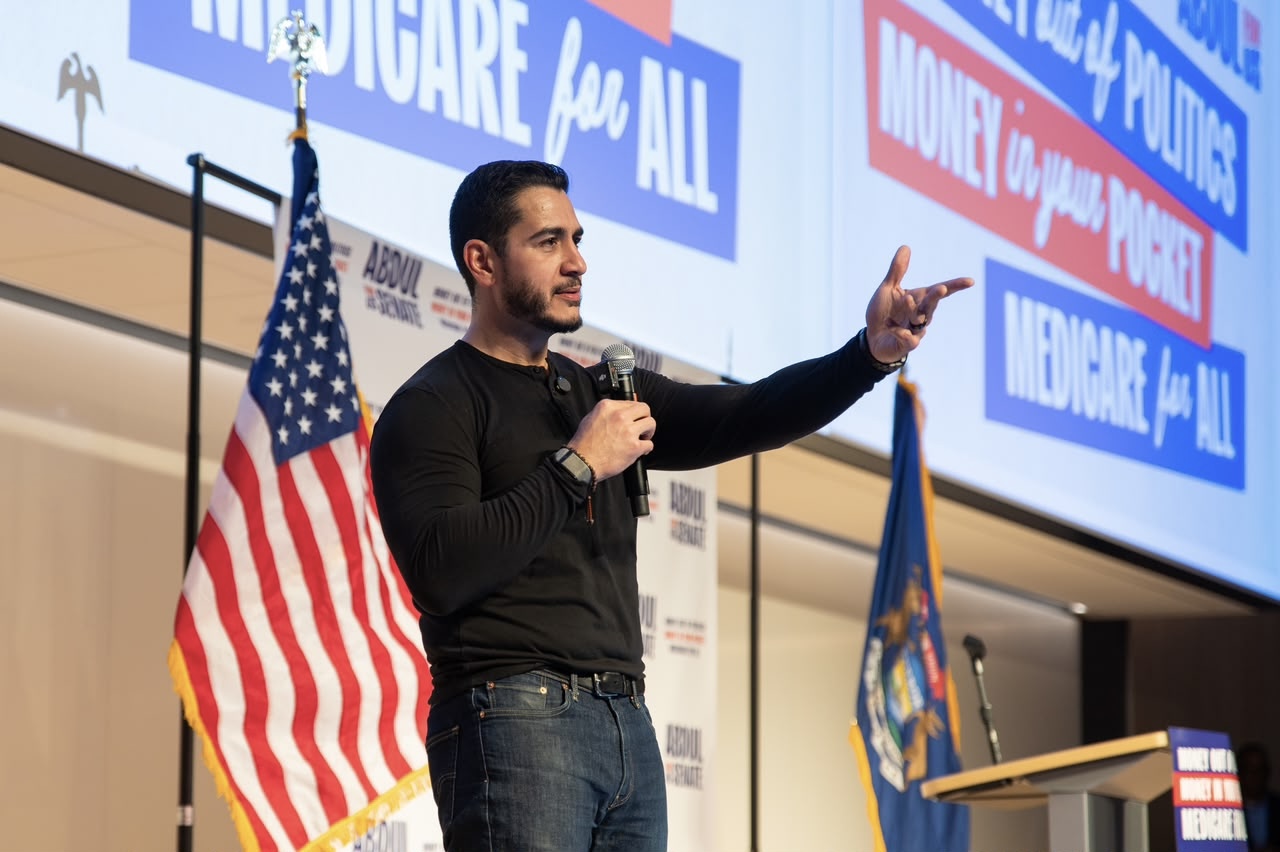
Born and raised in Michigan to an Egyptian immigrant father, Abdul El-Sayed is a public-health scholar, Rhodes Scholar, former Detroit health director and Democratic politician whose journey from medicine to public service has brought him into the national spotlight.
By Abdullahi Yusuf
Abdul El-Sayed’s journey to the United States Senate began in Southeast Michigan, where he was born on October 31, 1984, in Rochester Hills. The public-health scholar and Democratic politician has built a career spanning academic research, government administration and electoral politics. His victory in the 2026 Michigan Senate election has also made him the first Muslim elected to the United States Senate.
Raised in Michigan, El-Sayed attended public schools before pursuing higher education at some of the United States and Britain’s leading institutions. His academic journey took him from the University of Michigan to the University of Oxford as a Rhodes Scholar, and later to Columbia University, where he earned his medical degree.
His interest in public health developed from a growing recognition that medical care alone could not address the many factors determining whether people live healthy lives. During his medical training, he became increasingly interested in the social and economic conditions that influence health, including poverty, housing, education and access to essential services.
El-Sayed has recounted an encounter with a homeless woman who had substance-use problems and whom he had seen in a hospital. After her discharge, he later encountered her sleeping in a subway station. The experience reinforced his interest in the circumstances surrounding illness and the limitations of treating patients without addressing the wider conditions affecting their lives.
At the University of Michigan, he studied biology and political science, graduating in 2007 with highest distinction. He also played lacrosse as a defender. As a Rhodes Scholar, he attended Oriel College, Oxford, where he earned a doctorate in public health. He subsequently obtained his medical degree from Columbia University in 2014.
El-Sayed went on to become an assistant professor of epidemiology at Columbia, where his research examined public health, health inequalities and the factors shaping population health. His academic work has included more than 100 peer-reviewed publications.
In 2015, he was appointed executive director of the Detroit Health Department, taking responsibility for rebuilding the department following years of restructuring during the city’s financial crisis. His tenure included initiatives addressing children’s health and environmental risks, among them programmes providing free prescription glasses to children and expanding lead testing in schools and early-childhood facilities. The Michigan League of Conservation Voters recognised him as its Public Official of the Year.
He left the Detroit position in 2017 to contest the 2018 Democratic primary for governor of Michigan. Running on a progressive platform, he finished second, receiving more than 340,000 votes. Although he did not secure the party’s nomination, the campaign brought him wider recognition in state and national politics.
In 2022, El-Sayed took up another public-health leadership role as director and health officer of the Wayne County Department of Health, Human and Veterans Services. Wayne County, which includes Detroit and surrounding communities, has a population of approximately 1.8 million people.
One of the initiatives associated with his tenure was a medical debt relief programme launched in 2024 in partnership with the non-profit organisation Undue Medical Debt. The programme aimed to cancel up to $700 million in medical debt for approximately 300,000 residents. By October 2026, Bridge Michigan reported that $57.4 million had been settled, benefiting 83,291 people. The reported figure represented progress towards the programme’s broader target, not the full amount originally envisaged.
Beyond public administration, El-Sayed has written and spoken about healthcare and American politics. He co-authored Medicare for All: A Citizen’s Guide, served on the Biden-Sanders Unity Task Force in 2020 and hosted the podcast America Dissected. He is also the author of Healing Politics: A Doctor’s Journey into the Heart of Our Political Epidemic, which explores the relationship between politics, public health and social wellbeing.
El-Sayed is the son of Mohamed, an Egyptian immigrant, and was raised in Michigan by his father and stepmother, Jackie. He identifies as Arab-American and Muslim, an aspect of his background that has featured prominently in public discussion of his political career. In an interview with the Los Angeles Times, he addressed the place of his faith in his public life, saying: “I’m not running to be a Muslim senator. I’m running for the U.S. Senate and happen to be Muslim.”
His religious identity has attracted scrutiny during his campaigns, but El-Sayed has maintained that his faith is part of who he is, while his public responsibilities extend to people of every background.
He is married to Sarah, and they have two daughters, Emmalee and Serene. He is also affiliated with several labour and professional organisations, including the American Federation of Teachers, the Service Employees International Union, the National Writers Union and the American Association of University Professors.
In the 2026 election, El-Sayed defeated Republican candidate Mike Rogers to win Michigan’s United States Senate seat. The victory made him the first Muslim elected to the US Senate, marking a historic milestone in a career that has taken him from public-health research and local government to the highest levels of American electoral politics.
SPONSORED
SPONSORED

SPONSORED

SPONSORED
