
ASF Executive Director’s Address at Inaugural Zakat Distribution
The following is the full text of an address delivered by Safiyyah Omowunmi Shuaib, Executive Director/CEO of the Abdullahi Shuaib Foundation (ASF), at its inaugural Zakat distribution ceremony held in Lagos.
The programme marked the Foundation’s first major disbursement of zakat funds to beneficiaries across the state.
Full Text:
Bismillahir Rahmanir Rahim
Distinguished guests, respected scholars, valued partners, esteemed donors, members of the media, beneficiaries, ladies and gentlemen,
As-salamu Alaikum Warahmatullahi Wabarakatuh.
All praise is due to Almighty Allah (SWT), whose guidance, mercy and blessings have made it possible for us to gather today for this historic occasion, the first Zakat Distribution Ceremony of the Abdullahi Shuaib Foundation (ASF).
Today marks an important milestone in our collective effort to translate the noble principles of Islamic social finance into tangible social impact. It is also a moment to reflect on the power of compassion, responsible stewardship and collective action in addressing the challenges faced by vulnerable members of our communities.
The Abdullahi Shuaib Foundation was established with a vision of building a just and empowered society driven by Islamic social finance, knowledge and responsible governance. Guided by our motto, “Empowering Communities, Advancing Compassion,” we remain committed to uplifting underserved communities through zakat, sadaqah, waqf development, humanitarian support, education, economic empowerment, research and advocacy for transparency and good governance.
Distinguished guests, ladies and gentlemen, this inaugural zakat distribution programme demonstrates the transformative impact that can be achieved when generosity is combined with integrity, accountability and strategic planning.
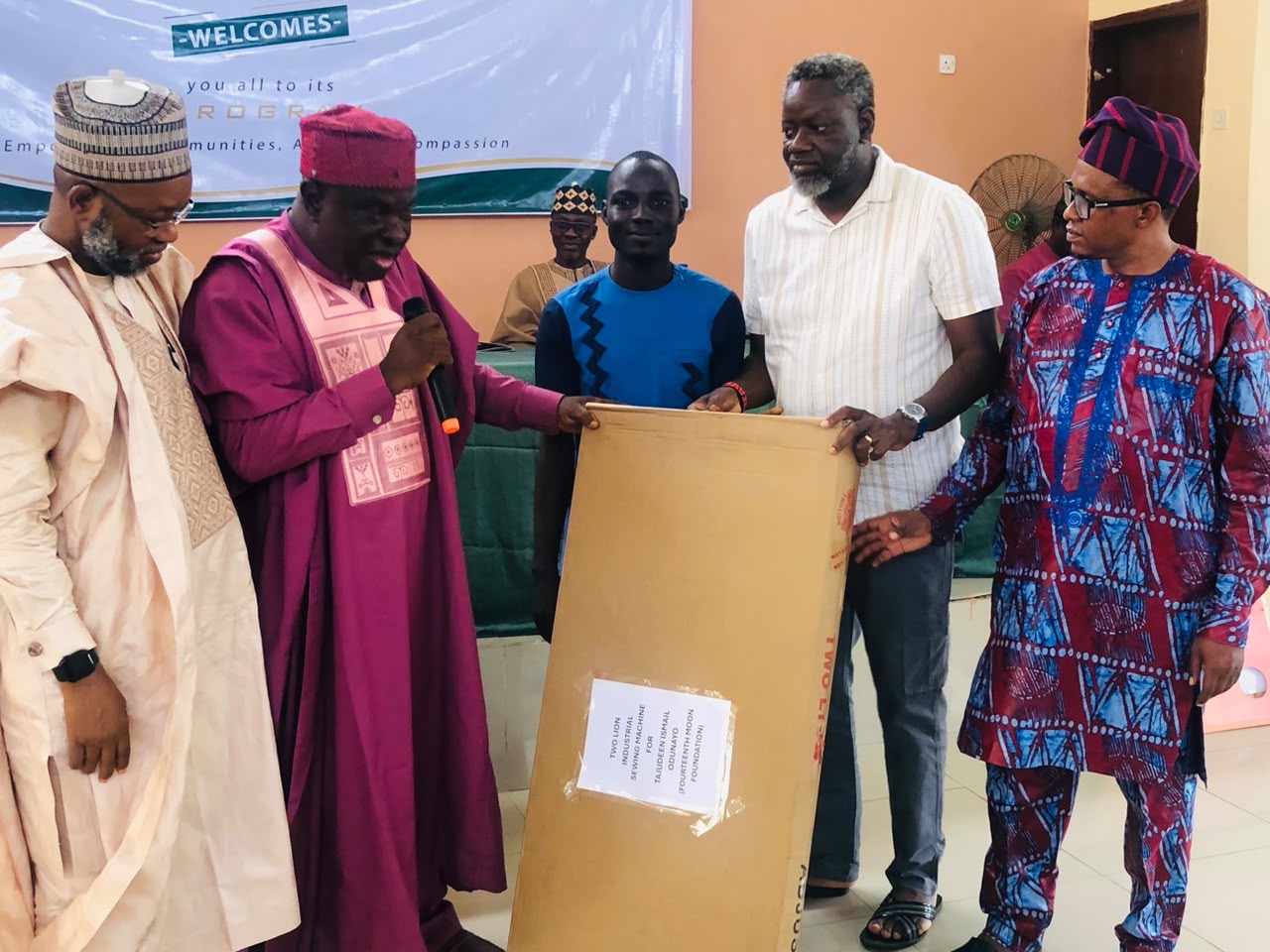
In 2026, the Foundation successfully mobilised a total of ₦17,688,663.66, which is being disbursed to deserving beneficiaries across various communities. A total of 69 beneficiaries received support under this programme, with an average intervention value of approximately ₦272,133 per beneficiary. Some of the beneficiaries will go home with items such as four deep freezers, three industrial sewing machines, a sewing machine and a laptop, among others. The remaining beneficiaries will be given cheques in various amounts.
Our interventions were carefully structured to address both immediate needs and long-term development priorities.
A comprehensive review of the dashboard and disbursement data provides important insights into the scale, structure and strategic direction of the Foundation’s inaugural zakat intervention programme. The analysis, organised across five analytical tables and five corresponding figures, demonstrates a data-driven and impact-oriented approach to zakat administration.
As presented in Table 1 (Amount and Count by Intervention Category) and illustrated in Figure 1 (Disbursement by Intervention Category), Economic Empowerment recorded the highest allocation both in terms of financial value and number of beneficiaries supported. This category accounted for the largest proportion of total programme expenditure, reflecting the Foundation’s strategic emphasis on sustainable livelihood development and long-term poverty reduction. Education Support emerged as the second-largest intervention area, followed by Humanitarian Assistance and Medical Support. The distribution pattern indicates a balanced intervention strategy that combines welfare support with economic and educational empowerment.
The dashboard further reveals the important role played by institutional collaboration and community partnerships in programme implementation. According to Table 2 (Amount and Count by Partner Organisation) and Figure 2 (Partner Organisation Contribution to Beneficiary Reach), six partner and affiliate organisations participated in beneficiary identification, verification and programme coordination. The analysis indicates variations in the number of beneficiaries and value of interventions facilitated through each partner network, demonstrating the importance of decentralised community structures in strengthening outreach efficiency and targeting accuracy. The data also suggests that organisations with deeper grassroots presence contributed significantly to beneficiary mobilisation and case verification processes.
Geographical coverage analysis contained in Table 3 (Geographical Distribution of Beneficiaries) and represented visually in Figure 3 (Community Reach Across Lagos State) demonstrates that the intervention achieved substantial outreach across multiple communities within Lagos State. The dashboard indicates that disbursements were concentrated in areas with higher identified vulnerability levels and greater social welfare needs. This geographic spread reflects a targeted allocation strategy aimed at maximising programme impact while ensuring that support reached underserved and high-need communities.
The gender composition of beneficiaries, presented in Table 4 (Gender Distribution Analysis) and Figure 4 (Gender Representation Among Beneficiaries), indicates that the programme maintained a relatively inclusive balance between male and female beneficiaries. The analysis highlights the Foundation’s commitment to equitable access to support opportunities irrespective of gender. Female beneficiaries, particularly widows, single mothers and economically vulnerable women, constituted a significant proportion of the intervention population, reinforcing ASF’s broader social protection and empowerment objectives.
An assessment of demographic inclusion and beneficiary composition is presented in Table 5 (Beneficiary Classification Analysis) and visualised in Figure 5 (Distribution of Beneficiaries by Social Category). The findings show that the programme successfully reached multiple vulnerable groups, including needy families, students, widows, orphaned students, divorcees with children and other socially disadvantaged individuals. This broad social coverage reflects the Foundation’s commitment to ensuring that zakat resources are directed toward individuals and households facing varying forms of socioeconomic vulnerability. The analysis also demonstrates that the intervention framework was intentionally inclusive and responsive to diverse welfare needs across communities.
Cross-analysis of the five tables and figures further reveals strong alignment between programme priorities, beneficiary vulnerability profiles and resource allocation patterns. Intervention categories with higher financial allocations also corresponded with areas demonstrating broader socioeconomic impact potential, particularly economic empowerment and education support. At the same time, the humanitarian and medical intervention components ensured that urgent welfare and health-related needs were adequately addressed.
Overall, the dashboard analysis confirms that the Foundation’s inaugural zakat distribution programme was implemented through a structured, transparent and impact-focused framework that prioritised accountability, inclusion and sustainable community development. The integration of community partnerships, targeted beneficiary selection and balanced intervention allocation contributed significantly to the effectiveness and credibility of the programme.
Beyond the numbers and statistics, however, the true impact of this programme is measured in human terms.
It is reflected in the student who can now continue his or her education with renewed hope. It is reflected in the widow whose burden has been eased. It is reflected in the entrepreneur who now has an opportunity to expand a small business and support a family. It is reflected in the patient who can access much-needed medical care. Most importantly, it is reflected in the dignity restored to individuals and households who might otherwise have been left behind.
On behalf of the Board of Trustees and Management of the Abdullahi Shuaib Foundation, I wish to express our deepest appreciation to all zakat contributors whose generosity made this intervention possible. Your trust in the Foundation and your commitment to fulfilling this important pillar of Islam have directly transformed lives and strengthened communities. We pray that Almighty Allah accepts your zakat, blesses your wealth and grants you abundant rewards in this life and the Hereafter.
We also extend our sincere gratitude to our affiliates, associates, volunteers, scholars, community leaders and partner organisations for their unwavering support and collaboration. Your dedication, expertise and commitment have been instrumental in the successful implementation of this programme.
Special appreciation goes to members of the media for their support, partnership and coverage of our activities. Through your platforms, the message of compassion, responsible giving and community development reaches a wider audience, inspiring greater participation in charitable and developmental causes.
To our beneficiaries, today represents not only support received but also an opportunity and a responsibility. We encourage you to utilise these resources wisely, productively and in accordance with the objectives for which they were provided. We hope that the assistance received today will serve as a catalyst for greater self-reliance, stability and prosperity. Our aspiration is that many of today’s beneficiaries will become tomorrow’s contributors and champions of community development.
As we look to the future, the Abdullahi Shuaib Foundation remains committed to expanding its programmes in Islamic social finance development, education, healthcare, economic empowerment, water and sanitation, research, publications and governance advocacy. We will continue to leverage innovation, technology and strategic partnerships to enhance transparency, improve impact measurement and reach more vulnerable communities.
This ceremony is not the culmination of our efforts; it is the beginning of a journey. With the continued support of our donors, partners and stakeholders, we are confident that ASF will continue to serve as a trusted platform for compassion, empowerment and sustainable development.
May Almighty Allah (SWT) bless our efforts, accept our contributions, grant relief to those in hardship and enable us to continue serving humanity with sincerity, excellence and compassion.
SPONSORED

SPONSORED

SONSORED
