
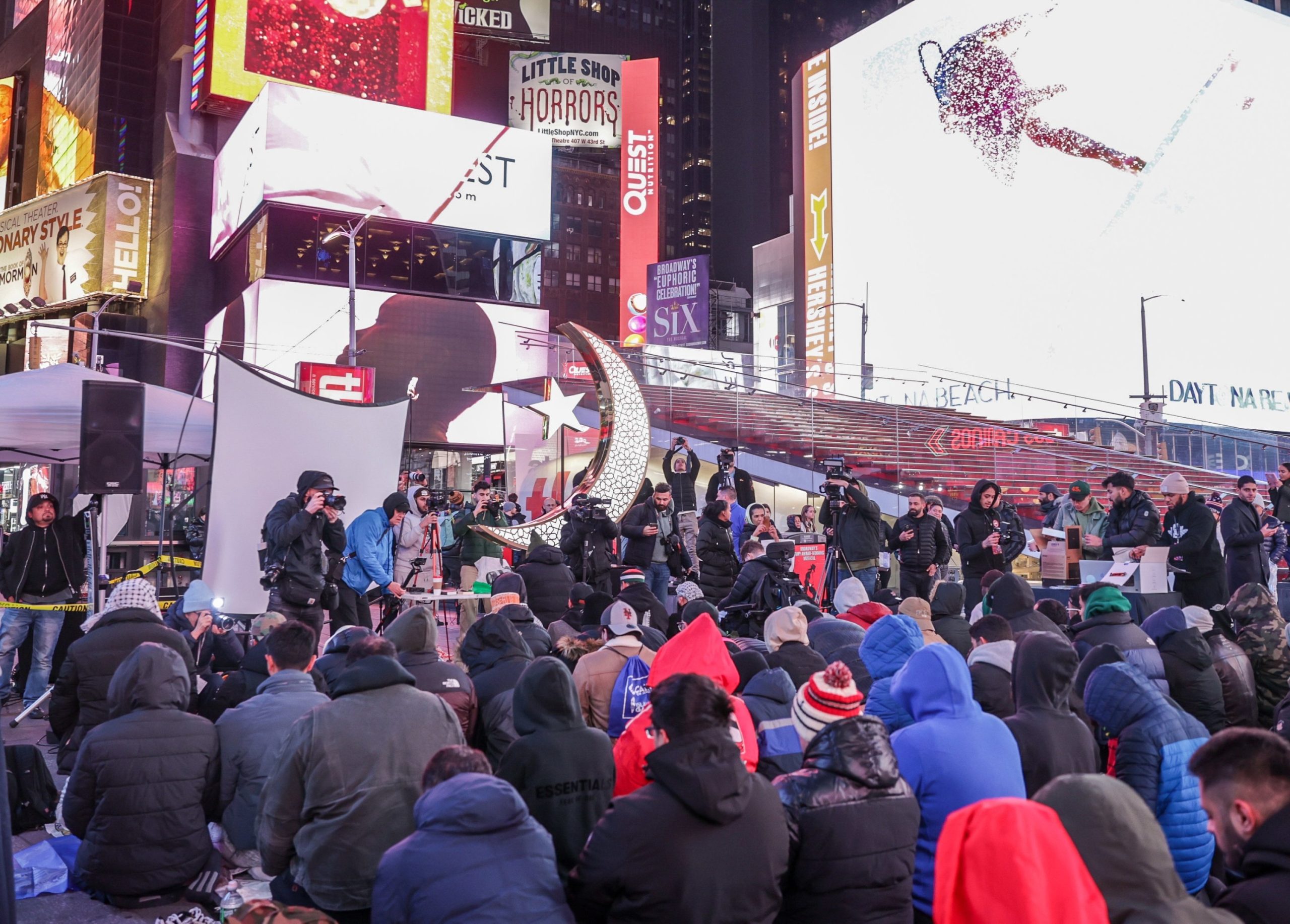
Muslim New Yorkers navigate Ramadan amid constitutional crisis
Despite political unrest sowing seeds of fear in New York City and overseas, Muslim communities are determined to continue observing their holiest month of Ramadan.
This year’s Ramadan, a month-long period where participants fast from dawn to sunset, and Eid al-Fitr –– a grand holiday celebrated on the Islamic lunar calendar at the close of the fasting month –– will fall on March 29-30.
“This is a time to pray and fast for peace and understanding. In principle, we all have to be hopeful for clarity and safety, Muslim or not Muslim alike,” said Harlem Senator Cordell Cleare. “We know that our communities respect this period of spiritual upliftment.”
In the last two years, the city’s vastly diverse Muslim community had been struggling to accommodate an influx of migrants and asylum seekers. Newly arrived Muslims from north east and west regions in Africa were finding it hard to access Halal food, especially those living in shelters, and observe Ramadan properly.
“I knew growing up it was tough for me because in my community I was part of that first generation of young West African Americans in that neighborhood,” said Husein Yatabarry, executive director of the Muslim Community Network (MCN), who is a Bronx native of Gambian descent. “I don’t even think that they really understood what Eid was. I think there is a lot more acknowledgement and understanding [now].”
Yataberry said that despite the growing commercialism in relation to Ramadan and Eid, with decorations and toy distributions in schools and at mosques, there’s definitely still difficulty in providing Halal meals to Muslim communities in need. MCN recently partnered with City Comptroller Brad Lander, a mayoral candidate this year, Islamic Relief USA, and five local organizations to distribute over 12,000 boxed dinners for “Iftar” during Ramadan. Places the city can’t get to, nonprofits fill the gap, said Yataberry.
“It’s still difficult to access [Halal meals] in shelters,” said Akinde Kodjo-Sanogo, assistant director of organizing and advocacy for African Communities Together (ACT). “We have limited funds, but we do our best with food distribution, ordering food and water for Masjids as much as we can.”
Franchisee Kamal Raza owns two International House of Pancakes (IHOPs) that are open 24 hours in Laurelton, Queens and on East 149th Street in the Bronx. He offers a special Ramadan menu that’s available all day and is usually slammed with customers in the wee hours of the morning that come for “suhoor meals.”
At present, Raza purchases Halal meats and goods retail from local sellers at a more expensive price point since he can’t buy in bulk. He said the reason more fast-casual chains don’t commit to providing Halal meals is because of an issue with guaranteeing consistency and quality. He created separate grills and uses different utensils for cooking and preparation to ensure that there’s no contamination. “I’ve been in New York City since 1987. I used to live in Long Island and drive all the way to Jackson Heights just to buy Halal meat,” said Raza. “Now we can at least go to Restaurant Depot.”
Luckily, there’s an outpour in demand from the Muslim community in the city regardless of the anxiety over the political climate, said Raza, who identifies as a Democrat.
Meanwhile, the ongoing Israel/Palestine war in Gaza had stirred many Muslim New Yorkers to political action. They took to the streets, protesting the city and federal administrations for not taking a definitive stance against the war. Bloody conflicts between Israel and Palestine stretch back decades. This recent round of fighting began on Oct. 7, 2023 when Hamas, a quasi-governmental terrorist organization, attacked and kidnapped Israeli citizens. Fighting lasted for 17 months before leaders were able to broker a ceasefire in favor of a prisoner exchange for the last two months. Israel launched fresh strikes on Hamas forces in Gaza on Tuesday morning, March 18, 2025. Concurrently, U.S. forces commenced airstrikes in Yemen targeting Houthi rebels.
Council on American-Islamic Relations (CAIR) Action, a national Muslim political advocacy organization, denounced the strikes against Gaza and Yemen. “This destructive alliance and militaristic approach severely compromise America’s global credibility, security, and moral leadership,” said CAIR Action Executive Director Basim Elkarra. “These policies are not ‘America First’—they directly undermine our nation’s interests, fueling resentment and violence worldwide. It’s time for American lawmakers to end this complicity, halt funding for aggressive military actions, and prioritize peace and justice.”
In New York City, college campuses, such as Columbia University, had become a hotbed of political outrage as students loudly protested the war and treatment of Palestinian citizens. Mahmoud Khalil, a Palestinian-American graduate student at Columbia until last year, led several protest efforts on campus. He was arrested by U.S. Immigration and Customs Enforcement (ICE) agents on March 8 inside his university-owned apartment “without a warrant” despite being a green card holder. He’s been transferred and detained in Louisiana with no charges as of yet, reported the Associated Press.
President Donald Trump has vowed to revoke Khalil’s green card and deport him, in an effort to silence student protests on campuses nationwide. In a recent open letter, Khalil called himself a “political prisoner” and said he’s been targeted because of his use of free speech –– a guarantee in the U.S Constitution’s First Amendment.
Khalil has become a central figure in the city’s mayoral race in conversations about immigration and Trump’s deportation agenda, while Mayor Eric Adams has been slammed for his refusal to comment because of his agreement not to criticize Trump.
Khalil’s arrest has shaken Muslim New Yorkers of all backgrounds.
MCN has discussed Khalil’s arrest with Columbia students and many that have their visas or green cards or are already naturalized citizens expressed a sense of deep fear. Yataberry knows of students that were placed on a “list” at Columbia and “doxxed” in the last year and a half. At least two students that he knows of are scared about being on a federal list of some sort.
MCN turned to ‘Know Your Rights’ sessions in shelters, mosques, and schools to educate the community on their rights last year. But it feels a bit futile now when the federal administration disregards the city’s laws and relies on outdated alien sedition acts to detain people without warrants or due process, said Yataberry. He wholeheartedly advocates for having lawyers on retainer for migrants and asylum seekers, and is pushing for the governor to pass the Access to Representation Act (ARA) S.141/A.270. He said that it’s currently in the state legislature’s budget, so he’s hopeful it will go through this year.
Many also fear they may be blanketly targeted as “terrorists.” Yataberry spoke about a similar issue after the 9/11 terrorist attacks caused a spike in Islamophobia throughout the city. He said Imams and mosque leaders, who experienced that trauma and surveillance in the early 2000s, are opting to no longer speak about politics in their establishments.
He said that it’s certainly an uneasy time to observe Ramadan, but hopes that people prevail. “I think the spirit of Ramadan is to persevere during tough times. Physically, you’re going through adversity without drinking water or food during the time the sunlight is out. I think internally it’s to keep your thoughts at bay and put your faith in God,” said Yataberry.
“We are believers. It’s not easy for people to live in fear but they are hopeful,” said Kodjo-Sanogo. “Some have stopped going out to work or coming to the masjid to pray because they fear they’ll be recorded.”
Sanogo added that ACT serves a large group of Sudanese and Muslim immigrants as well. Though it’s less spoken about in international headlines, Sudan’s Khartoum is also gripped in the midst of a civil war that broke out during Ramadan in April of 2023.
“To me, personally, I’m against war. This is not the solution. They should be able to sit down and talk and come to a compromise without weapons,” said Kodjo-Sanogo. “They make assumptions about Muslims. Muslim doesn’t equal violence.”
Source- Amsterdam News
SPONSORED

SPONSORED

SONSORED
