
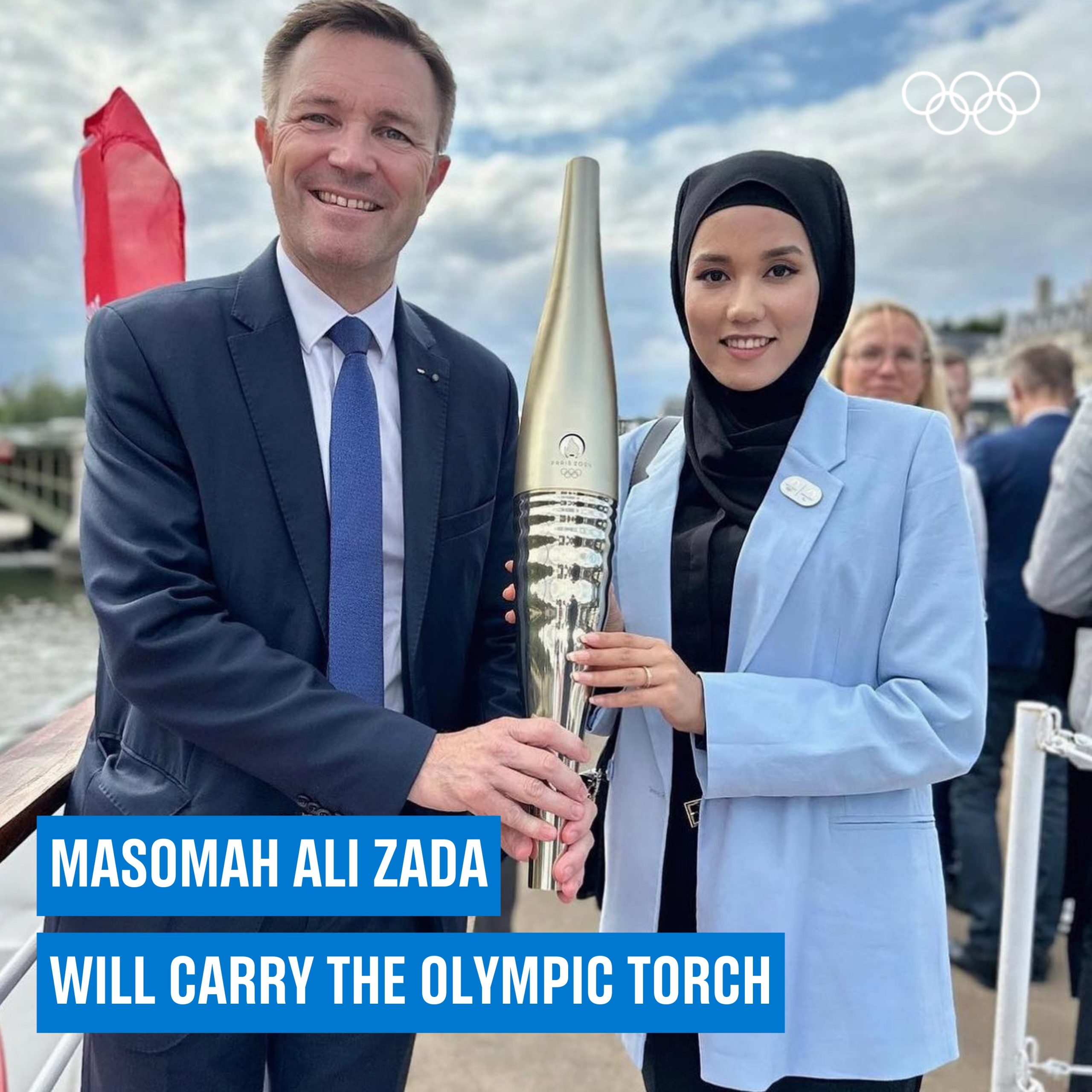
Olympic refugee team leader hopes for first medal
By Abdullahi Yusuf
The Taliban may have banned women from sport in Afghanistan, but Masomah Ali Zada – head of this year’s Olympic refugee team – is determined to keep championing their rights from her adopted home in France.
Three years ago, Ali Zada, 28, became the first Afghan cyclist to compete in the Olympics after winning a spot in the refugee team at the Tokyo Games.
On Friday, she will attend the opening ceremony of the Paris Games, the figurehead of the largest Olympic refugee team to date. Her appointment has special significance as the Games are the first summer Olympics since the Taliban seized power in Afghanistan in August 2021, sparking a massive exodus of refugees.
The Islamist administration has since banned women from school and work and imposed harsh restrictions on everyday life.
Ali Zada says the refugee team – representing more than 100 million displaced people around the world – will send a powerful message of peace, solidarity and inclusion.
“It’s a team everyone can support,” she said. “We would also like to inspire other refugees and give them hope that one day things will change.”
Nobody on the two previous refugee teams has won a medal, but Ali Zada hopes Paris will change that.
The first refugee squad competed at the Rio Games in 2016 with 10 athletes. This year’s team numbers 36 athletes from countries including Eritrea, Syria, Iran, Afghanistan and Sudan. Olympic organisers formed the team to focus attention on the world’s refugee crisis and give displaced athletes a chance to compete.
“I’ve suffered a lot of discrimination in my life, so I’m very proud to be (leading) a team where we are all from different countries, but are all respected in the same way,” said Ali Zada, who will not race in these Games.
“It’s very moving.”
The squad will participate in 12 sports including wrestling, athletics, swimming, cycling and judo.
Flag bearer Yahya Al Ghotany, who will compete in taekwondo, only picked up the sport at a refugee camp in Jordan after fleeing Syria. He will carry the team’s flag with Cameroonian-born boxer and medal hopeful Cindy Ngamba who lives in Britain.
Afghan members include Manizha Talash, now living in Spain, who will compete in the new Olympic sport of breaking, and taekwondo practitioner Farzad Mansouri who lives in Britain and is also eyeing a medal.
Mansouri, Afghanistan’s flag bearer at the Tokyo Games, lost his teammate in the Aug. 26, 2021, suicide bomb attack on Kabul airport as people scrambled to leave after the Taliban’s takeover.
Six other Afghan athletes – three men and three women – will also compete in a separate Afghan team announced in June. The squad was formed with the help of senior members of Afghanistan’s Olympic committee in exile. No Taliban have been invited to the Games.
OLYMPIC TORCH
In May, Ethiopian-born cyclist Eyeru Gebru became the first member of any refugee team to carry the Olympic torch, bearing the flame through the northern French town of Bayeux.

Ali Zada, who carried the torch in her home city of Orleans earlier this month, said she had received many messages from women in Afghanistan inspired by her story.
“As a refugee and as a woman I had a lot of challenges on my journey, but they could not stop me,” she said.
“I broke taboos in my country and showed that women have the right to do sport and to cycle.”
Ali Zada learnt to ride a bike as a child while living in neighbouring Iran. But when her family returned to Afghanistan when she was 10, Ali Zada discovered a society that frowned on girls cycling.
She initially threw herself into taekwondo, but when she got the opportunity to join the women’s national cycling team in 2012 she jumped at the chance.
“It was dangerous because some people didn’t agree with it. They thought it was their duty to stop us. They wanted to hit us.”
People would try to ram them with cars, hit them with stones or pelt them with fruit and vegetables.
One day during training in a mountainous region, a man leaned out of a car and struck Ali Zada, egged on by his companions. The attack only strengthened her resolve to fight for women’s rights.
“I will never forget how they looked at me and laughed. I was so angry. I saw there were no rules and nothing to protect us,” she said.
“From that day, my goal became to normalise cycling for women so that women could use a bike without fear.”
Ali Zada’s Olympic dreams took root during the 2012 London Games when she saw how her fractured country was brought together after Afghan athlete Rohullah Nikpai won his second bronze in taekwondo. Nikpai is the only Afghan athlete to have won an Olympic medal.
“On that day, people from different ethnicities united and wanted to celebrate this victory together. When I saw this, I wanted to do the same and unite my people,” said Ali Zada who is from the Hazara minority – a predominantly Shi’ite community that has long been persecuted.
NOBEL PEACE NOMINATION
Afghanistan’s women’s cycling team was nominated for the Nobel Peace Prize in 2016. With security threats escalating, Ali Zada’s family sought asylum in France in 2017.

Ali Zada, who recently completed a masters in civil engineering, knows first-hand how hard her athletes have had to fight to continue training while rebuilding their lives from scratch in new countries.
SPONSORED

SPONSORED
