
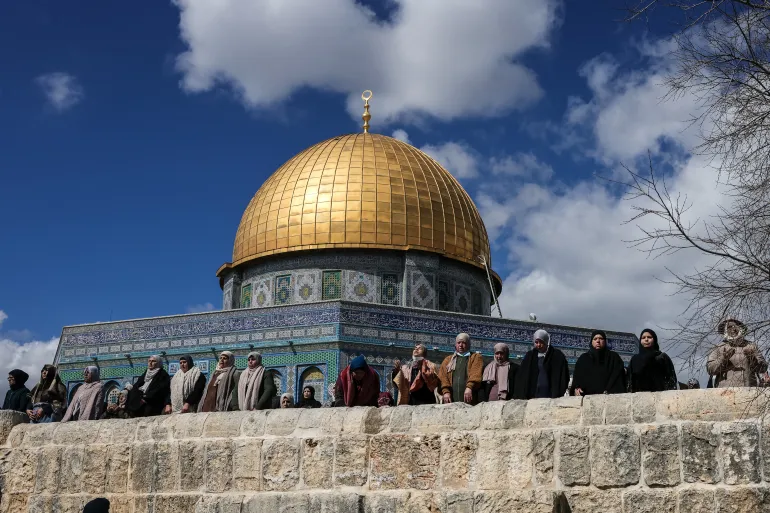
Palestinians Raises Alarm Over Restrictions to Mosques
By Sadiq Abdulfatah
Palestinian officials raises alarm over Israeli’s restrictions on prayer at the Al-Aqsa Mosque in Jerusalem and the Ibrahimi Mosque in Hebron describing the act as “violating freedom of worship” and aim to gain full control over both mosque.
Israel has kept Al-Aqsa Mosque in occupied East Jerusalem closed since the start of the US-Israeli attacks on Iran on Feb. 28, while allowing only about 50 worshippers to pray at Ibrahimi Mosque in the occupied West Bank.
According to media advisor to the Governorate of Jerusalem, Maarouf al-Rifai, Israeli authorities have kept Al-Aqsa closed for 13 days and which deprives the worshippers from observing prayers there during the final 10 days of Ramadan.
“Israeli occupation authorities continue to close Al-Aqsa Mosque and prevent worshippers from praying there during the last days of Ramadan and prevented two Friday prayed of this fasting month,” he said
Al-Rifai explained that this cannot be considered a security measure as the consistent closure of the two mosque stops thousands worshippers from observing Laylat al-Qadr, which is considered in Islam, the holiest night in Islam.
“It is a systematic political decision aimed at imposing control over Al-Aqsa and undermining the historical and legal role of the Islamic Waqf Department in Jerusalem, which is affiliated with Jordan’s Ministry of Awqaf and Islamic Affairs.” he added.
As the Palestinians remain committed to their religious right, Al-Rifai called on the international community and human rights organizations to intervene stressing that only 50 worshippers have been allowed to enter for each prayer since last Friday.
Abu Sneineh described the measure as “arbitrary” and a violation of international law and freedom of worship, calling for the mosque to be opened to all worshippers without restrictions.
“We remain present at the mosque even with small numbers to protect it and prevent any harm,” he said, adding, “Ibrahimi Mosque is an Islamic endowment belonging solely to Muslims, and we demand it be opened to all worshippers.”
He said Israel had completely closed the mosque at the start of the US-Israeli attacks on Iran, before partially reopening it last Friday.
Israel divided the Ibrahimi Mosque in 1994, allocating about 63% of the site to Jewish worshippers and 37% to Muslims, after a settler massacre on Feb. 25 of that year that killed 29 Muslim worshippers.
The mosque is normally opened fully to Muslim worshippers only 10 days each year, including Fridays during Ramadan, Laylat al-Qadr, Eid al-Fitr, Eid al-Adha, Israʾ and Miʿraj, the Prophet Muhammad’s birthday, and the Islamic New Year.
During the final days of Ramadan, the mosque is usually crowded with worshippers and fully opened to Muslims on the 27th night of Ramadan and during Eid. It remains unclear whether Israel will allow this year.
SPONSORED

SPONSORED
