
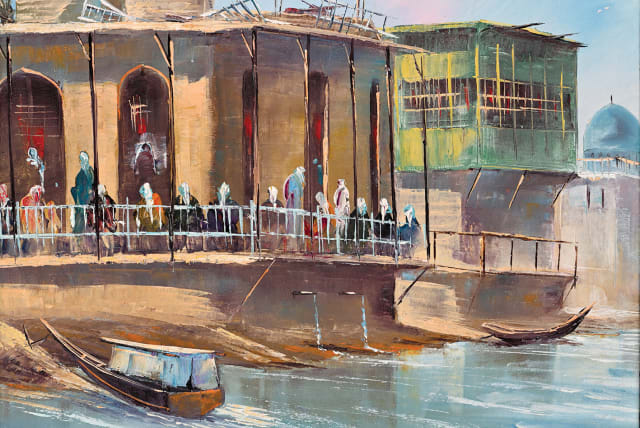
New Islamic Museum of Art exhibit shines spotlight on Iraq
By Abdullahi Yusuf
Museums worldwide have long grappled with dwindling attendance and the challenge of reinvention. Some have redefined their programming, while others have turned to cutting-edge technology to enhance artistic experiences.
The Museum for Islamic Art has taken a more straightforward yet compelling approach by launching a new gallery that introduces a fresh dimension to its exhibitions. As I followed museum general director Gilad Levian up the stairs from his office, we ascended higher than I had ever been in the building.
“This used to be the museum library,”Levian explained as we reached the uppermost level, opening the door to a high-ceilinged, sunlit room that immediately felt inviting. The artworks within also beckoned me forward, offering a glimpse into the contemporary artistic landscape of Iraq—particularly through the works of its senior artists.
The exhibition, titled MiEres LeHeres in Hebrew—meaning “From Cradle to Destruction”culminates with the subtitle Contemporary Iraqi Art. The showcase was made possible largely due to the vision and dedication of Oded Halahmy, an 86-year-old Iraqi-born Israeli-American artist based in New York.
Halahmy, who runs the Pomegranate Gallery in Soho, has devoted considerable effort and resources to providing Iraqi artists with a platform to exhibit their work. His mission is to present a different, more enriching narrative of Iraq—one that contrasts with the turmoil and violence often depicted in global media.
“The Iraqis are very proud of their culture,” Levian noted. “Iraq is the cradle of human history. That’s why we chose this title. This is where the earliest civilizations began.”
Levian emphasized that Iraq’s history has been marked by both prosperity and destruction, a theme captured poignantly in the exhibited works. “This is not just about ancient times. Throughout history, Iraq has seen ups and downs. But its heritage endures within its people, regardless of the regime.”
Halahmy’s deep connection to his homeland is evident throughout the exhibition. Near the entrance, an introductory text features his poignant statement: “It seems that I left Iraq, but Iraq has never left me.”
“He lives his Iraqiness,” Levian remarked. “Through his books, his art, even his clothing.” He added that Halahmy, whom he has spoken with but never met in person, even makes his own traditional Iraqi garments.
This deep cultural connection permeates MiEres LeHeres. Many of the works reflect Iraq’s turbulent past, particularly the devastation of the past fifty years, including the brutal era of Saddam Hussein’s rule in the late 1970s.
The exhibition also carries an extraordinary backstory involving a U.S. soldier stationed in Iraq who sought permission from his commanding officer to meet local artists and purchase their works. His aim was to sell the pieces in the U.S. and send the proceeds back to the struggling artists.
When Halahmy learned of the initiative, he immediately offered his support.
“He told them he would exhibit the works at his gallery and personally acquire any that weren’t sold,” Levian recounted. This act of generosity ultimately helped bring the artworks to the Museum for Islamic Art.
Among the pieces on display are several by Halahmy himself, capturing the emotional depth of Iraq’s history and present struggles. His Mercy for Baghdad series, for instance, reinterprets the Iraqi national flag, incorporating past and present elements to reflect the country’s shifting identity. Other works feature gashes and stitches, symbolizing both Iraq’s suffering and resilience.
“When Iraq suffers damage, it is on a massive scale, Levian observed. “But it always recovers.”
For many visitors, MiEres LeHeres offers an unexpected perspective on Iraq, beyond the conflict-ridden images portrayed in the media. The exhibition captures moments of daily life and cultural richness that are rarely acknowledged outside the country.
Levian also drew parallels between Iraqi and Israeli society, both of which encompass a rich mix of ethnicities and traditions. “Almost every country has different cultural layers. In Israel, it’s particularly evident because of our history of immigration. But if you look closely, Iraq is just as diverse.”
One of the first works that caught my eye was a painting by Nazifa Rashid, created in 2000. The portrait of a woman with deep, expressive eyes evokes both strength and tenderness, reminiscent of Frida Kahlo’s work.
”There’s something very naïve about this,” Levian remarked. The painting, titled Nostalgia, incorporates symbols of Iraq’s history, such as the crescent moon and possible cuneiform inscriptions, interwoven with bright floral motifs that hint at renewal.
Cuneiform, one of the world’s earliest writing systems, is referenced again in Uruk Old Love, a triptych by Hanaa Malallah. The London-based artist juxtaposes this ancient script with bullet holes and distressed textures, reflecting Iraq’s violent present.
Devastation is also central to Laylat an Nar (Night of Fire), a series by Mohammed al-Hamadany depicting the 2003 U.S. invasion of Baghdad. In these intense paintings, fiery red hues, skeletal faces, and symbolic chairs evoke themes of war, loss, and power.
Halahmy’s contribution includes sculptures, such as My Homeland, a nickel-bronze piece featuring five figures, a palm tree, and a pomegranate crown symbols of Iraq’s enduring spirit.
Qasim Sabti’s Book Cover Collage series pays homage to Iraq’s rich literary heritage, referencing the destruction of libraries from the Mongol invasion of 1258 to modern conflicts. The collages, featuring torn book pages and spines, echo the cultural losses of the Nazi era.
In contrast, Hassan Massoudy’s calligraphic triptych, based on an 11th-century Andalusian poem, injects a note of optimism: “Perhaps despair itself may lead toward hope.”
Yet the exhibition’s closing pieces, Ismail Khayat’s Anfal Memory Series, deliver a sobering reminder of Iraq’s darkest chapters. His vividly colored yet haunting “death masks” memorialize the 180,000 Kurdish victims of Saddam Hussein’s chemical attacks during the 1980s Anfal campaign.
For Levian, the exhibition’s circular layout tells a full story from hope and cultural richness to destruction and resilience.
“This exhibition captures Iraq’s cycles of history optimism, conflict, identity, and memory,” he reflected.
MiEres LeHeres is more than an art exhibition; it is an opportunity to understand Iraq beyond its political struggles. It reminds us that, despite adversity, Iraq’s artistic and cultural legacy endures and continues to inspire.
SPONSORED

SPONSORED
