

The Hawan Daushe: Kano Experience
By Khadijah Sani
Islam categorically recognises two festivals, the Eid –fitri (celebration after the completion of Ramadan fasting) and Eid- Adha (the day of Nahar). And on these occasions, Muslims are encouraged to be thankful to Allah and rejoice with their families, friends, neighbours and non Muslims of their communities.
These two festivals are uniquely celebrated globally, but with a touch of glitz and glamour in the Northern part of Nigeria. In this region, the festivities are marked with ancient and exciting traditional activities locally known as Hawan Daushe or Durbar Festival, which means ceremonial military parade or contest.
During the activities, the emirates are assembled in beautifully adorned and yet armed horses for racing contest, in a ceremonial warfare. To make the lot, each town, district, and noble household is expected to contribute a regiment to the defence of the Emirate, for sizable participation. This is usually at the beckon of the Emirate Military Chief. At the parade, regiments would showcase their horsemanship, preparedness for war and loyalty to the Emirate. The last and most fierce riders then were the Emir’s household and regimental guards, the Dogari.
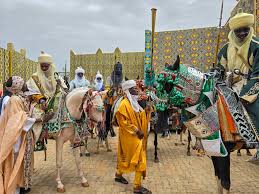
It is this tradition, which metamorphosed to the popular Durbar Festivals of today, in which thousands flock to witness, particularly that of Kano Emirate. In addition, to being celebrated as part of eid festivals; it has also become a festival celebrated in honour of visiting Heads of State as well as other notable events.
A royal parade with pomp and pageantry of thousands of men on horses adorned with garments and regalia, starts with thousands of people walking early morning after the Emir to the eid prayers, (this is in line with the tradition of the Prophet walking to eid).
Later on their way back, it becomes a procession of horsemen to the public square in front of the Emir’s palace, where each village group, district and noble houses take their assigned places. Last to arrive is the Emir and his splendid retinue; through another route on his horse to the admiration of his subjects to take up his place in front of the palace to receive the jahi, or homage, of his subjects.
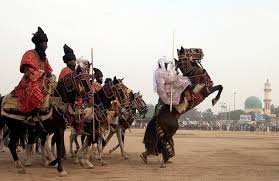
With hundreds of horsemen on the parade grounds, the Emir’s procession begins with his rides among his guards and servants amidst the shooting of flintlock muskets. The Emir is immediately recognized, veiled and clad in white with a huge fanning parasol lifts up and down over him.
The procession is strictly for men, dressed in magnificent turbans with one ‘ear’ or two sticking out, denoting their royal linage. Young and old participate to ensure that tradition is well known and passed than to the next generations.
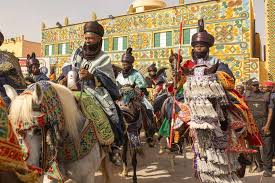
Each groups racing across the square at full gallop, swords glinting in the sun. They pass just few feet away from the Emir, then stop abruptly to salute him with raised swords or fist and shout “Rankaya Dede” (all hail thee), proudly proceeding to line the sides of the parade ground. Subsequently, the Emir gives an address to the excitedly waiting crowd before departure.
Of all the modern day Durbar festivals, Kano Durbar is the most magnificent and spectacular, with touch of glitz and glamour. Here, there are addition innovations like the introduction of Islamic concert and bazaar. The fanfare is intensified with small bands of Fulani men performing shadi, a fascinating sideshow to behold. Added are the dexterous show of acrobats flips, in response to the soothing rhythmic shrill of trumpeters and flutters.
However modern day politicking in Kano Emirate and Insecurity in the Northern States are taking the shine away from the traditional Hawan Daushe (Durbar) as made popular in Kano State
SPONSORED

SPONSORED
