
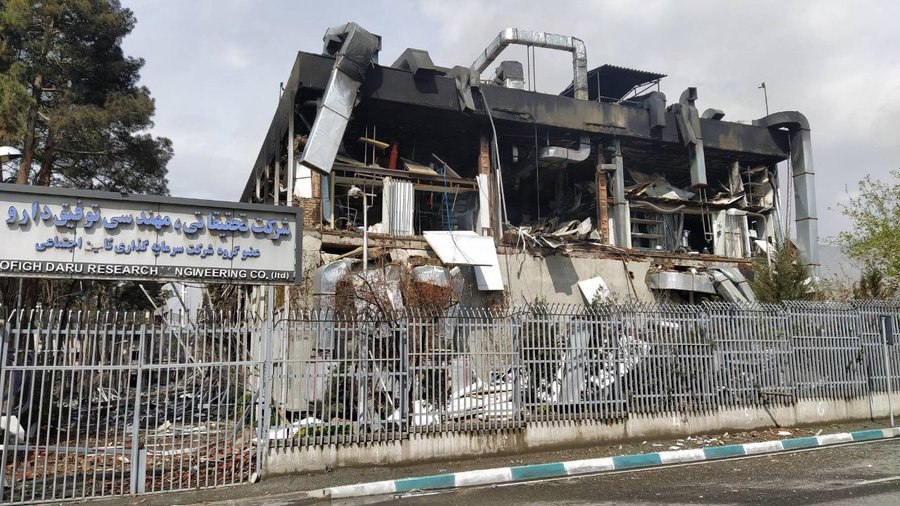
Iran warns of ‘severe punishment’ after strike on pharmaceutical facility
Foreign minister condemns attack on medical infrastructure as evidence mounts of a widening conflict, raising fears over civilian impact and the erosion of wartime boundaries
By Abdullahi Yusuf
Iran has issued one of its starkest warnings yet, accusing Israel of deliberately targeting a pharmaceutical facility and vowing a forceful response, a development that raises fresh questions about how far the conflict is now prepared to go.
The country’s foreign minister, Abbas Araghchi, said the strike marked a troubling escalation, suggesting that the boundaries between military and civilian targets are becoming increasingly blurred.
“The war criminals in Israel are now openly and unashamedly bombing pharmaceutical companies,” he said, in a statement that combined condemnation with a clear signal of intent. “Our armed forces will severely punish aggressors.”
At the centre of the latest dispute is the Tofigh Darou industrial complex, a facility Iranian authorities say produces raw materials used in medicines, including treatments for cancer patients. Officials claim the strike destroyed both its production lines and research units.
There has been no independent confirmation of the extent of the damage, nor of the precise nature of the target. But if verified, the implications would be significant: the deliberate or incidental targeting of medical-related infrastructure would represent a notable shift in both optics and consequence. For Tehran, the language used in response is as important as the strike itself.
Araghchi’s remarks appear designed not only to condemn, but to draw a contrast positioning Iran as a state capable of retaliation, rather than one constrained or vulnerable. In doing so, he invoked a comparison with conflicts elsewhere in the region, signalling that Iran does not see itself as operating under the same limitations.
“What they’ve gotten wrong,” he said, “is that they are not dealing with defenceless civilians.” It is a message aimed as much at deterrence as it is at domestic and regional audiences.
The broader context is a conflict that has steadily widened in both scope and intensity. What began as targeted strikes has evolved into a pattern of sustained exchanges, missiles, drones, and counter-strikes stretching across multiple fronts.
Iran has responded with repeated attacks on what it describes as Israeli and US-linked positions, while Israel has continued to target sites it says are connected to Iran’s military and strategic capabilities.
But as the conflict deepens, so too does the ambiguity. Where once the lines between military and civilian infrastructure appeared more clearly defined, they are now increasingly contested, with each side framing its actions through its own strategic and political lens.
That ambiguity carries risks.
Strikes on facilities linked, even indirectly, to civilian life can rapidly shift international perception, complicate diplomatic efforts, and heighten the possibility of further escalation. They also raise difficult legal and ethical questions, particularly in a conflict already marked by competing narratives and limited independent verification. For now, what is clear is that the rhetoric is hardening.
Iran’s warning of “severe punishment” is not new in tone, but its timing and the nature of the alleged target, suggests a conflict moving into a more volatile phase, where symbolism and signalling are becoming as significant as the battlefield itself.
And in wars defined as much by perception as by power, that shift can be just as consequential as any strike.
With additional information from Press tv
SPONSORED

SPONSORED
