
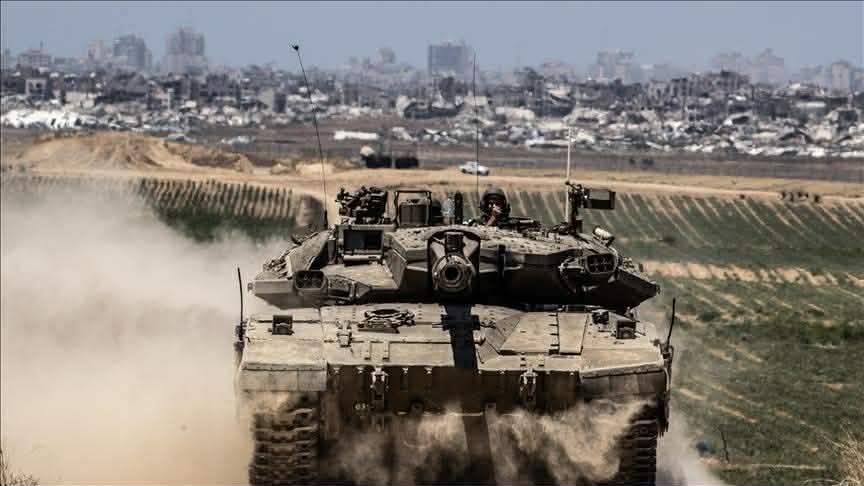
Heavy Israeli tank losses claimed as Hezbollah steps up cross-border attacks
Dozens of Merkava tanks reportedly destroyed in days, raising fears of a wider regional conflict and exposing the growing vulnerability of heavy armour
By Abdullahi Yusuf
The Lebanese armed group Hezbollah says it has inflicted significant damage on Israeli military hardware in a series of coordinated attacks across southern Lebanon and northern Israel, claiming to have struck dozens of Merkava tanks in recent days.
In statements released through its media channels, Hezbollah said its fighters targeted Israeli armoured units with guided missiles and drones across multiple locations, including Debel, Al-Qantara, Taybeh and Deir Siryan. The group reported successive waves of strikes over a 48-hour period, describing the operations as among its most intensive since the latest escalation began.
The Israeli military has not publicly confirmed the scale of the losses claimed. Independent verification of battlefield figures remains difficult, with both sides engaged in an intensifying information war alongside ongoing hostilities.
The reported attacks come amid heightened tensions along the Israel-Lebanon border, where exchanges of fire have increased following months of sporadic clashes. Hezbollah said it carried out dozens of operations in a single day, targeting what it described as Israeli military positions and movements.
The group framed the strikes as a response to continued Israeli attacks on towns and villages in southern Lebanon, which it says violate existing ceasefire understandings. Israel, meanwhile, has maintained that its operations are aimed at neutralising threats along its northern frontier.
At the centre of the claims is the Merkava tank, widely regarded as one of the most advanced armoured platforms in Israel’s arsenal. Hezbollah sources say dozens of these tanks have been hit or destroyed since early March, with several targeted in quick succession across different regions.
Military analysts note that such claims, if substantiated, would represent a significant tactical development, highlighting the vulnerability of heavy armour to precision-guided weapons and drone attacks in modern warfare.
Analysts also point to the stark cost imbalance between the weapons used. Anti-tank guided missiles and attack drones often costing a fraction of the price, are increasingly being deployed against high-value assets such as main battle tanks, which can cost millions of dollars and take years to manufacture.
This asymmetry, experts say, reflects a broader shift in conflict dynamics, where non-state actors rely on mobility, lower-cost technology and targeted strikes to offset conventional military disadvantages.
Some commentators have drawn comparisons with earlier confrontations between Israel and Hezbollah, particularly the 2006 war, when anti-tank weapons were used extensively against Israeli armour. While the scale and circumstances differ, analysts say the current developments underline the continuing evolution of tactics on both sides.
With attacks continuing across multiple locations, there are growing concerns that the situation could escalate further into a wider regional confrontation. The absence of verified casualty and damage figures, combined with competing narratives, makes it difficult to assess the full impact of the latest fighting.
What is clear, however, is that the conflict is entering a more intense phase, one in which both military capability and information control are becoming central to the battle on the ground.
With additional information from Press tv
SPONSORED

SPONSORED
